












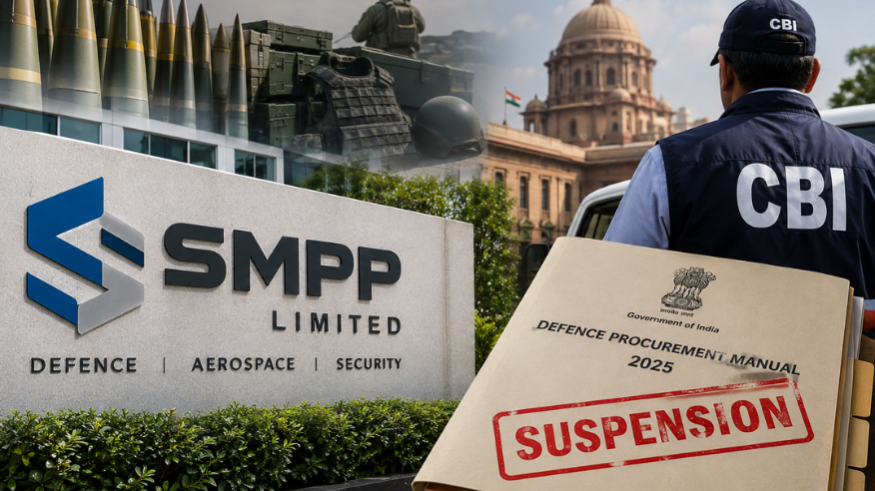
SMPP could face suspension from defence business after CBI case

The Government of India may soon suspend Defence Manufacturer SMPP Limited from future defence contracts following the arrest of CEO Ashish Kansal by the Central Bureau of Investigation (CBI) in an alleged bribery and defence information leak case..
According to officials cited by Hindustan Times, the Department of Defence Production is expected to examine action against the company under the Defence Procurement Manual 2025. The manual allows the Ministry of Defence to suspend or ban business dealings with companies accused of corrupt practices or other illegal activities during the defence procurement process.
SMPP is a private defence manufacturer involved in the production of ammunition, loitering munitions, bulletproof jackets and helmets. The company has been in the defence manufacturing business for more than three decades.
On October 14, the CBI arrested Kansal, along with Anil Kumar, an executive director at state-owned Munitions India Limited (MIL), and Kumar’s brother, B Harshavardhan. The agency is investigating allegations that Kumar demanded and accepted illegal gratification from private contractors and vendors in exchange for official favours and the disclosure of sensitive information concerning MIL’s defence production and procurement activities.
The case is linked to a ₹500 crore ammunition supply contract awarded to SMPP by MIL. According to the CBI’s FIR, Kansal was in regular contact with Kumar regarding the contract, under which SMPP was to supply ammunition to MIL over a period of one year. The agency has also named an SMPP employee, Ravit Kumar Tewatia, in the alleged conspiracy.
The CBI has not publicly identified the specific defence information that was allegedly disclosed. Its allegations refer broadly to sensitive information concerning MIL’s defence production, procurement and other strategically important activities. The agency has said that such unauthorised disclosure could affect India’s strategic and national security interests.
The possible action against SMPP is significant because the Defence Procurement Manual allows the government to act even while an investigation is ongoing. Under the 2025 rules, business dealings with an entity may be suspended when a criminal investigation is initiated or a complaint is referred to an investigating agency.
A suspension would make the company ineligible to participate in future bids and prevent new requests for proposals from being issued to it. The normal suspension period is up to one year, although the rules allow extensions in certain circumstances, including cases involving national security.
However, suspension would not automatically mean the cancellation of every existing SMPP contract. The procurement manual distinguishes between contracts connected to the procurement process under investigation and other contracts. Contracts directly linked to a suspended procurement process can be held in abeyance, while other contracts may continue unless the competent authority decides otherwise.
The rules also provide for a more serious consequence if a company is eventually banned from government business. A ban can follow the filing of a CBI chargesheet or the establishment of misconduct by a competent court, tribunal or authority. For grounds including corrupt practices and national security concerns, the ban can run for at least five years under the 2025 manual.
For now, no such ban against SMPP has been announced. The CBI investigation is continuing, and the allegations against the accused have not been established in court.
The immediate question is whether the Ministry of Defence will suspend SMPP from future bids and how any such action could affect its ongoing ammunition business with MIL.
Savio Rodrigues
Savio Rodrigues is a Research Analyst at Escape Velocity MediaWorks Pvt Ltd and writes for Chakra News on Defence, Geopolitics, National Security. He holds a Master’s degree in International Relations from the University of Mumbai.




Comments