






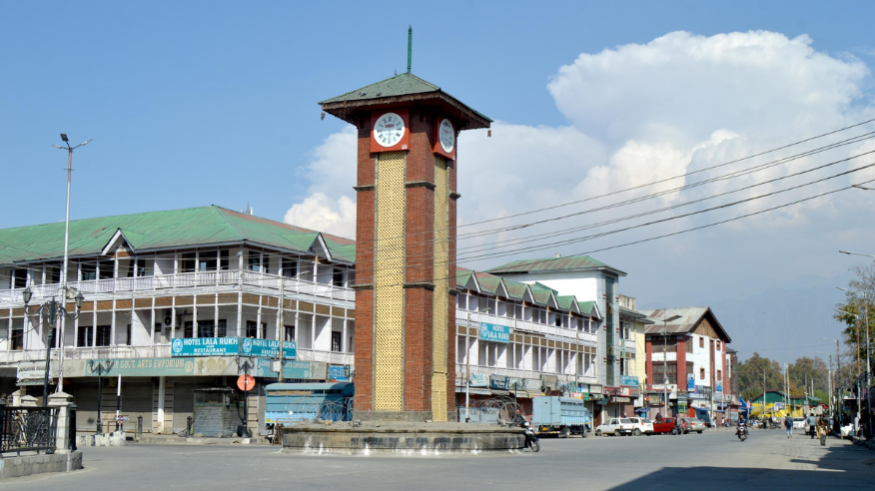
Jammu and Kashmir after Article 370

August 5, 2025 marks six years since the abrogation of Article 370. On August 5, 2019, the Centre abrogated Articles 370 and 35A, which had granted special status to Jammu and Kashmir and its residents. The government also bifurcated the state into two Union Territories—Jammu and Kashmir, and Ladakh. Opposition parties in India and neighbouring countries like China and Pakistan had voiced their concerns over the move. Despite this, the government went ahead with the decision.
Investments
Before the abrogation, attracting investments in Jammu and Kashmir was difficult due to constitutional restrictions. Job opportunities were limited, and many youth had to migrate for employment. Post-abrogation, the government began focusing on economic development, launching the Jammu and Kashmir Industrial Policy 2021 to support local industries, incentivise businesses, and ease the process of setting up enterprises.
During the Assembly session on March 11, 2025, Deputy Chief Minister Javed Iqbal Chaudhary informed that investments worth ₹10,516 crore have been made since 2019—₹3,407.63 crore in Kashmir and ₹7,108 crore in Jammu. These include:
Kashmir: ₹164.37 crore (2019-20), ₹148.89 crore (2020-21), ₹125.87 crore (2021-22), ₹737.36 crore (2022-23), ₹1,423.17 crore (2024-25 till February)
Jammu: ₹132.27 crore (2019-20), ₹263.85 crore (2020-21), ₹250.89 crore (2021-22), ₹1,416.07 crore (2022-23), ₹1,966.20 crore (2023-24), ₹3,079.57 crore (2024-25)
A New Central Sector Scheme (NCSS) was also introduced by DPIIT. As per the Economic Survey, J&K received investment proposals worth ₹1.63 lakh crore till December 2024, expected to generate employment for over 5.9 lakh people. Since 2019, 1,984 units involving ₹9,606.46 crore investment and employing 63,710 people have started operations.
Education
Before Article 370’s abrogation, lack of premier institutes like IIT and IIM and frequent shutdowns due to unrest hindered educational development. Post-2019, the government implemented the New Education Policy (NEP) 2020, promoting skill-based, multilingual, and digital learning.
Scholarships and schemes like Kasturba Gandhi Balika Vidyalayas, Mid-Day Meals, and Samagra Shiksha Abhiyan improved inclusivity, especially in tribal and remote areas.
IIT Jammu, inaugurated in 2016, offers undergraduate to doctoral programmes. In May 2025, the Cabinet approved its expansion (along with five other IITs) with an outlay of ₹11,828.79 crore. An IIM Jammu also caters to management education needs.
Tourism
Once Bollywood’s favourite shooting location, Kashmir's tourism declined due to militancy. Post-2019, its image has undergone a transformation.
The Jammu & Kashmir Tourism Policy 2020, Industrial Policy 2021, and Film Policy 2021 were introduced to revive the sector. Cinema halls reopened in 2021 after three decades. Srinagar saw its first multiplex in 2022, followed by theatres in Pulwama, Shopian, Baramulla, and Handwara.
In 2023, J&K hosted events like the G-20 Tourism Working Group Meeting, Miss Universe Press Conference, and Formula F4 race. The T20 Legends League marked the return of international cricket after 35 years.
In June 2024, the Ministry of Home Affairs reported that over 1.08 crore tourists visited J&K in six months. Union Minister of State for Home Nityanand Rai said tourism recorded a 15.13% annual growth in the last three years, contributing 8.47% to GSDP in 2022-23 (up from 7.84% in 2019-20).
Tourist footfall figures:
2020: 34,70,834
2021: 1,13,14,884
2022: 1,88,64,332
2023: 2,11,24,674
Jan–June 2024: 1,08,41,009
New tourism destinations include Gurez, Keran, Teetwal, and R S Pura, with a focus on golf and adventure tourism. Amarnath Yatra and Vaishno Devi remain major religious attractions.
Infrastructure
Prior to 2019, infrastructural development was restricted due to constitutional limitations. Travelling within J&K or to other parts of India was difficult.
Post-abrogation, infrastructure projects gained momentum. The Dr. Syama Prasad Mookerjee Tunnel, operational since April 2017, connects Chenani and Nashri via NH-44. The Zoji La Tunnel, under construction, will link Srinagar with Leh. In June 2025, the Peer Ki Gali Tunnel was approved to speed up apple transportation from Shopian.
On June 6, 2025, PM Modi flagged off the Vande Bharat Express connecting Katra and Srinagar in just three hours.
Also inaugurated that day was the Chenab Rail Bridge, the world’s highest railway bridge, part of the Udhampur-Srinagar-Baramulla Rail Link (USBRL). The challenging Katra-Banihal section, involving complex tunnels like T-49 (India’s longest), is under construction. The entire USBRL is declared a “National Project”.
Kashmir even in 2025 is still some way from realising its potential and it is true that challenges remain. The state still has to bear the brunt of terror emanating from neighbouring Pakistan. Nevertheless, the abrogation of Article 370 has facilitated economic growth, improved connectivity, enhanced education, and revived tourism. Jammu and Kashmir is gradually integrating with the national mainstream, emerging as a destination of opportunity, development, and peace.
Arjun Dev Singh
Arjun Dev Singh has a deep interest in defence, security, and strategic affairs. With a strong analytical lens and a passion for military and geopolitical developments, Arjun strives to bring clarity and context to complex national and international issues.


Comments