












Why India the Refining Superpower matters to the US

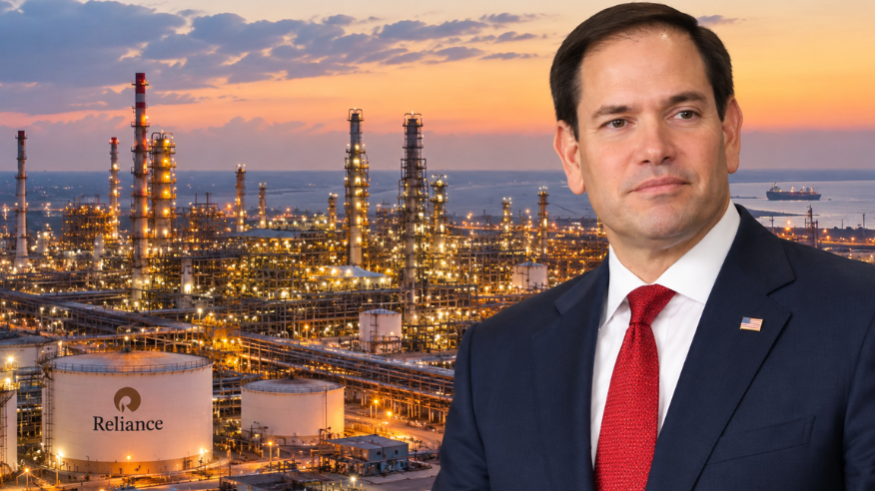
US Secretary of State Marco Rubio travelled to Gujarat's Jamnagar on Wednesday to visit Reliance Industries’ Oil Refinery Complex. The visit comes a day after Rubio described India as a “crude oil refining superpower” and said Washington would discuss with Reliance the possibility of processing more Venezuelan crude. His visit focuses on putting India’s refining capacity at the centre of the United States’ energy strategy.
On October 9, US President Donald Trump announced that Russia would immediately supply more than 300,000 tonnes of diesel to the US and global markets, followed by another 500,000 tonnes in November and 1 million tonnes thereafter. The move came as diesel prices in the US approached record levels HOW MUCH ahead of the November 3 midterm elections.
Jamnagar is home to the world’s largest single-site refining complex. Operated by Reliance Industries, it has a combined crude processing capacity of around 1.4 million barrels per day. The complex consists of two refineries. The first was commissioned in 1999 with a capacity of 660,000 barrels per day. The second, an export-oriented refinery, was commissioned in 2008. Together, they account for around 68.2 million tonnes per annum of refining capacity. The Jamnagar complex alone represents roughly one quarter of India’s total installed refining capacity, 267.1 million tonnes per annum as of April 2026.
Reliance says the refinery has processed more than 216 different grades of crude oil from around the world. Its refinery configuration has a Nelson Complexity Index of 21.1, which is the highest in the world. A higher complexity allows a refinery to handle heavier and more difficult crude and convert more of it into higher-value products such as petrol, diesel and aviation fuel. The Jamnagar refinery is by-far the world's most complex oil refinery with the second one being in the US with a rating of 16.1 — 5 points below the Jamnagar one.
Much of Venezuela’s oil is heavy or ultra-heavy and contains high levels of sulphur. Such crude requires sophisticated refining equipment to separate, upgrade and convert its heavier components into commercially valuable products. Rubio specifically pointed to this capability while explaining why Washington wants more Venezuelan oil to be processed in India. “They have the capability to refine heavy crude,” Rubio said, adding that Reliance had done so in the past and could process more as Venezuelan production increases.
“The crude oil slate of the Jamnagar refinery has always been diverse. This gave us the ability to source feedstock from different regions and tide us over the current crisis,” Debangsu Ray, Cluster President and Head of the Jamnagar Refinery and Petrochemical Supersite at Reliance, told S&P Global’s Platts at the Asia Pacific Petroleum Conference (APPEC) in September 2026. He also said Jamnagar's Nelson Complexity Index of 21.1 gives it the versatility to process almost all crude oil grades.
On Wednesday, Brent crude was trading around $110.85 per barrel, up nearly 11% from around $100.34 a month earlier, as escalating tensions in the Middle East continued to raise concerns over global oil supplies. Washington wants Venezuela to increase oil production and bring more crude into global markets.
India provides both a large refining industry and access to one of the world’s most sophisticated refining complexes. Reliance is already receiving Venezuelan crude. Commodity intelligence firm Kpler estimates that Reliance could receive around 370,000 barrels per day of Venezuelan oil in October, although some shipments could be delayed into November. The figure is an estimate of expected receipts and not confirmed physical deliveries.
For Washington, the issue is also connected to global fuel supplies. The US is dealing with energy pressures created by conflicts involving Iran and Yemen and disruptions around important shipping routes. Rubio said energy security is directly linked to national security and pointed to the importance of large refining facilities during periods of supply disruption. Jamnagar gives global oil markets another major centre capable of converting different types of crude into usable fuels.
Significantly, Reliance has committed over $6 billion to build a new refinery in Brownsville, Texas, along the lines of the Jamnagar complex. Construction was expected to begin in 2026, although no firm completion date has been announced.
Reliance is already a major supplier of refined petroleum products to international markets. Trade data cited by Reuters showed that the company exported 21.66 million tonnes of refined petroleum products from Jamnagar in the first half of 2025. This included large volumes of diesel, petrol and aviation fuel. The refinery therefore does not simply process crude for India's domestic market. A substantial part of its output moves into international markets.
The Jamnagar complex distinguishes India's refining strength from countries simply having large crude imports. India imports most of the crude oil it consumes, but its refineries can process crude from multiple suppliers of all varied grades and export finished petroleum products. This gives Indian refiners flexibility when crude prices, supplies or geopolitical conditions change. Jamnagar has processed more than 216 crude grades, giving Reliance the ability to switch between different sources of crude depending on market conditions.
Rubio's visit comes as Washington seeks deeper energy and commercial ties with India. His discussions in India covered trade, investment, defence, technology and energy. The decision to travel from Mumbai to Jamnagar highlights the growing importance of private Indian energy companies in the bilateral relationship. Reliance is not merely an Indian consumer of global oil. Its refining capacity makes it an important participant in global energy markets.
Savio Rodrigues
Savio Rodrigues is a Research Analyst at Escape Velocity MediaWorks Pvt Ltd and writes for Chakra News on Defence, Geopolitics, National Security. He holds a Master’s degree in International Relations from the University of Mumbai.



Comments