








From Bab el-Mandeb to Tigray: The Red Sea’s Widening Contest

With the Houthis holding Yemen’s Red Sea coast, renewed Ethiopia–Eritrea tensions and a Gulf rivalry in the open, the Middle East and the Horn of Africa have become a single strategic theatre.
The Red Sea has become the hinge between the Middle East and Africa. The war involving Israel, the United States and Iran, and the Houthi campaign that has grown out of it, has shown how instability on the Arabian side can disrupt global shipping, threaten Gulf security and pull the Horn of Africa into regional competition. On the African side, renewed fighting in Tigray, a collapse in relations between Ethiopia and Eritrea, and Sudan’s civil war are opening new fault lines.
These crises intersect with the ambitions of Saudi Arabia, the UAE, Türkiye and Egypt, and the interests of Israel, Iran, the United States and China. The Middle East and the Horn can no longer be analysed as separate regions.
The Houthis: from disruptor to gatekeeper
Closely aligned with Iran but with their own objectives and power base, the Houthis have become the pivotal actor in this system. After 7 October 2023 they attacked Israel and commercial shipping. A US–Houthi ceasefire in May 2025 covered only American vessels; other attacks stopped only with the Gaza ceasefire that October. The Houthis rejoined the regional war on 28 March 2026.
Their ambitions have since grown. In July they declared their 2022 truce with Riyadh over after the bombing of the Sanna airport, and announced a naval blockade of Saudi Arabia. In September a ground offensive took Mokha, Dhubab and Perim Island, giving them Yemen’s entire Red Sea coast and the eastern shore of Bab el-Mandeb, within about 130 kilometres of the US base at Camp Lemonnier in Djibouti.
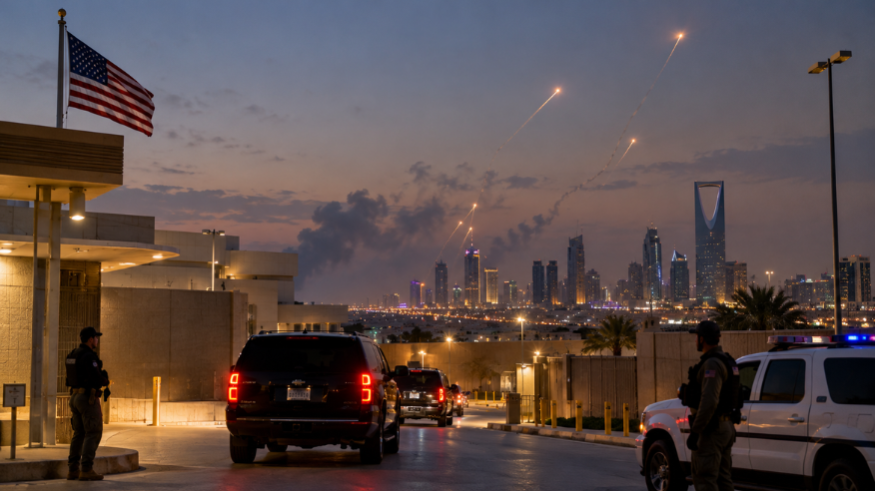
October brought a sharp escalation. Strikes on airports in Riyadh, Abha and Dammam between 6 and 12 October killed at least 20 people, the deadliest attacks on Saudi soil in over a decade. On 19 October, ballistic missiles hit a government training camp in Shabwa, killing at least 53 recruits, according to local authorities. Egypt’s foreign minister, Badr Abdelatty, has said Cairo will respond to “whatever is being asked by the Saudis”.
The Houthis’ power lies in asymmetry: they need not defeat a navy to divert shipping, raise insurance costs and punish far stronger states. With Hormuz largely closed, Saudi crude has relied on the pipeline to Yanbu on the Red Sea, and the Houthis now hold that route’s southern exit. For Iran, they offer leverage over a second chokepoint; for Egypt, they threaten Suez Canal revenue. And with the eastern side of Bab el-Mandeb in Houthi hands, the ports and alignments on the western side — in Eritrea, Djibouti, Somaliland and Somalia — matter more than at any time in decades.
The Gulf: From divergence to rupture
Saudi Arabia and the UAE share an interest in maritime security, but not a strategy. For Riyadh, Yemen is a direct national security threat to its territory and to Vision 2030. The UAE pairs security partnerships with ports and logistics across the Horn, including Berbera in Somaliland — infrastructure that is strategic as much as commercial.
Their rivalry is now open. When the UAE-backed Southern Transitional Council moved into Hadramawt and al-Mahra, Saudi Arabia responded with airstrikes; the STC announced its dissolution in January 2026 and its leader fled to Abu Dhabi. The two are also widely seen as favouring different sides in Sudan. The Houthi threat may push them back towards coordination, but deterrence alone will not secure the Red Sea without diplomacy in Yemen and cooperation with coastal states.
Türkiye, Egypt and Israel: New stakes on the western shore
Türkiye has built deep ties with Somalia and brokered the 2024 Ankara Declaration on Ethiopia’s sea access. Its role is now tested differently: as a party, with Saudi Arabia and Pakistan, to the Mecca Joint Defence Agreement, which raises the question of whether it must act against the Houthis.
Egypt sees the Red Sea through the Suez Canal and the Nile, and its dispute with Ethiopia over the Grand Ethiopian Renaissance Dam shapes its growing ties with Eritrea and Somalia. Its readiness to back Riyadh, and interest in the Mecca pact, add a new dimension.
Israel has gained a foothold too. Its recognition of Somaliland in December 2025, the first by any state, gives it a partner on the Gulf of Aden opposite Yemen, sharpening Somalia’s sovereignty concerns and the competition over Berbera.
These powers bring investment and diplomacy, but also intensify local rivalries. Governments in the Horn are not passive: they choose partners to advance their own goals.
Ethiopia and Eritrea: The danger of a wider war
This is the most dangerous fault line in the Horn. The two countries fought a border war in 1998–2000, reconciled in 2018 and fought together against the TPLF in 2020–2022. But Eritrea was not party to the Pretoria agreement that ended that war, and the alignment has collapsed.
On 23 September 2026, a rebel alliance including the TPLF launched an offensive and briefly seized Mekelle. Government-allied forces have since pushed north to Adigrat, about 30 kilometres from the Eritrean border. Ethiopia has told the UN Security Council that Eritrean troops advanced up to 60 kilometres into Tigray and has invoked its right to self-defence. Eritrea denies sending troops and calls the charge a pretext for war; reports of its forces crossing have not been independently verified. Diplomatic ties have been severed.
Beneath Tigray lies the question of the sea. Landlocked since Eritrea’s independence in 1993 and dependent on Djibouti, Ethiopia has sought alternatives, including its 2024 memorandum with Somaliland, and Abiy Ahmed repeated on 5 October that sea access is a national necessity. Eritrea fears for its port of Assab, which faces the Houthi-held coast across Bab el-Mandeb. The European Union has warned that the confrontation could trigger a broader regional war, drawing in Somalia, Egypt and Sudan.
Sudan: the war moves east
Sudan’s civil war, now in its fourth year, has displaced around 13 million people. On 7 October army chief Abdel Fattah al-Burhan rejected talks with the Rapid Support Forces (RSF). On 18 October the army said it had intercepted RSF drone swarms aimed at military sites and dams in Gedaref and Kassala, near the Ethiopian and Eritrean borders. With Egypt and Saudi Arabia closer to the army, and the UAE accused — which it denies — of backing the RSF, Sudan is part of the same contest over the Red Sea and the Nile.
A connected theatre
The result is a fluid order, not two clear blocs. The Houthis follow Iran but pursue their own aims; Saudi Arabia and the UAE are at odds; Türkiye, Egypt and Israel are building positions on the Horn’s coast; and the United States and China both keep bases in Djibouti.
The Houthi capture of Yemen’s Red Sea coast has changed the stakes. Questions once seen as African — who controls Assab, who uses Berbera, how Ethiopia reaches the sea — are now questions of Gulf and global security, giving more outside powers reasons to intervene.
Three steps could reduce the risk. Treat freedom of navigation at Bab el-Mandeb and stability on the Horn’s coast as one agenda. Keep the Ethiopia–Eritrea dispute from becoming a proxy contest by backing African Union and IGAD mediation. And ensure any settlement with Iran covers the Houthis and the Red Sea, not only Hormuz.
The Horn of Africa is no longer peripheral to Middle Eastern geopolitics. It is part of one strategic environment stretching from the Gulf through the Red Sea.
Sources
- 2026 Yemen offensives; October 2026 Houthi attacks on Saudi airports — Wikipedia
- Houthi attack on Shabwa camp kills at least 53 — Al Jazeera, 19 Oct 2026
- Egypt ready to support Saudi Arabia — Bernama/Anadolu, 13 Oct 2026
- STC announces dissolution — AP, Jan 2026
- Israel recognises Somaliland — AllAfrica, Dec 2025
- Ethiopia, Eritrea: inching towards war? — Al Jazeera, 11 Oct 2026; EU urges de-escalation Addis Standard
- Burhan rejects talks — Al Jazeera, 7 Oct 2026; RSF drone strikes in east — Sudan Tribune, 18 Oct 2026
Dr. Manoj Mathew
Dr Manoj Mathew is a former United Nations political affairs official with extensive experience in conflict and post conflict settings, including Iraq, Afghanistan and Libya. He has worked on political affairs, peacebuilding and statebuilding, and holds a PhD from Jamia Millia Islamia.


Comments