







Pakistan is a ‘brick wall’ that could collapse when one crisis hits, says Sushant Sareen
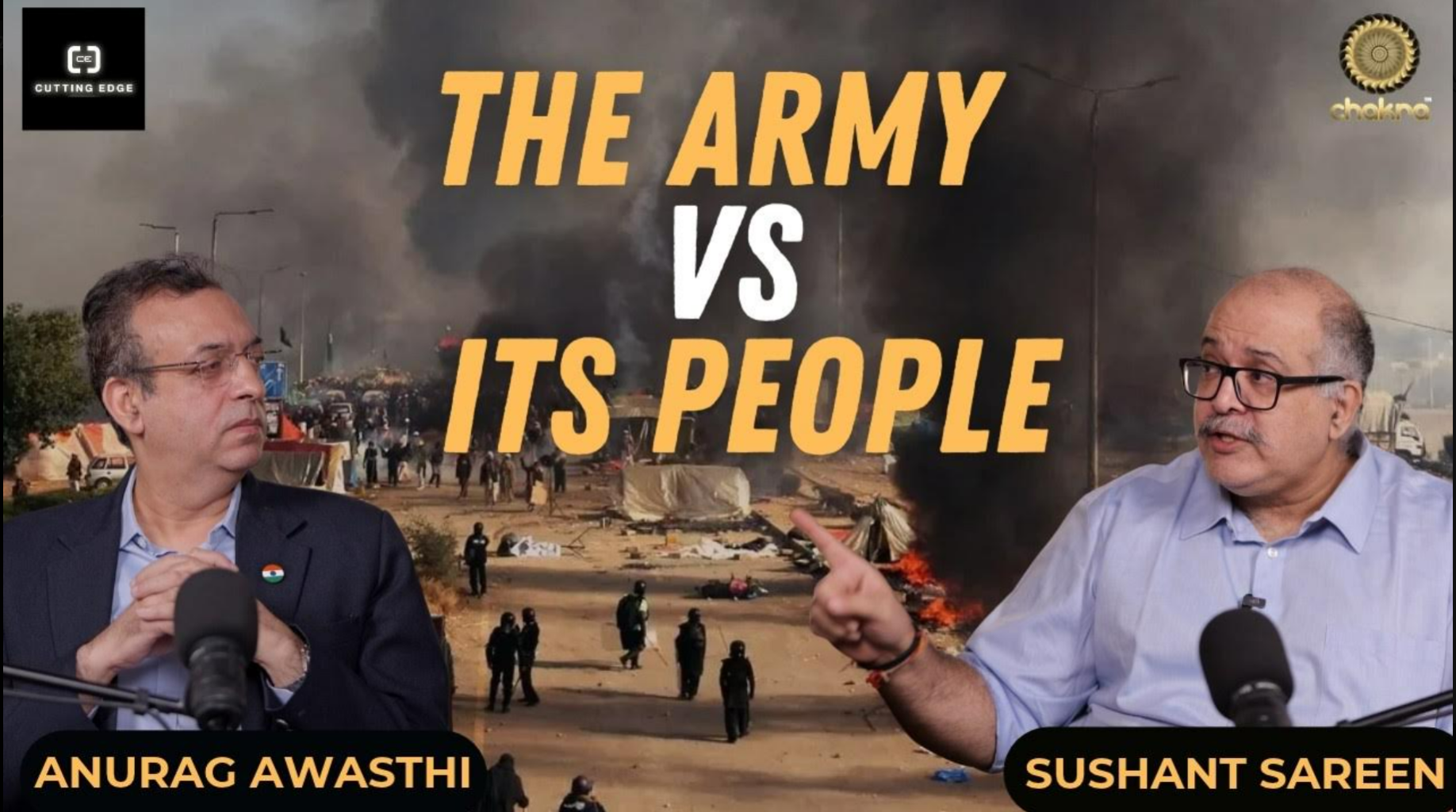
Pakistan has withstood repeated political, security and economic crises, but the removal of one critical “brick” could eventually bring down the entire system, Sushant Sareen said on The Cutting Edge podcast with Col Anurag Awasthi. Sushant Sareen is Senior Fellow at the Observer Research Foundation.
Sareen compared Pakistan to a brick wall that can survive the loss of several bricks, but warned that it is impossible to know which crisis could trigger the collapse of the entire structure. “It’s very difficult to predict what will happen next in Pakistan,” he said.
Sareen said the question is not whether Pakistan is facing a crisis, but how many separate pressures the system can absorb before one of them triggers a wider breakdown. “If in a brick wall, you knock out one brick, the wall will keep standing,” he said. “Then there will be that one brick. When you take it out, the whole edifice collapses.” He said identifying that final brick in advance was impossible, leaving Pakistan’s future difficult to predict despite the growing pressures around it.
Sareen said the situation is particularly serious in Pakistan occupied Kashmir, Khyber Pakhtunkhwa, Balochistan and Sindh - almost all of Pakistan. He said the unrest in Pakistan occupied Kashmir represented a deeper challenge because people who had considered themselves separate from the rest of Pakistan were now questioning the authority of the Pakistani state. He said the Joint Awami Action Committee movement was significant because it emerged from civil society rather than being controlled by established political parties.
The unrest in Pakistan occupied Kashmir has included protests, clashes with security forces and restrictions on communications. At least 24 people were killed during nearly two weeks of unrest in June, according to Reuters. Internet services were also suspended in parts of the region during the protests. Sareen said this reflected growing resentment over political, civic and economic rights and argued that the alienation is being difficult for Islamabad to contain.
He linked this change partly to the developments in Jammu and Kashmir in 2019. Sareen said the constitutional changes made by India that year weakened the belief among sections of Pakistan occupied Kashmir that Pakistan would eventually take control of Jammu and Kashmir. According to him, this contributed to a shift in political demands, with people increasingly asking Pakistan to address their own rights and economic concerns rather than focusing only on Kashmir’s dispute with India.
The Pakistan Tehreek-e-Insaf (PTI) launched a long march towards Islamabad in October after initially announcing the protest in September. The federal government subsequently imposed emergency rule and governor’s rule in the province and authorised the deployment of the Pakistan Army to assist the civilian administration. This sharply escalated the confrontation between the federal government and Imran Khan’s party.
Sareen said the PTI march was significant because the party managed to mobilise supporters despite pressure from the military establishment. He said the government’s decision to block roads with containers and deploy security forces showed that the march had created considerable concern in Islamabad. However, he said the movement eventually lost momentum and the subsequent emergency in KPK effectively placed the province under military influence with a civilian structure remaining on top.
Sareen also said Imran Khan remained the only politician with a genuinely nationwide political base. He argued that Pakistan’s other major parties remain concentrated in particular regions, while Khan’s Pakistan Tehreek-e-Insaf has support across Punjab, Sindh, KP and parts of Balochistan. He said Khan’s political future would remain closely tied to his ability to withstand pressure from the military establishment. “If today there is a politically popular leader in Pakistan, it is only him,” Sareen said.
The situation is also complicated by Pakistan’s defence commitments to Saudi Arabia. Pakistan, Saudi Arabia and Türkiye signed the Makkah Joint Defence Agreement in August, under which an armed attack against one of the three countries is to be treated as an attack against all three. Sareen questioned how far the agreement would go if the conflict involving Saudi Arabia and the Houthis were to expand into a larger ground conflict.
Pakistan has already maintained a significant military presence in Saudi Arabia. Reuters reported in May that Islamabad had deployed around 8,000 troops, a squadron of fighter jets and a Chinese HQ-9 air defence system to Saudi Arabia during the Iran conflict. Sareen argued that Pakistan would face difficult choices if it were expected to undertake direct military action in Yemen because such an intervention could expose its forces to a prolonged conflict.
Sareen also rejected the idea that Pakistan’s nuclear weapons would automatically protect it from the consequences of a wider regional conflict. He said nuclear weapons could act as a deterrent but would not solve Pakistan’s economic, political or internal security problems. He argued that the nuclear issue should therefore not be treated as a solution to the wider crisis facing the country.
Watch the Full Podcast: https://youtu.be/AqaeHjEZsdc?si=83IJ8Jf6o6zm5K8Z
Savio Rodrigues
Savio Rodrigues is a Research Analyst at Escape Velocity MediaWorks Pvt Ltd and writes for Chakra News on Defence, Geopolitics, National Security. He holds a Master’s degree in International Relations from the University of Mumbai.


Comments