












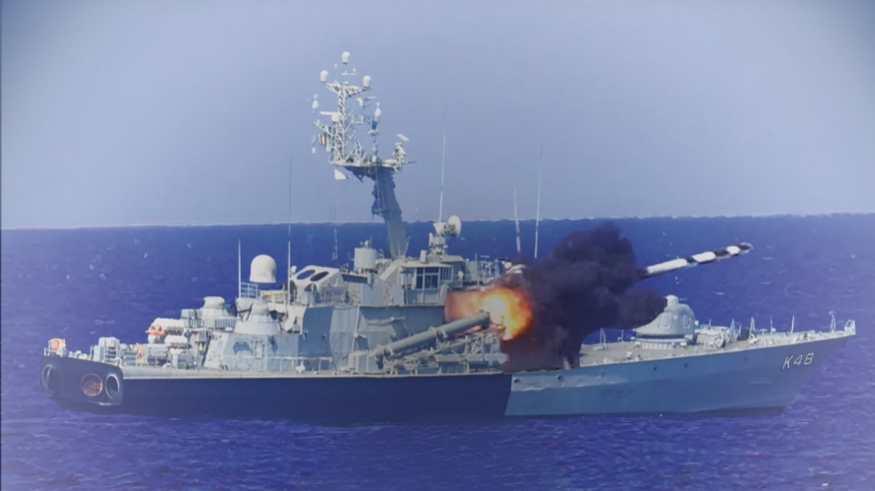
Indian Navy’s ‘Killers Squadron’ to get Brahmos missiles

The Indian Navy has begun upgrading its Veer-class missile corvettes with Indo-Russian Brahmos cruise missiles, dramatically enlarging the engagement range of its smallest war vessels.
During the 1971 India-Pakistan war, Indian Navy missile boats launched the most devastating ship-to-ship missile attacks in history.
In Operations Trident and Python, two attacks on Karachi on the night of December 4 and December 8, four Osa-1 class missile boats sank a Pakistani destroyer, a minesweeper, a merchant ship, a tanker and damaged several other vessels.
The Osa-1 class missile boats were replaced by the Soviet-built Veer class corvettes in the late 1980s. But with time, the 70 km range P-20 missiles might have become outdated. Now, the Pakistan Navy’s nightmare is set to continue. The Indian Navy has upgraded a Veer-class corvette, the INS Vidyut, with four Brahmos missiles (in two-twin inclined launchers abaft of the bridge). Plans are underway to similarly a few other missile corvettes from the 22nd missile vessel squadron.
The Indo-Russian Brahmos supersonic cruise missile has a range of over 500 km, more than five times the range of the older P-20 anti-ship missiles. The subsonic P-20 can be jammed and intercepted by hard-kill measures like anti-missile missiles and fast-firing cannons. The Brahmos flies in at close to three times the speed of sound and is extremely difficult to intercept.
Brahmos uses an Inertial Navigation System (INS) that relies on internal sensors to determine acceleration, orientation and position. This ensures that the missile follows its pre-set trajectory immediately after launch, even without external signals. During mid-flight, it receives positional corrections through satellite navigation support. These corrections help refine its flight path, compensate for drift in INS readings and maintain accuracy over long distances. This stage keeps the missile aligned with the intended bearing towards the target zone. When the missile is close to the target, it activates its active radar seeker. The seeker emits radio waves, detects reflections and uses the difference in return signals to identify and lock onto the target. This allows the missile to autonomously track and engage even moving or time-sensitive targets.
The Brahmos has so far been fitted only on larger frontline Indian Navy destroyers of the Kolkata class and Shivalik class frigates, but not on the seven Veer-class missile corvettes, based on the Soviet Tarantul-class missile boats.
The Osa-1 and Osa-2 class missile boats were replaced by the Veer class, which were inducted into service between 1987 and 2002. A total of 13 were built, five acquired directly from the Soviet Union, and eight manufactured by Goa Shipyard Limited and Mazagon Dock Limited. The last two ships of the class, the INS Prabal and the INS Pralay, are equipped with 16 Uran-E anti-ship missiles (SS-N-25 Switchblade).
Five ships, INS Veer, INS Nipat, INS Nirbhik, INS Nirghat, and INS Nishank, have been decommissioned, and one vessel, INS Prahar, was lost after a collision with a merchant vessel off Goa on April 22, 2006.
If all seven ships are upgraded, the squadron will have a combined punch of 28 Brahmos missiles, more than the number of major surface combatants in the Pakistan Navy.
The operational range for ship-launched variants is typically 290 km to 450 km. These retrofitted vessels are capable of utilising the Brahmos-ER (Extended Range), which has a range of 800 km to 900 km.
Indian Navy has 26 principal surface combatants— 13 destroyers (168 missiles) and 13 frigates (104 missiles), equipped with Brahmos missiles.
A full upgrade of the Killer Squadron will take the Indian Navy’s numbers up to 300 Brahmos missiles. It clearly shows that instead of going with the US Harpoon anti-ship missiles, the French MBDA MM-40 BLOCK 3C Exocet missiles, or even the Russian Kh-35 Uran-E, the Indian Navy is more focused on standardising the Brahmos missiles for its warships.
Arjun Dev Singh
Arjun Dev Singh has a deep interest in defence, security, and strategic affairs. With a strong analytical lens and a passion for military and geopolitical developments, Arjun strives to bring clarity and context to complex national and international issues.




It is worth rethinking whether (differant types and) all the vessels are to be fitted with the same missile. While retro fitting would be a good idea though cumbersome, in my opinion spece for development should be left for tomorrow. GVK.
IN ,missing the trees for the forests . India needs MARINERS & eco system that transports them fast, safe & loaded across nautical miles all around.... hence ratherthan wasting money on rafale ( apart naval needs ) best to spend it on FORMATION OF JAL VERSION OF BHAIRAVS .... INDIA has most Eco systems - sensors sub drones , loitering systems sea skimming drones unmanned boats what now it needs be TRAINED MEN & THEIR CHARIOTS .... Is where a 50,000 force ( marine expeditionary force ) births - 10,000 from Tamil Nadu , rest from Maharashtra, Andhra , Bengal, Assam , odisha & Gujrat.... India must consider across India upgrading fishing vessels with speed & ability to carry 30 perssonel with full gear , over sea planes ( 100 + nos ) & fast crafts along Indian army cavalry module alternated with back up mossiw firing electronic jamming & drones initial strike ... EVOLVE no more lakir ke fakir ( besides fakiri not in our culture ) Bairagi be about inner self connect journey ( uncharted & unstructured) !!! EXPERTS MUST STEER CREATE CUSHIONS DEPTH ... guess a ehole lot of bunch needs to brush up mindset servings....