



The Iran Deal: Peace or Strategic Mistake?
The Sandeep Unnithan Show
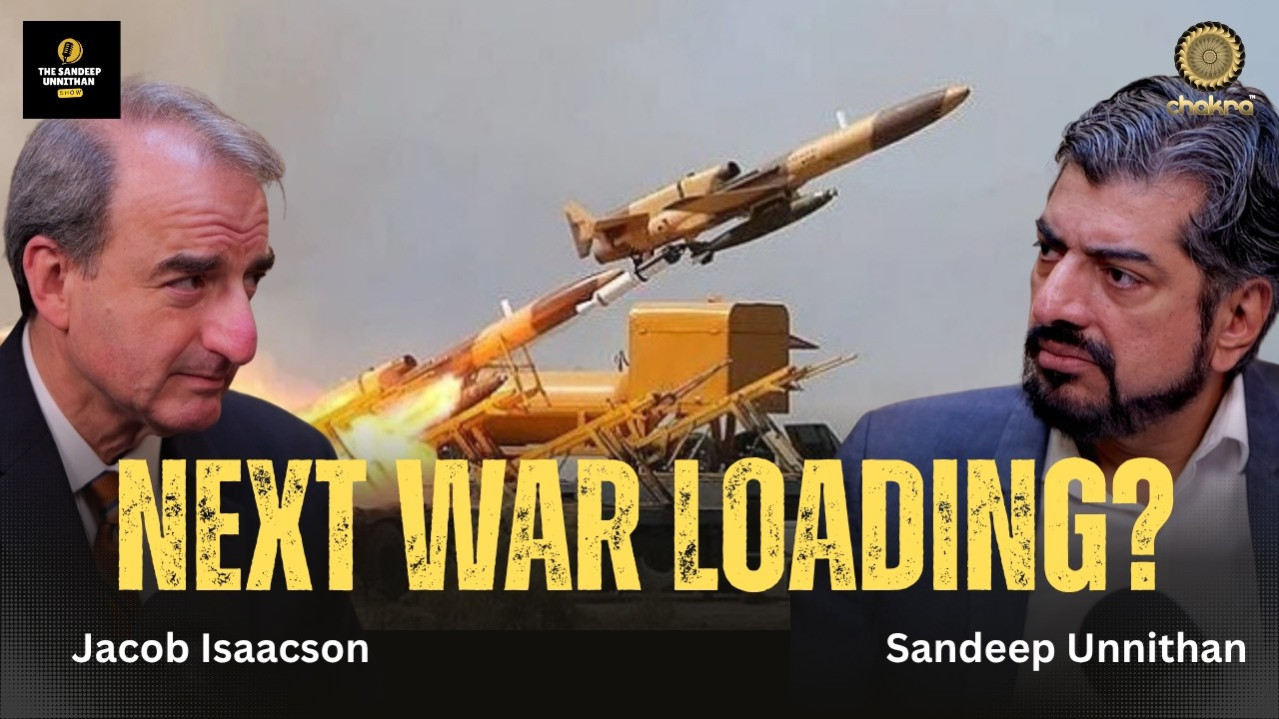
Feat. Jacob Isaacson, American Jewish Council (AJC), Chief Policy and Political Affairs Officer
Sandeep Unnithan: Hello and welcome to the Sandeep Unnithan Show, your weekly dose of defence, geopolitics and much more. Today, I am privileged to have with us here at the Chakra Studios, Jason Isaacson. Jason is the Chief Policy and Political Affairs Officer of the American Jewish Committee. He's visiting India from the United States. I'm going to be talking to him about this new MOU between Iran and the United States. Jason, welcome to Chakra News. It's good to see you again. Good to be back with you, Jason. And we were on an India Today panel just a few hours ago, and we were talking about this MOU, this agreement, this peace deal. What do you make of this? The Iran deal, where the United States seemed to have conceded considerable ground. What do you make of this?
Jason Isaacson: So, I hesitate to call it a peace deal. It's a ceasefire deal to open the Strait of Hormuz with a promise of negotiations, a commitment for negotiations that will theoretically lead to some kind of new arrangement regarding the nuclear program of Iran, regarding other aspects of Iran's threat to the stability and security of the region, primarily the nuclear file. And it will involve the unfreezing of the frozen assets of Iran and a reconstruction fund. Some of the details that were in the MOU that we have all been reading for the last couple of days might still somehow be amended. Who knows? Because so many things have changed just in the last 72 hours or so. But it looks like a deal that is mostly about relieving the world of the pressure that's been imposed by Iran's blockage of the Strait of Hormuz, less about the resolution of the issues that frankly motivated the president of the United States to initiate this military campaign in the first place on February 28th.
Sandeep Unnithan: Right. So, you know, talking about the issues that you raised, there were about five big issues that the United States and Israel mentioned when the conflict began. The first one, of course, is Iran's nuclear program, nuclear enrichment program, fissile material that they had gathered, 440 kilos of it, we've been told. The second is the proxy network, the so-called axis of resistance, which had to be dismantled. The third is, of course, the ballistic missile program, which the United States wanted them to stop, to roll back, to dismantle. And the fourth is, of course, regime change. Do you think any of these have been achieved?
Jason Isaacson: No. And by the way, let me add to that. I mean, those are the main elements that were objectives of the United States and, frankly, Israel, which joined the United States in this campaign on February 28th. There are another 11 tons or so of enriched uranium, not as highly enriched as the 440 kilograms, that are somehow buried around Iran. And that could also be the seed for a future.
Sandeep Unnithan: Further enrichment.
Jason Isaacson: Exactly. Further enrichment. And at least the description that we have seen in the MOU text that has been circulated suggests that nothing is going to be done to interfere with Iran's current mechanisms to enrich. Whether further constraints will be imposed at some point in the negotiations over the next two months. Maybe. Let's hope. But as of now, it looks as though the United States is giving Iran a green light to at least maintain what they have, contrary to the positions that, frankly, the president had taken not so very long ago. And the Republican Party and frankly, many Democrats, not all, had taken for some time, which is that Iran has no inherent right to enrich uranium. It's not in the non-proliferation treaty. They have assumed that right, but it's not guaranteed to them. Wasn't it there in the JCPOA? In fact, in the JCPOA negotiations in 2014 and 2015, they were granted that right, which was, frankly, one of the reasons why my organisation, the American Jewish Committee, was opposed to the JCPOA. No one gets the right to enrichment.
Sandeep Unnithan: No.
Jason Isaacson: They could have had, you know, nuclear reactors for electricity and for other purposes without having to enrich on their own, without necessarily enriching on their own soil. And yet they were given that in the course of those very difficult negotiations in 2014, 2015. And this has just somehow been guaranteed to them in the MOU, which is unfortunate. So there's the right to enrich. There are the other 11 tons or so of less enriched, but still enriched uranium that's buried somewhere in Iran. And, there's the whole campaign that, frankly, the radical regime in Tehran has been conducting to destabilise its region, to spread its radical ideology across the region.
Sandeep Unnithan: Proxies.
Jason Isaacson: Proxies and other ways to try to subvert countries on the other side of the Arabian Gulf, none of which seem to be addressed at this point. So, I'm very concerned that a lot has been given to the Iranians even before we start these negotiations. And let's hope in the 60-day window that this MOU provides, there can be progress toward fulfilling the objectives that the president laid out on February 28th that you just enumerated. But let's also recognise that a 60-day window for such negotiations is a very tight window if you're negotiating with basically the world's best bargainers. They have proven again and again their ability to go to the most extreme lengths in any process of negotiations on the most minute details. The JCPOA took 20 months to negotiate. And we ended up with a less-than-satisfactory agreement. If the president and his people feel that somehow in 60 days, we're going to come up with something even better than that agreement. Look, I admire their courage and vision and aspirations, but I don't know how possible it is.
Sandeep Unnithan: But, you know, a little while ago, Jason, we were talking about the fact that a document as significant as this ought to have passed through US Congress. Why didn't Congress get a vote on this?
Jason Isaacson: Well, it's, you know, it's a very murky question. What is an MOU? Is it the same thing as a kind of document that you would necessarily bring to the US Congress before? Not treaty.
Sandeep Unnithan: Right.
Jason Isaacson: It's not really. Is it really a binding agreement between the United States and the Islamic Republic of Iran? It's a commitment by the president. He signed it at Versailles. It was signed digitally a couple of days ago as well. And there'll be some kind of ceremonial signing, I suppose, in Geneva. At some point, certainly at the conclusion of this period, if it's 60 days or 120 days or whatever, because it's extendable, as you've said. If there is a final agreement, that by law should go to the US Congress. And if it ends up with an agreement that is sort of sketched out in the MOU that we've been seeing, I have a hard time imagining that there will be support for such an agreement in the US Congress now. But who knows? Politics in my country is going up and down. There's a great deal of polarisation. And there has been pretty consistent sort of rubber-stamping by the Republican majority in Congress for what the president wanted, although that's starting to dissipate a little bit. We'll see. I'm waiting to hear voices in Congress fully supportive of this. Lindsey Graham, who seemed quite concerned about the details as of a couple of days ago, seems to be less concerned based on some recent discussions he's had with senior administration officials. It may be that the details that emerge are much more satisfying than what has been sketched out in the MOU. And people will be satisfied that there are sufficient provisions to ensure the long-term kind of diminishing of Iran's capabilities in the nuclear file, in the ballistic missile file, on the support of terrorist proxies. I'm hopeful that that's where we'll get. At this point, I have a lot of questions. I have many more questions than I have answers.
Sandeep Unnithan: And in fact, we have several questions as well, as in what is the object of this war if it leaves Iran in a stronger position than it was at the start of the conflict? Do you believe that Iran today, especially after this MOU, is in a stronger position than it was on the 28th of February?
Jason Isaacson: It's interesting, Sandeep. It's a debatable point. I think there are certain...
You can argue both sides. You could say that the military of Iran has been degraded by this war. I think without question. They have certainly depleted their own stockpiles of missiles and drones, although they seem to have a lot of drones. And there have been various estimates that a very significant percentage of their current stockpile of missiles has been destroyed, and their ability to manufacture others has been destroyed. But they still have other facilities, and they have a lot of stuff underground, and we don't know where everything is. So there's been a serious depletion of their abilities, but they still have abilities, as they have proven, because in the last few days and weeks, I mean, just leading up to this MOU, they were firing at Bahrain and everything. I was actually in Bahrain and woke up at four o'clock in the morning to hear things exploding over my head. So, they still have capabilities.
Their nuclear program has been significantly set back. That happened in June of 2025, and it also happened in the course of the two and a half months or so of bombings. The leadership of the country has been rearranged. Many of the Ayatollahs and the people around him and their IRGC commanders and other people in power have been killed in this action, but they have replacements who don't seem to be any more reasonable and moderate than their predecessors. So there has been an impact, and there's been severe economic damage. So one could say that there have been certain accomplishments, but the regime has not been changed. The personnel have been changed, but not the regime itself. It still poses a threat. It hasn't in any way backed off from its ambitions to exert influence across the region. And it insists that Hezbollah is basically a satellite of Iran, controlling Lebanon, which, from this document, makes it seem as though the Iranians feel they have the right to assume control over Lebanon. And for the United States to somehow grant them that ability, that right, is preposterous. So I'm hopeful that that will all get ironed out in the course of this 60-day negotiation, which, by the way, has enormous security implications for Israel, of course, because I'm sure you want to talk about that, so I'll just jump ahead. Nothing should be able to constrain Israel from defending itself. No country has the right to tell Israel that it can't defend itself if it is attacked or if it is about to be attacked.
Sandeep Unnithan: Or this rhetoric of Israel doesn't have a right to exist.
Jason Isaacson: Exactly. So Hezbollah has fired thousands of missiles, rockets, and drones into Israel over the course of the last couple of years and hundreds and hundreds over the last few months, and even since the April so-called ceasefire between Hezbollah and Israel. If Lebanon, by order of, not Lebanon, excuse me, if Hezbollah, by order of Iran, should fire a drone or a rocket into Israel over the next few weeks, can Israel not respond? Of course, Israel will respond. Will that somehow upset this delicate process that the United States is engaged in with Iran? It could. I mean, you've heard some commentary over the last 48 hours or so from U.S. officials that suggest, no, of course, Israel can still have the right to defend itself, but it's not clear if you look at the document itself and what the political implications will be if that goes forward, and then will there be people around the world who say, oh, Israel is just trashing this agreement, and therefore Israel does not want peace, and therefore Israel is responsible for, again, the Strait of Hormuz being closed because the Iranians will respond. It sounds like a trap, basically, that Iran is capable of laying through Hezbollah to fire into Israel. Israel responds, and then Iran says, oh, well, that's, you know, the jig is up. We're going to reimpose our control over the Strait of Hormuz. So there are a lot of questions that have to be sorted out and a lot of concerns that Israelis have, who thought that they were going into this process in partnership with the United States. Their strongest ally, with whom they really share the same sense of threat posed by the Iranian regime, much worse is existential for Israel, but the same sense that this is a regime that threatens stability and security in the region, threatens American interests across the region, American allies in the Gulf, and a regime that has basically been at war with the United States for 47 years. It is not the United States that was saying, you know, death to Iran in 1979 or 1980. It was the Iranians who, not the Iranians, but the Iranian regime, the mullahs and their IRGC military support group, that were doing everything they possibly could to target America and America's friends and target Israel, the little Satan. So, somehow Israel is to be denied in any way the ability to defend itself, as it must be able to, through this process, is very troubling. Let's hope that we don't get to that point. Let's hope that Israel, which has no territorial ambitions in Lebanon, it simply wants to defend itself and protect itself against the attacks that have been so repeated by Hezbollah, will eventually be able to make good on, frankly, the promise that the United States has assisted in developing a real relationship between Israel and the legitimate government of Lebanon, which Hezbollah has done everything it possibly can to destroy. Let's hope that we can get back on that track, continue on the process that, frankly, President Trump initiated just a month or so ago, a month and a half ago, by having repeated conversations between the Israeli ambassador to Washington, the Lebanese ambassador to Washington, the possibility of even advancing that further with even higher-level negotiations. But again, that's all threatened by Hezbollah's continued grip on the security situation in Lebanon, on the government in Lebanon, and on their ability to, again, fire into Israel and therefore provoke a response by Israel.
Sandeep Unnithan: So, there's another process that President Trump initiated in his first 10 years, which was the Abraham Accords, a very significant breakthrough, probably one of the greatest geopolitical moves of the 21st century. Why aren't we hearing anything about the Abraham Accords in all of this? Do you believe that's gone on the back burner now? Or do you think the GCC countries, which have been at the receiving end of Iranian missiles and drone attacks, are actually going to come together and make peace with Israel?
Jason Isaacson: Well, you know, it's so interesting. I actually spent the last two and a half weeks in the Gulf. AJC opened an office in Abu Dhabi five years ago. They're frequently, and I've been in consultations with people as this was all going on, as the discussions were taking place. First of all, it must be pointed out that the United Arab Emirates and the Kingdom of Bahrain, which agreed to normalise relations with Israel and have been developing their relations with Israel for the last five years, five and a half years, have done nothing to back away from these agreements. They have doubled down on these agreements. In fact, they were attacked. And in fact, they were attacked viciously. The UAE, more than Israel, suffered thousands of drone and missile attacks. And as I said, while I was in Bahrain, I was hearing things explode over my head because they were being attacked as well, and Kuwait, Saudis and, Qatar and a little bit of Oman. But the Abraham Accords agreements that were reached in 2020, historic agreements, changed the region, opened up the possibility of Israel's full integration into the region for the benefit of those countries, of all of those countries, of regional stability and prosperity. And I have been in all of the GCC countries, and I have heard to varying degrees, because they don't all have the same ideas, the same concerns, the same hopes. But to varying degrees, all recognise that the region is changing and has to change and that Israel is part of the region. I mean, I remember so vividly being in a conference in Bahrain in 2018 and hearing the then foreign minister of the Sultanate of Oman. Actually, they called it the minister responsible for foreign affairs; they didn't call him the foreign minister. Talking about how Israel is in the neighbourhood and to pretend that it's not is fooling ourselves and pretending that somehow pretending that they don't exist is helping the Palestinians is also fooling ourselves. So there has been this awakening of the recognition of the benefit of a relationship with Israel. Various kinds of relationships, such as economic relationships, a security relationship, educational exchange, public health issues, and other things. Before the Abraham Accords, HAC had webinars with senior officials of the UAE before they announced their normalisation with Israel during the COVID crisis, on how they could benefit from sharing medical, public health technology and practices with Israel. This is understood across the Arab world, certainly in the Gulf. The United States has not backed away from its commitment to advancing the Abraham Accords. My organisation has been involved in these issues for decades, and we will continue to press as well, but we're not the only ones. For economic reasons, for security reasons, for a wide range of reasons, including, by the way, water management, water resource management, and the possibility now there are so many discussions that I've been involved in the last couple of weeks on AI, on quantum. There are such prospects for strengthening the ability of the region to really exert the kind of influence that its wealth should allow it to have.
Sandeep Unnithan: In fact, India also built on the Abraham Accords with the IMEC corridor.
Jason Isaacson: And yes, recognising the natural relationship between India and the Middle East and India's deep investment that will grow in a strengthened, more stable, more secure Middle East, more integrated Middle East. And the natural relationship that we have seen flower in the last couple of decades between India and Israel. And AJC has been very proud to be part of that process going forward, full of admiration for the consistent support in India of Israel's security and of the benefit to India and to the region of that kind of relationship. So that Abraham Accords process is far from over. It is continuing. And the continued commitment of the United States is quite strong. Yes, the Iran war has complicated things, and frankly, the Gaza war, of course. After October 7th, the atrocities committed by Hamas on October 7th, the 1,200 people who were killed in Israel by Hamas foot soldiers who crossed the border into southern Israel, and the 251 who were taken hostage, who were kidnapped and brutalised, traumatised Israel, set back the process of Israeli-Palestinian peace, and frankly, the process of advancing Arab-Israeli peace in general. That's receding into the distant past. More, it is still an issue on the mind of many Israelis, of course. But although that did, because of the two-plus years of war, the attraction to Israel by many people in the Arab world, they saw terrible images every day of what was happening in Gaza, as Israel had to respond to the Hamas attacks against an army that was embedded in a civilian population. And it was not popular in the Arab world, of course, understandably. Those governments still have not backed away from the commitments that they made in 2020. And they recognise also, although it's not always said in public, that Israel had very little choice. In fact, I remember quite distinctly a conversation I had with a Saudi official just after October 7th in which he said to me and some colleagues of mine who were with him that it's clear that Israel is going to have to respond to the Hamas attacks in a way that will be really brutal for the Palestinian population in Gaza because of the way Hamas has cynically embedded itself in the civilian population. So there's a recognition at the higher levels that this is a process that is in their interest to continue. And I'm expecting that we will see, again, a return of America's involvement in advancing the process of Arab-Israeli peace. And my organisation will continue to be very active. We created two years ago something that we call our Centre for a New Middle East, which is really all about finding ways to build bridges and build relationships and build trust. And we're doing that at the economic level and at the civil society level and at the governmental level, especially at the economic level, bringing business people to meet each other from the Arab world and Israel and their American counterparts and basically provide a firmer sort of economic foundation under a too often slow and stalled political process and give incentive to the politicians to move forward in the best interest of their communities.
Sandeep Unnithan: But, you know, looking at the current kind of peace process, if you can call it that, between Iran and the United States, do you think that a resurgent Iran after this agreement would hang like a sword of Damocles over any... Absolutely.
Jason Isaacson: I'm very worried about that. If, at the end point of this whole process, we can reach some sort of final agreement and Iran can recoup its frozen assets, billions of dollars, and can gain, according to the document, hundreds of billions of dollars in reconstruction funds, I'm sure that not all of those dollars will be invested in hospitals and schools and housing for the people of Iran. A lot of it will flow into the terrorist proxies and the IRGC network and the missile development, and maybe the nuclear program. Even if the nuclear program is, by the conditions of this agreement, set back 15 years or 20 years, the Iranians are patient. And I am worried that an IRGC-led or perhaps theocracy-led Iran will never give up on its commitment to do everything it can to prepare for the destruction of Israel and its domination of the region. And that is not in the best interest of the United States, of Israel, of our Gulf allies, or of India. So if we see a more empowered Iran at the end of this process, this will have been a terrible failure. If we see an Iran that is still weakened by the military campaign, under severe constraints to advance any kind of nuclear program that would continue to threaten the region, it will have been a success. But it's a painful process, and a lot of people have paid very dearly for that process, including, of course, the terrible death of the seafarers of India who paid with their lives for an incident that took place in the course of this.
Sandeep Unnithan: So, Jason, in conclusion, I must ask you this: while this MOU is being negotiated, it has given itself 60 days. Who knows what could happen in these 60 days, as you pointed out? Do you see in this current stalemate the seeds of a future conflict being sown? Because a resurgent Iran that threatens the existence of Israel, which possibly will have nuclear weapons at some point, threatens the GCC countries, it actually sets the stage for a conflict further down the line. And all we've done is we've kicked the can down the road.
Jason Isaacson: Look, that is the big question. And that is the concern that many of us have that perhaps, yes, certainly, it was important to open the Strait of Hormuz. Certainly, it's important not to have a conflict go on indefinitely. But if what we're doing is what was attempted in 2015 with the JCPOA, which was to push back for 10 years or 15 years the prospect of an Iranian nuclear program, military nuclear program, and that was deemed then insufficient, if we find ourselves again in the same situation where after all of this, after spending tens of billions of dollars and killing lots of people, and destabilizing the region, and depriving many people of livelihoods and energy over the last three months, if we find ourselves in pretty much the same position we were in in 2015, it will not be a success. I'm hopeful that that's not where we'll end up. I'm hopeful that, in fact, the negotiations will be smoother and more successful. And we will find the Iranian program to advance a military nuclear capability sufficiently, if not fully eliminated. And no longer will you have Iran doing everything it possibly can to destabilise its neighbourhood and also to threaten the existence of Israel. We are counting on the United States to make good on the promise that the President made on February 28. And I think he has the desire to do so, and he will have the support of many in the United States if he's able to succeed.
Sandeep Unnithan: Talking about the United States, Jason, what is the mood like back in the United States with this war? I mean, is there a sense of frustration about the rising prices and all that?
Jason Isaacson: Of course, there is. And you know, this was not a popular war in the United States. And this also weighed very heavily on the mind of the President, who's looking at midterm elections coming up in early November. And that's not very far away. And gas prices are high. They will come down, which is what he very much wanted and he promised. And there's also just increasing polarisation in the U.S. You know that. I mean, you're seeing the poll numbers, the President's own popularity has been weakened, not just because of the Iran war. But I do believe that if these negotiations over the next two months are successful, it will change that dynamic. And we'll see. The prices will come down. That will be important. And I'm sure we'll hear a lot about that for every 10 cents that drops from the price of gasoline. I'm sure we'll hear major announcements. And of course, we're about to celebrate the 250th anniversary of America. And so there's a kind of patriotic feeling that's kind of wafting through the land these days, even with all the divisions that we have in our own society. And I'm hopeful that we will find it in ourselves, in our hearts, to come back to what is good about America and not spend so much time worrying about what is divided and rotten. And there's a lot that's good in America.
Sandeep Unnithan: Absolutely. And thank you very much, Jason, for joining us. And congratulations on the 250th anniversary of the United States in advance on the 4th of July. We'll be watching it very carefully and closely with a lot of fondness, because, as Prime Minister Modi said, India and the United States are friends for the long term. And there is a lot that's been invested in this relationship.
Jason Isaacson: I'm sorry that I didn't say that myself, because the investment that my organization yes, personally, but my organization has had in doing everything we can to strengthen American support for the natural synergistic relationship between our country and India, working very closely with our Indian American partners, with whom we've been in partnership for decades to advance India-U.S. relations, going back to the civil nuclear deal in the last year or two of the George W. Bush administration, but consistently every year forward on so many issues working very closely. We know it's in the best interest of our country, it's in the best interest of India to have this natural bond, and we will continue to work on that.
Sandeep Unnithan: Right. And on that note, Jason, thank you very much. Thank you for your time and for your thoughts. And thank you for being here on Chakra News on my show. Thank you.
Watch the full podcast: https://www.youtube.com/watch?v=YB7LKNRG2Xs
Arjun Dev Singh
Arjun Dev Singh has a deep interest in defence, security, and strategic affairs. With a strong analytical lens and a passion for military and geopolitical developments, Arjun strives to bring clarity and context to complex national and international issues.


Comments