







The Hexagon Alliance

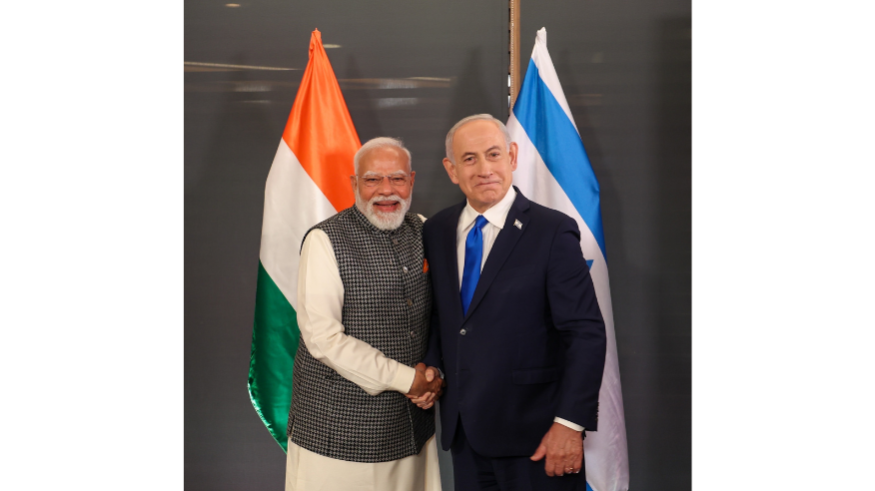
Prime Minister Narendra Modi’s visit to Israel from 25 to 26 February comes at a moment of extraordinary geopolitical convergence in West Asia. On one hand, Modi is scheduled to address Israel’s parliament, the Knesset, an event symbolising the political depth of India–Israel relations. On the other, the same week sees renewed talks between the United States and Iran over the future of the Iran nuclear deal, against the backdrop of an unprecedented American military buildup across the Middle East.
US aircraft carriers, strategic airlift platforms, refuellers and forward bases now form a visible pressure mechanism aimed at Tehran. The message is unambiguous: diplomacy is preferred, but escalation remains firmly on the table. It is in this charged environment that Israeli Prime Minister Benjamin Netanyahu, speaking on 22 February, publicly outlined a new geopolitical construct: The Hexagon Alliance.
Modi’s address to the Knesset has also become entangled in Israel’s internal political friction. Opposition leader Yair Lapid has demanded that Supreme Court Chief Justice Isaac Amit be present during the address, warning that the opposition would boycott the event otherwise. While this dispute is domestic in nature, it underscores the sensitive political moment in Israel where foreign policy signalling and internal legitimacy intersect.
What Is the Hexagon Alliance?
According to Netanyahu, the Hexagon Alliance is envisioned as a strategic alignment of six geopolitical spaces, rather than a rigid military bloc. The proposed members include Israel, India, Greece, Cyprus, select Arab states, most likely the United Arab Emirates and Bahrain, and a set of African partners such as Somaliland, Morocco, Ethiopia, and South Sudan.
The alliance rests on three pillars.
The first pillar is Security, centred on intelligence sharing, defence cooperation, counterterrorism and coordinated responses to radical non-state and state-backed actors. This includes maritime domain awareness across key sea lanes, cyber and electronic warfare collaboration, and capacity building in air and missile defence. Given the geographical spread of the proposed members (from the Eastern Mediterranean to the Indian Ocean), this pillar aims to create a continuous security architecture capable of monitoring and responding to threats that transcend borders, particularly those linked to Iran-backed networks and transnational extremist organisations.
The second pillar is Diplomatic Alignment, aimed at creating an axis of states that share similar threat perceptions, particularly regarding radical Islam, regional instability and Iranian influence. Rather than a formal military bloc, this pillar envisions a consultative axis that coordinates messaging in international forums, reduces policy divergence during crises, and presents a unified front on issues such as sanctions, conflict escalation, and regional red lines.
The third pillar is Economic Cooperation, focusing on trade, advanced technologies such as artificial intelligence, semiconductors and quantum computing, and infrastructure connectivity in the India-Middle East-Europe Economic Corridor. This pillar is designed to translate strategic alignment into tangible economic gains, binding member states through shared supply chains, investment flows and innovation ecosystems.
Netanyahu has explicitly framed the Hexagon Alliance as a counterweight to what he describes as two hostile axes.
The first is the Shia axis, often referred to as the “Axis of Resistance,” backed by Iran since the 1979 Islamic Revolution. This network includes Hezbollah in Lebanon, the Houthis in Yemen, Hamas in Gaza, Palestinian Islamic Jihad (PIJ), the Popular Mobilisation Forces (PMF) in Iraq, and the Assad regime in Syria.
The second is what Netanyahu calls an emerging Sunni axis, composed of Sunni-majority states such as Türkiye, Qatar, Saudi Arabia, Pakistan, alongside Jordan and Iraq. These countries have increased cooperation among themselves and criticised Israel for its actions in Gaza and recognition of Somaliland.
In 2025 alone, Israel conducted or was linked to military actions involving at least six countries: Qatar, Iran, Lebanon, Syria and Yemen, as well as operations connected to Gaza that extended into international waters near Tunisia and Greece. These developments have accelerated alignment among states that otherwise share limited ideological common ground.
Israel’s outreach to India is central to the Hexagon vision. New Delhi brings strategic weight, economic scale, technological capability and political credibility across the Global South. However, India is expected to approach any formal alignment with caution.
India maintains longstanding ties with Iran, including its strategic investment in the Chabahar Port, which provides access to Afghanistan and Central Asia. At the same time, India enjoys deep economic, energy and diaspora-linked relationships with Gulf Arab states that host millions of Indian workers. On the Palestinian question, India has consistently and carefully supported a two-state solution, balancing its partnership with Israel against broader regional equities.
During PM Modi’s visit, discussions with Netanyahu are expected to focus on Iran’s nuclear trajectory and the Palestinian issue, both of which are reaching critical inflexion points as the nuclear deal approaches expiry and regional military postures harden.
Right now, India has not even joined, but it has rattled Pakistan. Pakistan has called the hexagonal alliance the ‘Anti-Muslim Ummah bloc’ and has unanimously passed a resolution in its parliament on 25 February condemning it. The resolution was moved by Pakistan People’s Party lawmaker Palwasha Mohammad Zai Khan on behalf of all political parties against Israel's policies and actions. The PPP is an integral part of the ruling coalition led by PM Shehbaz Sharif. The Hexagon alliance positions India as a primary partner for Israel, Greece, and Cyprus, potentially marginalising Pakistan’s influence in the Mediterranean and Middle East.
India’s entry (even informally) would elevate it as a key security and diplomatic node connecting the Eastern Mediterranean, West Asia and the Indian Ocean. This could significantly deepen India’s defence, intelligence and technology cooperation with Israel and Europe, particularly in emerging domains like AI-driven warfare and cyber security. India would also gain leverage within Gulf geopolitics, but at the cost of tighter diplomatic balancing between Israel and Iran.
What will change in West Asia? West Asia appears to be moving toward an axis-versus-axis dynamic, where the Hexagon Alliance seeks to counter both Iranian-backed networks and a loosely coordinated Sunni political front. For Arab states like the UAE, Saudi Arabia and Bahrain, this creates a strategic dilemma: publicly align with Israel for economic and security gains, or maintain calibrated de-escalation with Tehran.
For India, the Hexagon Alliance presents both opportunity and risk. It could reshape how New Delhi engages with West Asia. India is no longer merely a balancing actor, but rather seen as a structural power broker in a region entering a new era of strategic consolidation.


Comments