





The Iran War and Israel’s Nuclear Ambiguity
The nuclear question over the Iran War focused on Iran’s nuclear ambitions and the threat those posed. However, two events occurred during the war which have now turned the spotlight on Israel’s nuclear status.
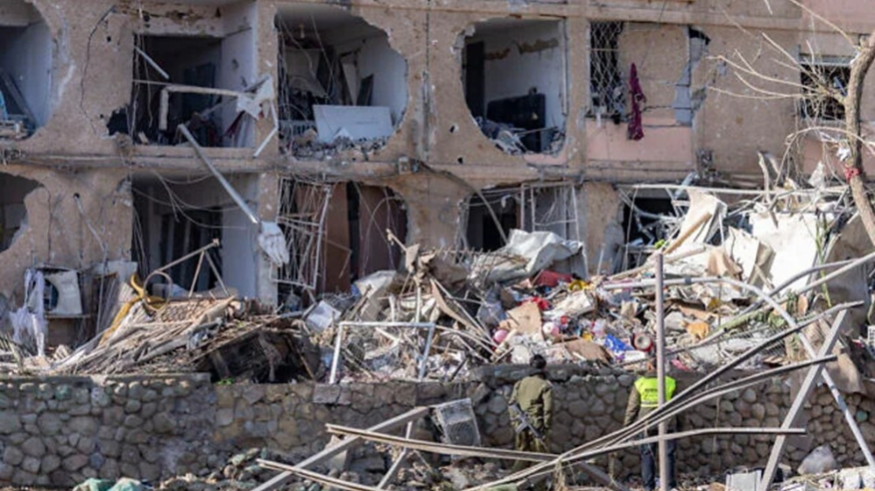
The first being 21 March when Iran launched ballistic missile strikes on the Israeli city Dimona. The targeting raised questions about the vulnerability of the Nuclear Research Centre, and Iran’s willingness to target it.
Thereafter on 04 May, a group of 30 US House Democrats sent a letter to Secretary of State Marco Rubio, citing the war with Iran as the catalyst for demanding transparency regarding Israel’s nuclear posture. They argued that America's policy of silence regarding its ally’s nuclear programme is no longer defensible in the current geopolitical climate.
Israel has always refused to confirm possession of a nuclear arsenal as per its policy of strategic ambiguity.
The Vela incident an atmospheric nuclear explosion is thought to mark the dawn of Israel's nuclear era. A "double flash" detected by an American satellite on 22 September 1979 near the isolated South African territory of the Prince Edward Islands in the Indian Ocean.
In October 1986, the Sunday Times published details of Israel’s undeclared nuclear programme, based on information and photographs by Mordechai Vanunu, who had worked at Israel’s secret Dimona complex beneath the Negev desert. The revelations were credible and linked to an identifiable source.
Israeli leaders have generally kept silent on their atomic capabilities, though in November 2023, an ultranationalist politician, Cabinet Minister Amichai Eliyahu said that one of Israel’s options in the war against Hamas could be to drop a nuclear bomb on the Gaza Strip. Prime Minister Benjamin Netanyahu, then suspended the Minister from cabinet meetings.
Israel is not a party to the NPT treaty and is estimated to have 90 nuclear warheads as per the International Campaign to Abolish Nuclear Weapons (ICAN).
The 04 May letter led by Joaquin Castro was sent to the Secretary of State Marco Rubio urging the US to publicly acknowledge Israel’s nuclear weapons programme. It said; “Congress has a constitutional responsibility to be fully informed about the nuclear balance in the Middle East, the risk of escalation by any party to this conflict, and the administration’s planning and contingencies for such scenarios. We do not believe we have received that information.”
Castro then posed a question whose essence lay in its simplicity; the United States openly discusses the nuclear programmes of Britain, France, India, Pakistan, Russia, North Korea, and China. Why should Israel’s be treated differently?
The letter would have been unthinkable a decade ago. Avner Cohen, a prominent figure in the nonproliferation and nuclear history, called it a break with a half century taboo in US politics.
Prime Minister Levi Eshkol shaped Israel’s policy of nuclear ambiguity in the 1960s. Facing intense pressure from the US to allow inspections of the Dimona reactor, in May 1966 he declared that Israel would "not be the first state to introduce nuclear weapons into the region.". On 05 October 1968, Eshkol added that “Israel has the knowledge to make atomic bombs.”
In 1974, Prime Minister Rabin repeated the formula but added that, “We can't afford to be the second either”. This would become that essential element in the formulation of deliberate ambiguity.
Opacity was never only about deceiving adversaries. Iran, has long operated on the assumption that Israel possesses nuclear capability. Its value was also political and diplomatic. It reduced pressure on Arab governments to acknowledge their nuclear inferiority and gave the US space to preserve Israel’s strategic advantage without having to defend it in every nonproliferation forum.
Israeli opacity both facilitated and depended on a US willingness to focus the nuclear nonproliferation question exclusively on Iran. Even the Joint Comprehensive Plan of Action did not fundamentally alter that logic. It put Iran’s programme under inspection while leaving Israel’s position undisturbed.
The latest war has broken that frame by making nonproliferation part of the overt grammar of a large regional conflict. Iran’s nuclear programme is now at the centre of a sustained, open conflict involving major powers.
One of the war’s stated purposes has been to destroy Iran’s nuclear capability and prevent it from becoming a nuclear weapons state. The strikes on Fordow, Natanz, and Isfahan were framed at eliminating Iran’s nuclear infrastructure.
Once a conflict of this scale and explicitness is waged over nuclear weapons Israel’s opacity becomes difficult to sustain and its present nuclear status comes to the fore.
This does not mean that Israel will abandon opacity. No Israeli government would change a posture that has served the country for decades. But opacity can erode without ending.
The consequences are playing out in two dimensions. The first is operational. The conflict has pushed Israel’s strategic geography into public view. The point is that Dimona is now part of the map of the conflict.
The second is that the conflict has made nuclear questions a routine part of public discussion in ways opacity was designed to prevent.
The shift surfaced even at the highest levels. When David Sacks, a senior White House advisor, raised the possibility of Israeli nuclear use if the war escalated further, Trump was asked about it and replied; “Israel wouldn’t do that. Israel would never do that.” Though not a formal acknowledgment. But the US President was publicly responding to the question marked a change.
The Iran war has changed the frame. Israel’s nuclear arsenal cannot remain outside the discussion at a time of continuing deterioration of global security. Though Israel may be losing its grip on strategic ambiguity but even under the strains of war, neither the US nor Israeli government is likely to abandon the old formula.
Simultaneously, Iran’s nuclear potential appears damaged but not eliminated. The fear is if Iran achieves the capacity for nuclear weapons without openly crossing the threshold then the region will have two countries living in strategically consequential ambiguity.
However, if Iran were to cross the threshold overtly, pressure on Israel’s undeclared posture would intensify. As the strategic benefits of ambiguity would erode making it meaningless to preserve opacity when an adversary has an acknowledged arsenal.
But the public scrutiny surrounding Israel's nuclear posture has escalated and the space between Israel’s capability and declaration is shrinking.
Maj Gen Jagatbir Singh, VSM (Retired)
Major General Jagatbir Singh is an Armoured Corps Officer who commanded the First Armoured Division. He served in varied terrains and tenanted important command, staff and instructional appointments including a UN Peace Keeping Mission in Iraq and Kuwait. He co-authored ‘Armour 1971’ and edited ‘Valour and Honour’.



Comments