









A GLOBAL SECURITY EPOCH

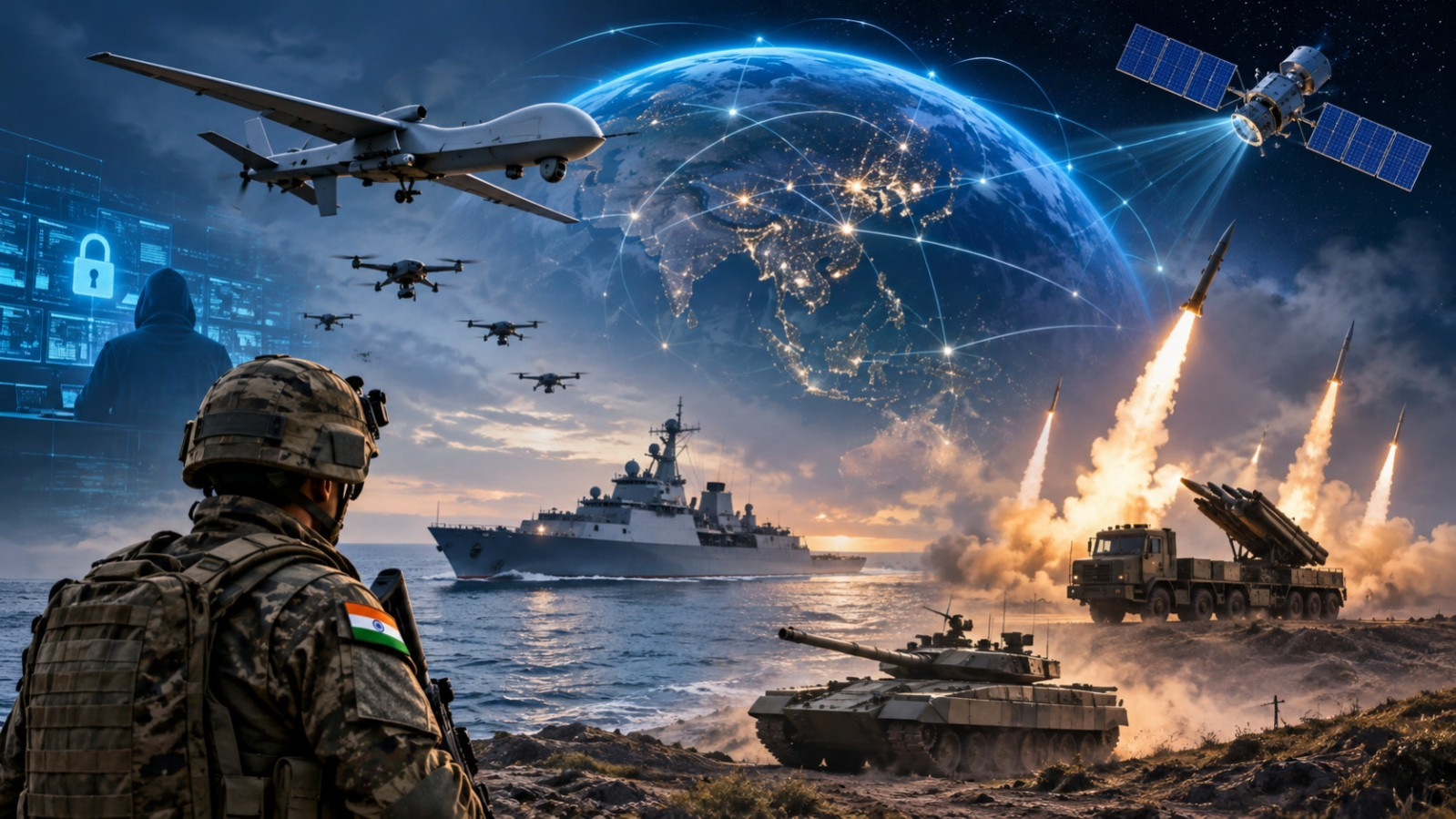
The international security architecture is under manifest challenge, stress and strain. Even as hard power returns as the central organizing principle in geo-politics, and technologies drive national security like never before, the globe is also in the midst of a massive revolution in military affairs built around dronery, AI, military autonomy, algorithmic warfare, lethal software, space, cyber, quantum, sub-terranean engineering, et al.
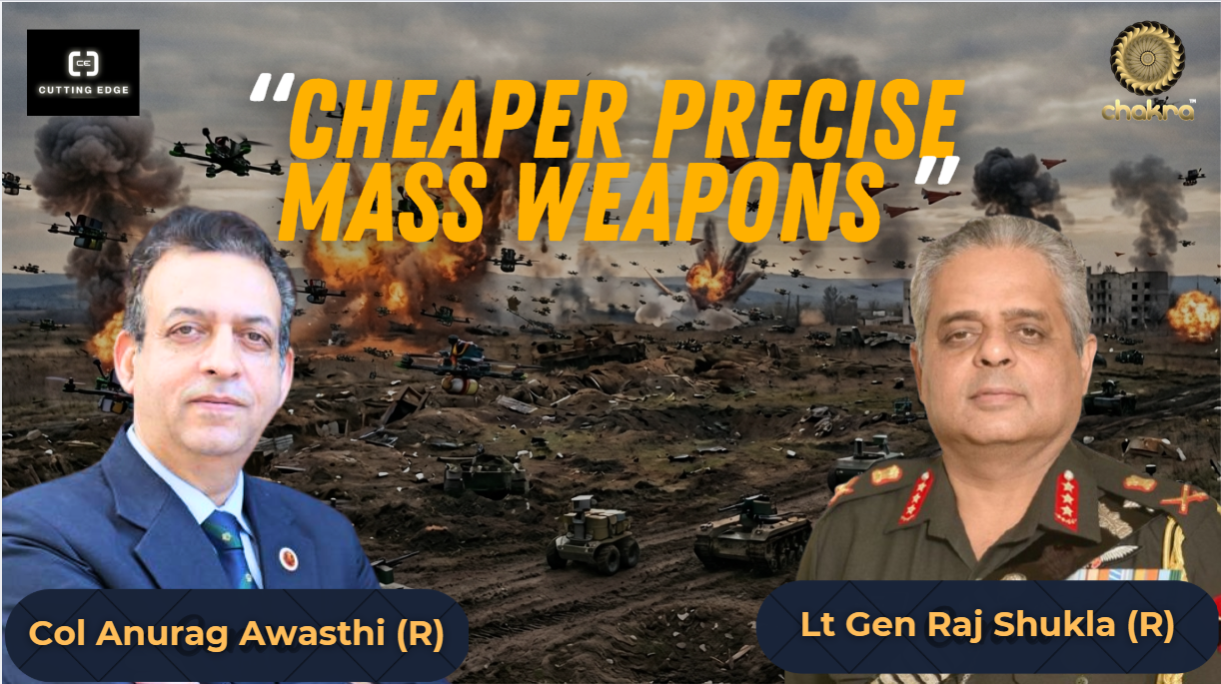
The security landscape is witnessing staggering change centered around a transformation to ‘cheap, precise, lethal, mass’. We seem to be in a once in two-three century moment, as momentous as the advent of gunpowder, mechanization, airpower and the nuclear age. In consequence, the metrics of deterrence, warfighting and global power, the character of war and business delivery are mutating in profound ways, with implications that range far beyond the military and defence. The ‘Adaptation Challenge’ is so huge that the national security community in India needs to grasp the
stakes and ideate/drive a strategic-military response in accord with the new grammar and vocabulary of national security. We need a major swivel in our strategic sensibilities in order to embrace the new metrics of deterrence.
The new models of deterrence are being fashioned by a tidal wave in deep-technologies in defence. The convergence of these technologies has birthed a new art and science called dronery, bleeding-edge software is creating new sources of tactical, operational and strategic advantage, while also opening the floodgates of business opportunities.
Till February 2022, when Putin attacked Ukraine (a country incidentally, without an air force or a navy), drones were seen mainly in weddings. Faced with the wrath and assault of the third most formidable military in the world, Ukraine’s technology geeks, first invented an AI enabled data analytics platform called Delta, plugged it into a versatile inventory of drones, then created a cheap, lethal, kill web that today masses operational effects in dronery, ranging from close air support to strategic air power. Dronery has been used to target
Russian warehouses like Wildberries, hit oil refineries, gas stations, carry out deep strikes on Moscow and St Petersburg, even as an instrument to isolate Crimea. Starlinks has been leveraged to take battlefield mobility and high-speed drone operations to an unprecedented high. The Russians have upped the ante even further: Geran drones (crude Shaheds upgraded through repeated battlefield iterations with advanced communications, navigation and now jet engine propulsion) are being used as part of a massive drone hunting campaign to decimate ports, destroy the energy, heating and water grids in key cities like Kyiv, Odessa, Kharkiv, as also disrupt the rail link to Warsaw. Shear drones are being used to snap the suspension cables of bridges. Glide bombs launched from Su-34s/Su-35s and hyper-sonic dominance (Zircon missiles) are adding to the devastation. With Chinese assistance, a Russian version of the Starlinks (Rassvet) is around the corner – that will exacerbate the kinetic havoc in dronery.
The salient lesson coming out of EPIC FURY is the sheer power of asymmetricity, low-tech innovation
and stealth partnerships (Iran, Russia and China). At the commencement of conflict all that the Iranians had were 5000 missiles (1000 to hit Israel and 4000 to strike the Gulf) but 35 exquisitely engineered, sub-terranean missile storage/manufacturing cities, dispersed across the Iranian geography and drilled into hillsides, as also a steady supply of Shahed drones. Such a granite-hardened asymmetric posture enabled Iran to not only absorb the weight of the missile strikes of the most powerful military in the world, but also deliver a potent response, hitting American military centers of gravity while picking apart gulf infrastructure. At least eight out of the sixteen American bases in the gulf have been annihilated. 81 American aircraft (the largest since Vietnam), 25% of the Reaper fleet, billion-dollar radars of the THAAD system, data centers, airport infrastructure, oil pipelines and installations have been decimated. Qatar’s revenues have fallen by 50%. The Shahed has proved to be as potent as the Tomahawk. USA is without a proximate port of call for its aircraft carriers – distant Diego Garcia (2500km) is a poor fallback option. More importantly, Iran has struck at the
roots of American power – the eleven aircraft carriers and 800 military base global architecture, whose primary purpose is to keep oil, global business and commerce flowing. With two maritime straits blocked and a third disrupted as also America’s abject failure to protect its own bases, that fundamental premise is under challenge.
In a prospective Taiwan contingency, US C-in C PACOM Admiral Samuel Papparo, asserts that to defeat a Chinese amphibious assault, there will be no need to attain maritime or air superiority; autonomous drones in the form of HELLSCAPE will be good enough.
The global security landscape continues to metamorphose by the day and by the hour.
Exquisite, multi-billion dollar packages delivered over 5-6 years are now being upended at the frontlines, by software innovations in two weeks and hardware solutions in four.
Starlink’s mega-constellation of satellites in the LEO, form a kind of giant phased-array telescope to detect stealth aircraft operating on mother earth. There is every
possibility that progress in the domain may put an end to terrestrial stealth in the next couple of years.
National security is increasingly becoming a game of polymaths / high quality entrepreneurial talent. Alex Karp (CEO Palantir) and Mykhailo Fedorov, Ukraine’s former Defence Minister and ardent advocate of aggressive, technological innovation, have launched a defence technology company to commercialize battlefield robotics, AI-enabled missiles, and interceptor drones. Pentagon recently announced a study on “Future Warfare – Project MERIDIEN’ to be headed not by some three or four-star, but by Elon Musk and Palmer Luckey.
India’s obtaining threat calculus magnifies the adaptation challenge by an order of magnitude. We must prioritise therefore, a five-pronged pathway that accelerates the transition to ‘cheap, precise, lethal, mass’: one, operationalize a drone-missile force, post-haste; two, invest in battlefield management software for AI-enabled data analytics, AI-enabled targeting, and drone swarming; three, strengthen resilience by addressing the complex challenges of air-defence geometries and embracing sub-terranean engineering ; four, grow our
presence urgently in the LEO space to build a military-grade Starlinks as also upgrade our cyber deterrence to Mythos like capacities; five, take meaningful steps to attract high-quality scientific and entrepreneurial talent to national security.
Wise statecraft - one that embraces the new metrics of deterrence with alacrity, speed and scale, will help to strengthen India’s national security posture in significant ways.
Lt Gen Raj Shukla
Lieutenant General Raj Shukla, PVSM, YSM, SM (Retd.) is a former Army Commander with over four decades of service in the Indian Army and serves as Member, UPSC. He is a noted writer and speaker on geopolitics, national security and strategic affairs.



Comments