











Army to begin field trials of Rs 2,000 crore jet-powered kamikaze drones

The Indian Army will begin field trials of indigenous jet-powered kamikaze drones this week in Pokharan, Rajasthan. The army has shortlisted 11 Indian companies in the programme estimated at Rs 2,000 crore.
The trials follow a competitive bidding process open only to Indian companies. Chakra News learnt that around 60 companies responded to the Army's Request for Information (RFI) issued in July 2026. Of these, 18 companies submitted bids, with 11 making it through the qualification stage.
On October 26, the Defence Acquisition Council (DAC) chaired by Defence Minister Rajnath Singh, accorded Acceptance of Necessity for the Army's Jet Based Kamikaze Drone System (JBKDS).
The Indian Army plans to procure 540 such units, its first such program to acquire high-speed kamikaze attack drones. The drones are being procured under the Fast Track Procurement (FTP) scheme.
Companies in the fray are Bharat Forge, VEDA Aeronautics, NIBE, Adani Defence, SMPP, …NRT, Tonbo, Munitions India Limited (MIL), Apollo Micro Systems and Zen Technologies. SMPP remains in the fray despite the arrest of its CEO Ashish Kansal by the CBI in connection with a defence bribery case.
The LRKDS project requires Indian industry to demonstrate its capability to showcase jet-based attack drones with a complete operational package including vehicle platforms. Vendors have to showcase their ability to transport the drones and also mission planning and briefing vehicles.
Kamikaze drones, also known as loitering munitions, are unmanned aerial systems designed to hover over an area, identify targets and strike them by crashing into them with an explosive payload. Unlike conventional surveillance drones, they are designed primarily for offensive operations. Jet-powered variants fly at speeds of 450 Kmph while conventional propeller-driven systems fly at 150-200 kmph. Jet-based drones reach targets faster and are harder to intercept.
The proposed procurement comes amid the growing use of unmanned systems in warfare. During the 88-hour Operation Sindoor, the IAF used Israeli-made Harpy/Harop kamikaze drones to attack Pakistani radars and command posts. Their use in the Russia-Ukraine war has also highlighted how relatively inexpensive unmanned platforms can be used to strike military infrastructure and battlefield targets.
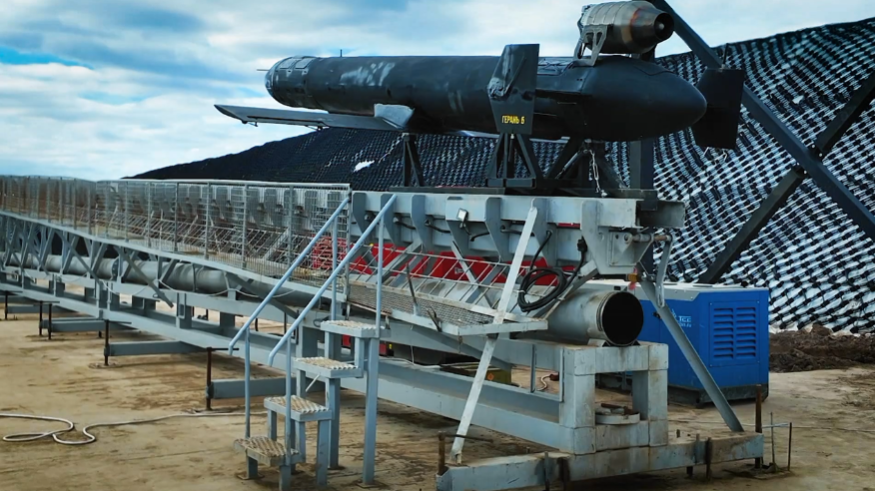
Iran was the first to field mass-produced jet-powered kamikaze drones in recent times with the Shahed-238 in 2023. The 238 was a jet-powered version of the Shahed-136, subsequently used in the Russia-Ukraine conflict. Russia later developed its own variants under the Geran series — The Geran-3, followed by the more advanced Geran-4 and Geran-5 in 2026. The Geran-5’s redesigned airframe resembles a cruise missile and can reportedly reach speeds of up to 600 kmph.
The development of these systems resembles a shift towards relatively low-cost, jet-powered long-range strike weapons. In October 2026, Ukrainian military intelligence disclosed details of Russia's new Filin cruise missile, which reportedly has a range of 1,200 km and a maximum speed of 800 kmph.
Savio Rodrigues
Savio Rodrigues is a Research Analyst at Escape Velocity MediaWorks Pvt Ltd and writes for Chakra News on Defence, Geopolitics, National Security. He holds a Master’s degree in International Relations from the University of Mumbai.



Comments