









China rejects Ladakh UT, reiterates 2019 stand; Integral, inalienable part of India says MEA

China on Tuesday reiterated that it does not recognise the Union Territory of Ladakh and has opposed India's latest move to give standard names to 28 places and geographical features in the region.
In response, India’s official spokesperson of the MEA Randhir Jaiswal said the Union Territory of Ladakh is an “integral and inalienable part of India”. He added that “no amount of denial by the Chinese side can change this established fact.”
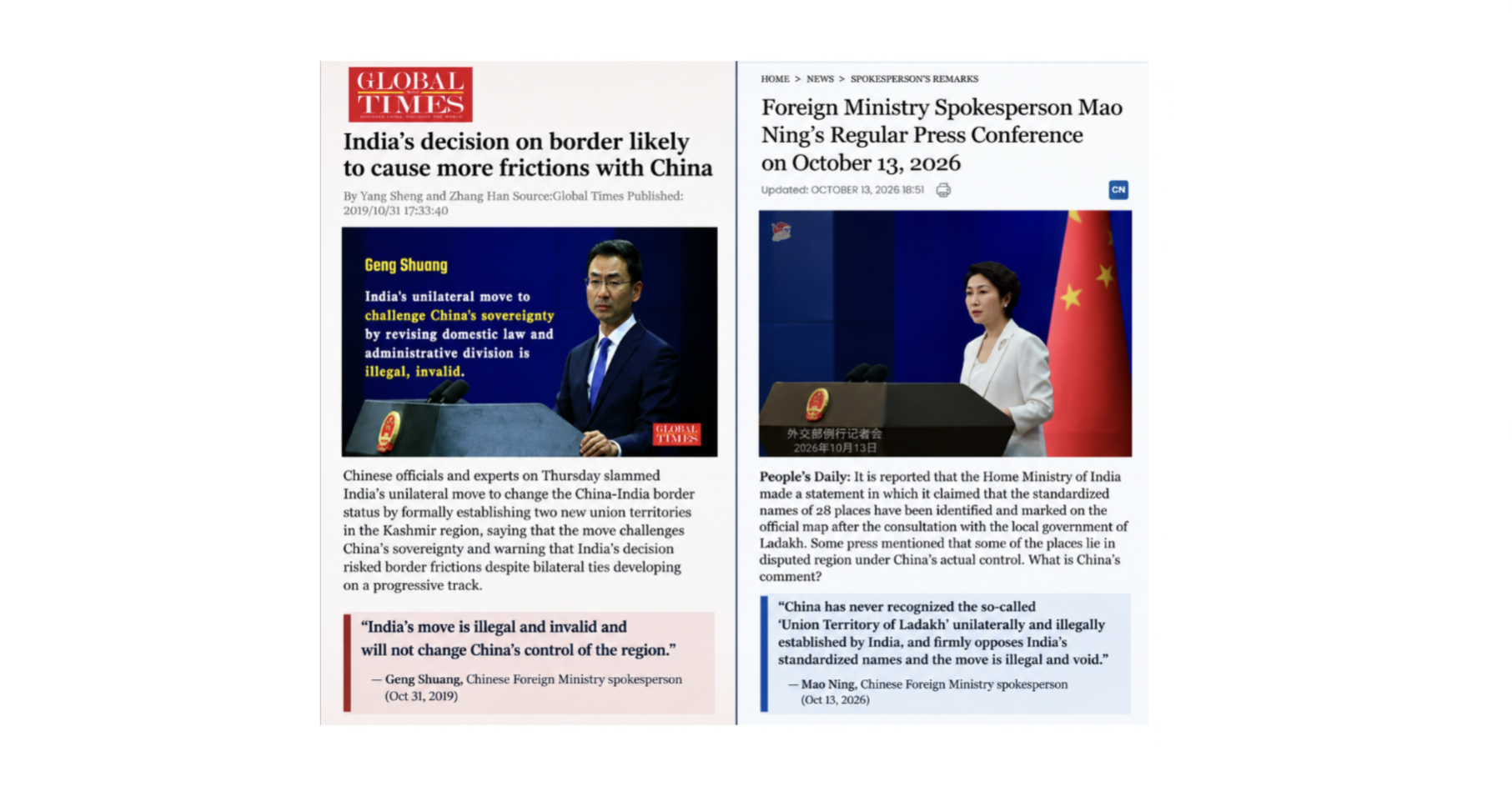
Chinese Foreign Ministry spokesperson Mao Ning said India had “unilaterally and illegally” established the so-called Union Territory of Ladakh. She was responding to India's decision to identify 28 places and features in Ladakh by standard names on the official Survey of India map.
Mao said China's position remained unchanged and that the Indian move could not alter what Beijing describes as the status of the western sector of the China-India boundary. She also called India's action “illegal and invalid,” saying the relevant areas have always belonged to China. It is reiterated that the UT of Ladakh is an integral and inalienable part of India. No amount of denial by the Chinese side can change this established fact.
China's latest statement repeats a position it took after India created the Ladakh Union Territory in 2019. On August 6, 2019, Chinese Foreign Ministry spokesperson Hua Chunying said China was “always opposed” to India's inclusion of what Beijing called Chinese territory in the western sector of the China-India boundary into India's administrative jurisdiction.
On October 2, 2026, India announced that 28 places and geographical features in Ladakh had been formally identified on the Survey of India map. It serves as a strategic assertion of Indian sovereignty and cartographic clarity along the disputed frontier, permanently documenting territorial claims to counter Chinese naming conventions. This list includes peaks, mountains, passes, glaciers, valleys, rivers, lakes and other land and water areas. Gogra and Hot Spring, which were among the friction points during the 2020 India-China military standoff, are also included.
Hua said China's position was “firm and consistent” and had not changed. She accused India of undermining China's territorial sovereignty by unilaterally changing its domestic law. China also said such a move was unacceptable and would not come into force.
The statement came shortly after Parliament passed the Jammu and Kashmir Reorganisation Bill in August 2019. The legislation divided the former state of Jammu and Kashmir into the Union Territories of Jammu and Kashmir and Ladakh. Ladakh formally became a Union Territory on October 31, 2019.
China therefore objected to India's administrative reorganisation of Ladakh from the beginning. Its latest statement shows that Beijing continues to use the same basic position while opposing India's latest mapping exercise.
India's move to put the 28 names on the official Survey of India map comes against the backdrop of the wider boundary dispute with China. The exercise was described by the government as a measure to ensure accurate recognition of the locations and improve public awareness about their names and geographical features. The exchange also reflects the continuing dispute over territory in the western sector, particularly eastern Ladakh, where Indian and Chinese forces faced off after the 2020 military standoff.
Savio Rodrigues
Savio Rodrigues is a Research Analyst at Escape Velocity MediaWorks Pvt Ltd and writes for Chakra News on Defence, Geopolitics, National Security. He holds a Master’s degree in International Relations from the University of Mumbai.




Comments