








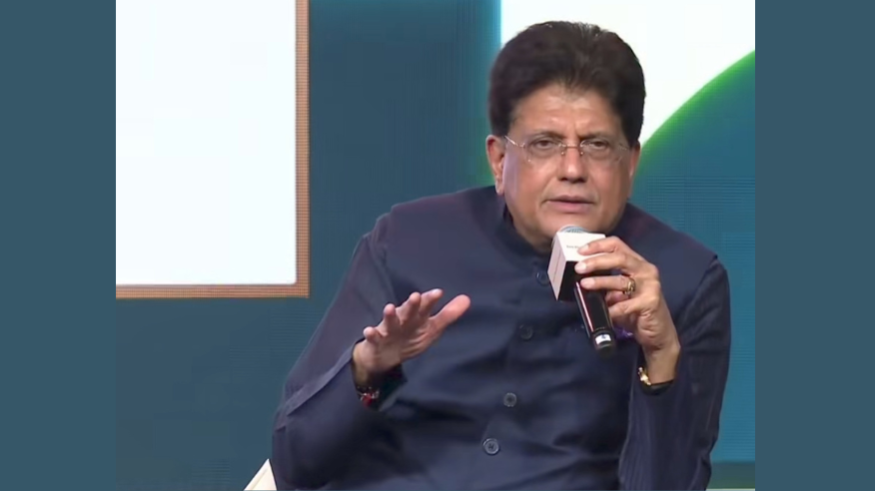
Andaman and Nicobar Islands economic bridge in Indo-Pacific: Piyush Goyal

Union Commerce and Industry Minister Piyush Goyal has called for a stronger economic focus on the Andaman and Nicobar Islands.
Addressing the Curtain Raiser of the upcoming Andaman Dialogue in New Delhi through a recorded message on Monday, Goyal said the global economy is undergoing major changes, with supply chains being reorganised and businesses placing greater emphasis on resilience, trusted partnerships and secure infrastructure.
The inaugural edition of the Andaman Dialogue is scheduled to be held in March 2027. The Andaman Dialogues is a regional platform focused on trade, financial connectivity and maritime resilience. The dialogues are being organised by the Mumbai-based think tank Forum for Integrated National Security (FINS) along with the Centre for Domestic Economy Policy Reseach (C-DEP).
Goyal said India has built its economic and trade policy over the past 12 years around three priorities: resilience, capacity and partnership. He said India is expanding infrastructure and building capabilities in strategic sectors such as shipbuilding, semiconductors, quantum technologies, critical minerals and biotechnology.
He also highlighted India's recent trade push, saying the country has concluded nine free trade agreements over the last four to five years, covering 38 developed and prosperous nations. According to Goyal, these agreements are aimed at reducing trade barriers and creating opportunities for farmers, fishermen, workers, professionals, women entrepreneurs, MSMEs and young people.
Goyal said the Andaman and Nicobar Islands can play a larger role in connecting India with the wider region. He proposed specialised working groups under the Andaman Dialogue focusing on trade, logistics, ports, shipping, regional infrastructure and finance.
These groups, he said, could map regional value chains, identify policy barriers and develop commercially viable projects involving countries across the region.
The Commerce and Industry Ministry will also facilitate engagement with trade and investment institutions, export promotion councils, industry bodies and chambers of commerce to take forward recommendations emerging from the dialogue, Goyal said.
Goyal also linked India's economic interests with maritime security. He noted that more than 80 percent of global merchandise trade by volume and over 90 percent of global data transmission depend on sea routes.
He said emerging challenges to maritime security, economic connectivity and regional resilience make a free, open, secure and rules-based maritime order a shared regional priority.
Admiral Dinesh Tripathi was the chief guest at the event. He highlighted the strategic importance of the Andaman Sea and its connection with regional economic activity. He said India's economic cooperation in the region will depend on the security of the maritime routes that support it.
Admiral Tripathi said the Andaman and Nicobar Islands occupy only about a quarter of one percent of India's land area but anchor nearly one third of India's Exclusive Economic Zone, covering around 600,000 square kilometres of ocean.
The islands also sit close to the Malacca and Singapore Straits, through which more than 100,000 vessels pass every year. Tripathi said the route carries a major share of global maritime trade and remains critical to India's economic interests.
He cited the disruption of shipping routes in the Persian Gulf as an example of the economic costs of maritime insecurity. Tripathi said 22 Indian-flagged vessels carrying more than 600 seafarers were in the western Persian Gulf during the crisis, with the Indian Navy working with government agencies and the shipping industry to ensure the safe movement of India-bound energy cargo.
He said maritime disruptions can raise insurance premiums and freight costs and cause delays far beyond the immediate area of a crisis. "Economic cooperation is only as strong as the security of the routes that carry it," Tripathi said.
Admiral Tripathi also highlighted India's growing maritime infrastructure. India's major ports handled around 950 million tonnes of cargo in 2025-26, around 7 percent higher than the previous year. He said the government has approved a Rs 69,725 crore package for shipbuilding and the maritime sector, including a Rs 25,000 crore Maritime Development Fund.
He said India's naval and commercial shipbuilding capabilities are closely connected because both sectors depend on the same workforce, steel, designers and suppliers.
Admiral Tripathi also pointed to growing regional cooperation. India-ASEAN trade reached around $128 billion in 2025-26, while India conducts coordinated maritime patrols with regional partners including Thailand.
He said India's upcoming chairmanship of the Indian Ocean Naval Symposium in 2027 will provide another channel of communication with regional partners.
Admiral Tripathi also highlighted the Information Fusion Centre for the Indian Ocean Region in Gurugram, which currently has liaison officers from around 16 to 17 partner countries. India plans to increase the number to 50 by 2028, he said.
Savio Rodrigues
Savio Rodrigues is a Research Analyst at Escape Velocity MediaWorks Pvt Ltd and writes for Chakra News on Defence, Geopolitics, National Security. He holds a Master’s degree in International Relations from the University of Mumbai.



Comments