









INDIA'S STRATEGIC AUTONOMY: THE PARADOX OF PARTNERSHIP

The US-China-Russia triangle remains a major driver of contemporary geopolitics. Their competition influences military alliances, technology controls, financial systems, energy markets and global supply chains. Yet viewing the emerging order primarily through this triangular lens risks overlooking a more consequential development: the redistribution of strategic agency across Eurasia, the Indo-Pacific and West Asia.
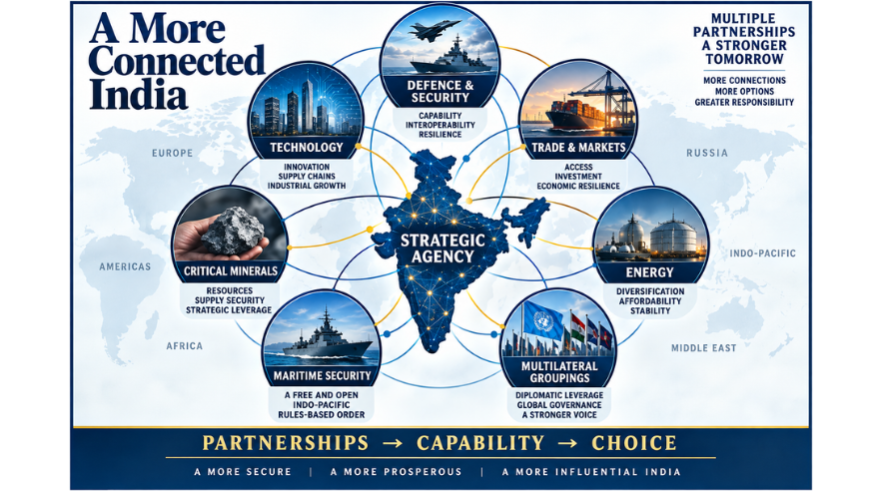
The world is no longer shaped only by decisions taken in Washington, Brussels, Beijing and Moscow. There are other powers that are acquiring greater capacity to influence outcomes. Geography, markets, energy, technology, critical minerals, manufacturing and military capability are creating new centres of leverage. Great-power competition remains central, but it now operates within a far more networked environment.
It is in this emerging order that India occupies an unusual position. It maintains a close and expanding relationship with the United States and its Indo-Pacific partners, while retaining a longstanding strategic relationship with Russia. It participates in BRICS and the Shanghai Cooperation Organisation, while engaging deeply with Europe, the Gulf and the wider Global South. Its expanding network of trade and economic relationships adds another layer to this architecture. India is therefore not operating within a single strategic framework, it is present in several at the same time. And therein lies the paradox. The more partnerships India develops to preserve its options, the more expectations those partnerships generate.
The Value Of Multiple Partnerships
There is considerable logic in India being present at multiple tables. Defence partnerships can bring access to technology, platforms, training and operational capabilities. Economic partnerships can open markets, attract investment and diversify supply chains. Multilateral groupings give India platforms, from which it can shape discussions rather than merely respond to them.
This should not be mistaken for an attempt to keep every major power equally satisfied. Nor should strategic autonomy be interpreted as equidistance. India's relationships serve different purposes. The Quad, BRICS and SCO do not perform identical functions.
Nor do India's relationships with the United States, Russia, France, Japan or the Gulf states rest on the same combination of security, technology, energy, trade and geopolitical interests. Their simultaneous pursuit is not inherently contradictory. India's own foreign-policy formulation has long linked national security and prosperity with the preservation of strategic space and autonomy. The real question is more difficult: what do these partnerships collectively do to India's freedom of action?
When Partnerships Create Expectations
Every partnership comes with its own set of expectations. A certain defence relationship may provide valuable capability, but it can also generate expectations regarding interoperability, operational cooperation or strategic convergence. An economic agreement may widen market access, but it can affect India's room for manoeuvre on tariffs, standards, investment and domestic industry.
India's expanding engagement with the West illustrates both sides of this equation. Access to capital, advanced technology, markets and resilient supply chains serves important economic and strategic interests. Closer cooperation with the United States and European powers also strengthens India's ability to respond to a changing Asian security environment. The Quad provides a platform for cooperation in the Indo-Pacific, including maritime security and critical and emerging technologies. The India-US Initiative on Critical and Emerging Technologies, alongside India's expanding trade engagement with Europe, shows how economic, technological and security interests are increasingly converging.
The India-France relationship offers another illustration. It has expanded beyond major platforms such as Rafale and Scorpene into areas including defence space, while cooperation and discussions extend to engines, ammunition and surveillance technologies. Such relationships can deepen capability and industrial capacity. They also create long-term requirements for sustainment, technology integration and interoperability. The challenge is to ensure that such interdependence strengthens Indian capability rather than creates vulnerabilities.
The same logic applies to economic partnerships. The India-EU Free Trade Agreement negotiations concluded in January 2026, creating the framework for substantially deeper economic engagement. Such arrangements can expand markets and diversify supply chains. Their cumulative commitments, however, require careful management of domestic industry and economic policy space.
Strategic groupings create their own expectations. The United States and its Indo-Pacific partners attach importance to India's role in shaping the regional balance. Russia places value on preserving its longstanding strategic relationship with India. BRICS provides a platform for countries seeking greater influence in global governance. European partners increasingly see India as an important economic, technological and strategic partner. The Gulf states have their own expectations centred on trade, investment, energy, technology and regional stability. These interests overlap in some areas and diverge in some others.
Strategic relevance carries a price. The more valuable India becomes to different partners, the more consequential its refusal to accommodate their expectations can become. Strategic autonomy is therefore not simply the ability to maintain multiple relationships.
It is the ability to manage the expectations arising from those relationships without surrendering independent judgement.
Does Interdependence Dilute Autonomy?
Not necessarily. Complete independence is neither possible nor desirable in an interconnected global economy. India will remain dependent on external sources for some energy, technology, capital, components and markets. No modern military can be entirely self-sufficient in every technology or capability either. Interdependence is not the opposite of strategic autonomy. Unmanageable dependence is.
A diversified defence relationship can reduce dependence on any single supplier. Multiple economic partnerships can provide alternative markets and supply chains. Technology partnerships can accelerate capability development. But diversification has to be accompanied by resilience. If different defence relationships create excessive dependence on foreign spares, software, ammunition, upgrades or specialised components, diversification may merely replace one vulnerability with several.
Similarly, trade agreements that increase market access can be beneficial, but their cumulative effect on domestic manufacturing, critical sectors and policy space requires careful assessment. Counting partnerships tells us very little. What matters is whether they increase India's capability, resilience and decision-making agency.
National Interest As The Anchor
This brings us to the central principle. India's partnerships are instruments of national strategy; they are not ends in themselves.
Membership of a grouping should provide India with influence, capability, access or diplomatic leverage. A defence partnership should strengthen national security. An economic agreement should contribute to prosperity and resilience. A technology relationship should build capability rather than perpetuate dependence. The test is straightforward: Does the relationship expand India's choices or progressively define them?
This does not mean that India can avoid difficult compromises. Foreign policy inevitably involves trade-offs. Security may require a decision that carries an economic cost. Economic opportunity may create strategic vulnerability. A diplomatic position may improve one relationship while complicating another. Strategic autonomy does not eliminate these trade-offs. It ensures that India makes them on its own terms. That is why strategic autonomy cannot rest upon diplomacy alone.
Autonomy Requires Capability
A country cannot preserve freedom of action indefinitely if it lacks the economic, technological and military capacity to exercise it.
Strategic autonomy therefore has a hard-power foundation. Indigenous defence production, resilient supply chains, technological competence, energy security, critical-mineral access, manufacturing strength, secure communications and financial resilience all contribute to the space within which foreign-policy choices can be made.
Diplomatic flexibility without national capability can eventually become dependence disguised as autonomy. India's growing emphasis on domestic manufacturing and technology, while simultaneously expanding external partnerships, reflects this reality.
The objective should be the capacity to engage the world without becoming captive to any particular external source of capability.
This is an important evolution in the meaning of autonomy. In an interconnected world, absolute independence is increasingly unrealistic. What matters is preserving sufficient strategic agency to make independent choices within conditions of unavoidable interdependence.
The New Meaning Of Strategic Autonomy
States will increasingly cooperate with one another in some areas while competing in others. Few relationships will remain neatly compartmentalised. Nor is a neat multipolar balance guaranteed. India's challenge is to navigate this environment without confusing participation with alignment.
India does not need fewer partnerships. It needs partnerships that leave it room to manoeuvre. The objective should be to derive maximum strategic value from them while retaining the freedom to disagree, diversify or choose differently when India's national interests require it.
The test of strategic autonomy is therefore not whether India can keep every partner comfortable. It is whether India can make an uncomfortable choice when its national interest demands it.
In the emerging order, the strategically autonomous state will not necessarily be the one with the fewest partnerships.
Nor will it be the one with the most. It will be the state whose partnerships expand its choices without defining them. For India, that is the real paradox of partnership—and perhaps the defining test of strategic autonomy in the decades ahead.
Lt Gen Tarun Chawla
Former Director General Artillery, DG Financial Planning of Indian Army



Comments