








90% of MiG-29K issues sorted out, says former Flag Officer Naval Aviation

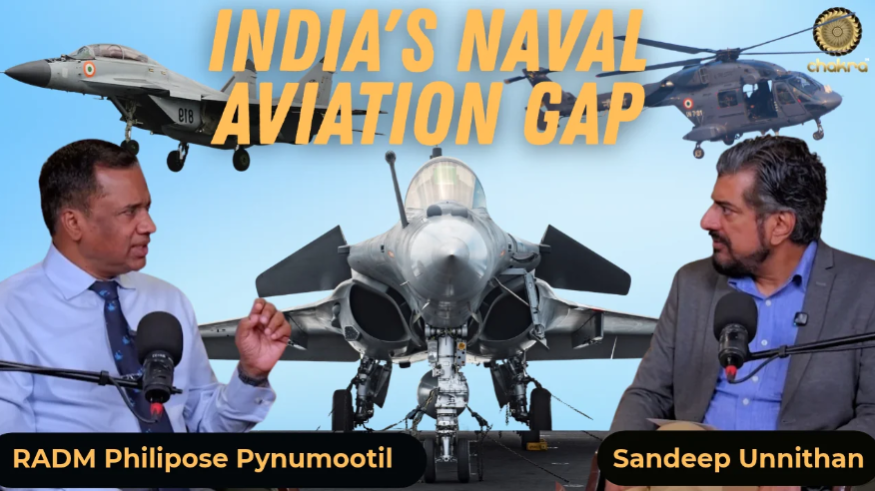
Around 90% of the initial technical problems with the Indian Navy's MiG-29K fighter aircraft have been resolved, according to former Flag Officer Naval Aviation Rear Admiral Philipose George Pynumootil. “I would say to 90% these issues have been sorted out,” he said in a conversation on The Sandeep Unnithan Show.
The MiG-29K fleet faced structural problems during its initial years of service. These included cracks in the engine mounts and radar mounts. Pynumootil said the mounts were subsequently replaced with titanium components. He also acknowledged the negative reports surrounding the aircraft but said the problems had been addressed. “Now, if you see, there's nothing negative emanating as far as the MiG-29K is concerned,” he said.
Pynumootil served as Flag Officer Naval Aviation from February 2018 to April 2022. During this period, he also held charge as Flag Officer Commanding Goa Naval Area. He served in the Indian Navy for 36 years before retiring in April 2022.
Pynumootil said the MiG-29K still has considerable service life left. The aircraft entered Indian Navy service in 2012. India had acquired 45 aircraft, of which around 40 remain in the fleet. He pointed out that a fighter aircraft typically has a life cycle of 25 to 30 years. Asked how much longer the existing fleet could operate, he said, “Another decade? Easily another decade.”
The Navy's incoming Rafale-M fighters are therefore not intended to replace the MiG-29Ks. India is acquiring 26 Rafale-M aircraft for its two aircraft carriers, INS Vikramaditya and INS Vikrant. “So, then why, no way are they replacing the MiG-29. So, they'll augment the MiG-29,” Pynumootil said.
He said the Navy needs more than 50 additional deck-based fighters to meet the requirements of both carriers. The 26 Rafale-M aircraft would meet only around half of this requirement. He also ruled out further purchases of the MiG-29K. “No, MiG-29Ks no way. It will be Rafale and more Rafales,” he said.
Pynumootil defended the MiG-29K's capabilities, pointing to its manoeuvrability and performance in close combat exercises. He said the aircraft had even outflown the F-35 during close-combat engagements. “The MiG-29 outflew the F-35 in close combat. So, manoeuvrability-wise, it was actually better,” he said. He added that the aircraft could become a more formidable platform with modern weapons. The Navy has already integrated the Israeli Rampage missile, while the Astra missile is expected to add to its capabilities.
He also discussed the limitations of India's naval Light Combat Aircraft programme. The LCA Navy's undercarriage was strengthened to withstand the impact of carrier landings. However, Pynumootil said the design was overcompensated, adding around 600 kg to the aircraft. This reduced its fuel and weapons-carrying capacity.
He said a fighter operating from an aircraft carrier must be capable of maintaining a combat air patrol for at least 45 minutes to an hour. “So, if you can't even do 45 minutes of a CAP, what's the point of having…” he said. He agreed that the LCA Navy configuration could not meet this requirement. “Exactly, exactly. That's the problem with the aircraft,” he added.
The discussion then turned to the Navy's shortage of helicopters. Pynumootil said the Navy needs at least 35 light helicopters to meet its operational requirements. However, maintaining 35 aircraft in service would require a fleet of around 60, given the number that would be undergoing maintenance.
He also raised concerns over the naval variant of the Advanced Light Helicopter (ALH). While he praised its cockpit and overall capabilities, he identified the absence of a suitable blade-folding system as a major limitation for ship-based operations. “Without the blades folding, the blade fold is the bugbear.
And it's a big problem. And you can't have that,” he said. He added that the Navy had been waiting for a solution for years. “They've been saying this for the last 10 years.”
For the larger helicopter requirement, the Navy is pursuing a Deck Based Multi-Role Helicopter (DBMRH) programme. Pynumootil said the indicative requirement could include around 90 anti-submarine warfare helicopters and 30 commando variants. The Navy and Coast Guard are also looking at around 70 to 75 helicopters in the 4.5 to 5-tonne category.
He explained that naval helicopters require specialised features because they operate in a demanding maritime environment. These include strengthened undercarriages, blade-folding systems, deck-traversing equipment and sensors such as radar, sonar and electronic support measures. “We are the most painful customers, the Navy worldwide, the demands are the most,” he said.
Pynumootil also called for greater use of unmanned aircraft to support manned helicopter operations. He suggested that platforms such as the Schiebel S-100 could take over routine surveillance tasks, particularly for the Coast Guard. “So now if a Coast Guard guy is going and doing a Bombay High surveillance, which he would have taken, say, three, four days, he can do it in five hours,” he said.
He favoured a mix of manned helicopters and unmanned platforms rather than replacing one with the other. This, he said, would allow the Navy and Coast Guard to use manned aircraft for demanding operational tasks while unmanned systems handle longer surveillance missions.
Watch the Full Podcast: https://youtu.be/9vtnR68jzrA?si=zS1RoRSsybHWMhTR
Savio Rodrigues
Savio Rodrigues is a Research Analyst at Escape Velocity MediaWorks Pvt Ltd and writes for Chakra News on Defence, Geopolitics, National Security. He holds a Master’s degree in International Relations from the University of Mumbai.


Comments