








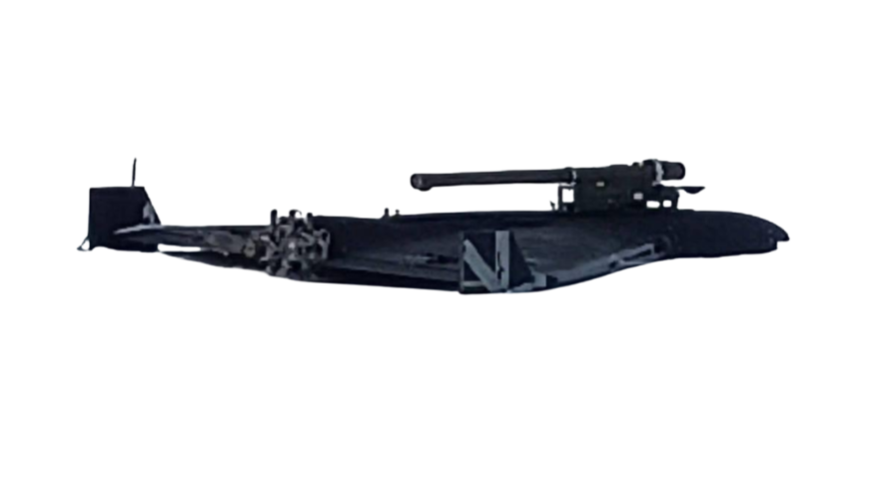
Air-to-air missiles, meshed networks- How Russia is upgrading its Geran-2 kamikaze drones

Russia has begun fielding advanced versions of the Geran-2 one-way attack drones featuring anti-aircraft missiles and meshed networks. These are among the most sophisticated versions of the 3.5 metre long and 2.5 metre wingspan Geran-2, a Russian version of the Iranian Shahed-136 drone. The Geran-2 is a distinctive delta-wing, pusher-propeller design hurling s a 50 kg warhead to a distance of 2,500 km. It has become the mainstay of Russia’s war against Ukraine.
DATA-LINKED DRONES
Of far greater significance are Geran-2 drones integrated with a datalink with mesh technology. Rather than relying on linear transmission chains, they make use of a web of distributed nodes that dynamically route traffic and can compensate for the loss or degradation of individual elements.
In a Substack article, author Fabian Hinz mentions that Mesh networks take the logic of airborne relays a step further. Russia first deployed UAV-based mesh networking in 2025, when it equipped the Alabuga-built Gerbera decoy UAV with Chinese-made imaging systems and mesh network modems. The resulting system functioned as a low-cost fixed-wing ISR platform, while also providing practical experience with mesh network-enabled UAV operations. The volume of downed Gerberas configured in this manner, along with the prevalence of mesh network modems for resale on Ukrainian online platforms, suggests the system has been adopted at scale.
By mid-2025, Russia had adapted this technology for use on Geran-2 OWA-UAVs. Imagery of recovered debris and in-flight footage emerging around that time showed Geran-2s fitted with the same type of mesh network modems, thermal imagers, and antenna pairs used on ISR Gerbera variants. Taken together, these modifications provide the Geran-2 with both a payload data link and an onboard imaging capability, enabling loitering-munition-style employment with operator control. Notably, this was not Russia’s first consideration of a loitering derivative of the Shahed design.
Iran had previously proposed a loitering variant, the Shahed-236, intended to operate in conjunction with an airborne relay. As with jet-powered Shahed variants, however, Russia appears to have declined the Iranian design in favour of developing a domestic solution. Russia’s domestic loitering Geran-2 variant allowed the country to transform an OWA-UAV system already produced at a significant scale into a loitering effector suitable for employment in the mid-range strike role (approximately 50-200km).
DRONE-PADS
In December 2025, Ukraine had intercepted a Russian Geran-2 drone carrying a Vympel R-60 (NATO name: AA-8 Aphid) air-to-air missile. The missile has a range of 4 km. The configuration was likely intended as a countermeasure against Ukrainian fixed-wing and rotary assets tasked with countering OWA-UAVs. It has started fitting MANPADS (Man-Portable Air Defence Systems) to its Geran-2 drones. This crude arrangement allows the drone to shoot at Ukrainian helicopters sent in to intercept them. The drones carry a camera and a radio modem. The missile is activated by an operator sitting in Russian territory. There is no evidence of this system having brought down a helicopter, but it was discovered on a Geran downed by Ukrainian forces in the snowy terrain in the Ukrainian Battlefield. The exact location of the downed drone is not known, but the drone is known to have been operating in the Donetsk region and Eastern Ukraine.
The drones are manufactured at Russia’s Alabuga facility. By mid-2025, Russia has produced hundreds of Geran-2 drones daily and targeted around 40,000 drone production in 2025.
The Igla MANPADS is designed to destroy all types of aircraft and helicopters, as well as small air targets such as cruise missiles at any time of the day when they are visually visible on head-on and catch-up courses in conditions of background and artificial thermal interference. The range of Igla is from 500 m to 6 km for engaging targets.
Arjun Dev Singh
Arjun Dev Singh has a deep interest in defence, security, and strategic affairs. With a strong analytical lens and a passion for military and geopolitical developments, Arjun strives to bring clarity and context to complex national and international issues.




Comments