



The Indian Navy’s Next Battle: From Platforms to Algorithms

The Sandeep Unnithan Show
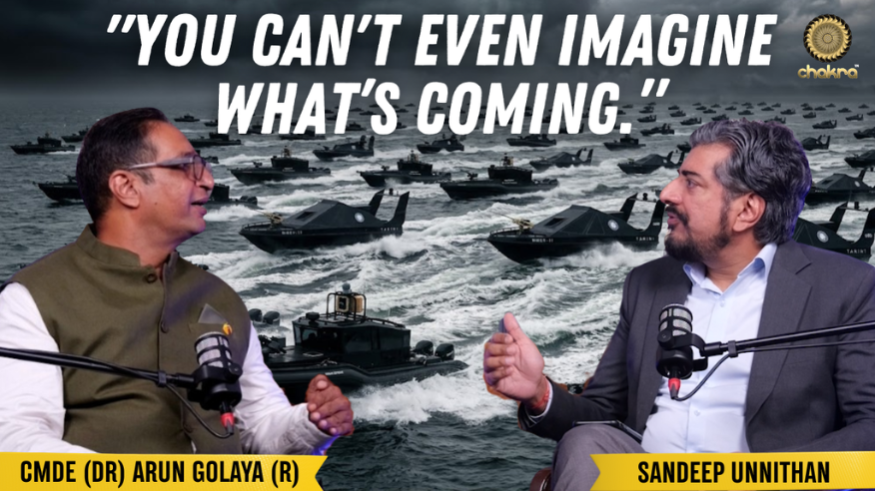
Feat. Cmde (Dr) Arun Pratap Golaya (Retd), A distinguished analyst and writer, with three decades of experience in the Indian Navy.
Sandeep Unnithan: Hello and welcome to the Sandeep Unnithan show, your weekly dose of defence, geopolitics and much more. Today I have with me on my show Commodore Arun Golaya. Commodore Golaya was in the NSCS for eight years where he steered technology projects and more importantly after that he was there in the Indian Naval Technology Development Acceleration Cell or TDAC. So, we're going to talk to Commodore Golaya about technology and what makes the Navy so ahead of the pack. Commodore Golaya, welcome to my show.
Arun Golaya: Thank you, pleasure being here.
Sandeep Unnithan: Commodore Golaya, straight off, why is the Navy ahead of the other two services when it comes to technology absorption? And this is something that my friends in the Air Force and the Army tell me that the Navy is ahead of us when it comes to Atma-Nirbharta, technology absorption, you've set up some very incredible organizations which we'll talk about but fundamentally why is the Navy ahead of the other two services?
Arun Golaya: So that's a difficult question to answer. So, before I come to the Indian Navy or the Indian, you know, the Indian Air Force and the Indian Army and I won't say we are ahead because you know otherwise it'll be inter-service rivalry. I'll come to that later. But I think globally, the navies are always or always have been ahead. Even you see the US example. In fact, I posted on this on Twitter a few days back saying if you see the US Navy, the US Navy has topped the US government patent portfolio for many years and you know, in 15 years at a go, they've topped this thing. So why are navies, not just the Indian Navy? I think a number of historical reasons for that also. One, I would say, you know, in the days of the sail and even before that, so when a ship sailed out, communication ashore was almost impossible.
Sandeep Unnithan: Right. So, the ship is self-contained.
Arun Golaya: Ship has to be self-contained. So, when the ship has sailed out, you do not get orders or you cannot, the commanding officer is the one who is, who has to take all decisions. Right. So that's one, that matters. A second thing is they have to be self-contained for repairs also. So that means, if you have a part defective and that spare is not available, you obviously have to make do and be self-sufficient. So that, that is the second thing, which I think it affects the mindset. The third thing, I think many people have said it in different ways, but essentially the quote is that in the army, when the orders are passed, the discussion stops.
Sandeep Unnithan: Right.
Arun Golaya: In the Navy, when the orders are passed, the discussion starts. Right. So that it's a US Navy quote. No. So what that essentially implies is that again, by the nature of the job, nobody can know everything. Right. So, a captain of a ship would be knowing a bit about everything, you know, a bit about the weapons, a bit about the radars, quite a bit. Right. A bit about communication, a bit about ASW, a bit about gunnery. But then he has his full team of specialist officers. Right. To advise him. And they expected to advise, he's supposed to get specialist advice. And not only from the officers, even the men. So, for example, a particular engine, there might be an ERA.
Sandeep Unnithan: Yeah.
Arun Golaya: Who is an absolute expert on that, you know.
Sandeep Unnithan: Artificers, you're talking about the artificers. I'm talking about the artificers. Oh my God, what a carder.
Arun Golaya: Quite a few, you know, the sailors also have their own niche expertise. Right. And the captain would lean to them for advice. Yes. Right. So, unlike the other services, where I don't think it happens to that extent, where, you know, where the commanding officer's word is law, and that's a requirement. I'm not saying there's anything wrong with that. But that's, you know, in a fighter cockpit, for example, the fighter pilot would be alone. He has to believe he's the best in case he has to survive. Right. He has to have that cockiness about him. In the Navy, on the other hand, you have, you're dependent on everybody.
Sandeep Unnithan: Right. So, you're heading an organization.
Arun Golaya: Heading an organization and teamwork. So, you get used to seeking advice and listening to advice. So, I think that makes a difference. Second thing is, again, by virtue of the fact that you always work in close quarters, and confined spaces, and everybody's there. Right. So, for example, so now, Agniveer might be making a report to the Admiral, right, on the flagship. So, the hierarchy automatically becomes much more flattened. Right. Unlike, say, in the Army, where, you know, it's a very, very steep hierarchy.
Sandeep Unnithan: And Agniveer will probably never see a General.
Arun Golaya: Never see a, might not even, you know, so that way, it's a very, very flat hierarchy. And this will be across navies. Right. So, all these factors, I think, go to make naval officers more receptive. To this thing. Coming to the Indian Navy, specifically as, you know, why has the Indian Navy, you're a naval child yourself. Your father was in the Navy. Right. And a navigator.
Sandeep Unnithan: Yes. So, I'm not a technical officer.
Arun Golaya: Right. But, you know, at the time of independence, and most people don't know this. Right. Because I've heard people say that, you know, but navies always had the institutes.
Sandeep Unnithan: It was here.
Arun Golaya: You had the warship design bureau. We didn't. Right. We didn't. At the time of independence, so HAL, in its previous avatar, when it was a private this thing, existed before independence. Pre-independence.
Sandeep Unnithan: It was set up in the 30s.
Arun Golaya: Yes. Our first aircraft. Yeah. The trainer, HG-2, flew in 51.
Sandeep Unnithan: Right.
Arun Golaya: Our first fighter was made in 61. That's much before. If you see the defence industrial ecosystem. Yeah. Other than Japan, which of course was a access part for the allies, the biggest defence industrial ecosystem in Asia. Right. Was in India, not in China. All the repairs, all the MROs, all the manufacture of the arms and ammunition. Right. The ordnance factories go back a long time. Yes. And during the Second World War, not only were we totally self-sufficient, but we were also supplying the other British colonies for when it came to, you know, weapons.
Sandeep Unnithan: Right. So, we had a fairly well-developed defence industry.
Arun Golaya: We had a fairly well-developed defence industry. Right. And yet, the navy did not really have much.So, navy was a late starter, you were telling me. It was a late starter in the sense that I wouldn't say we were a late starter. But what happened is that, okay, those Indian shipbuilders, the Wadiyas, for example, they have, you know, they were world-famous shipbuilders in India. I'm not even talking about, you know, the dry dock in Lothal and all that. But even if you talk about just 200 years back, 150 years back, but they were, because they used to make high-quality ships of teak wood.
Sandeep Unnithan: The HMS Trincomalee. Yes. It's one of the original teak ships.
Arun Golaya: Oh, so many more important, historically important ones, the American Declaration was signed on. Okay. So, but the transition when it happened from there, from the day, the age of sail to the steam. And from wood to metal. Yeah. That's the time the Indian shipyards, and the British did it consciously to protect their own shipbuilding industry. So, at the time of independence, we did not have, we virtually had nothing to speak of. Quite a few of our training establishments also went to, they were based around Karachi. So, they went post-independence to Pakistan.
So, we had to start more or less from scratch. Even, you know, tying up with IITs to have courses started for naval construction, setting up first, you know, initially, when we started off, we started off with a very small Directorate of Naval Design, which later became the Warship Design Bureau. So, starting from construction, when Vessi was set up, that was to integrate equipment from various diverse sources, you know, because we had a ship which would be, the hull could be indigenous, but then you had equipment from East, West, East, West, and in West also from various countries, like Netherlands.
IP10 was Italian. Right, Italian. So, Netherlands. So, all these institutions had to be set up. So, I think, I just wanted to clarify that when people say, you know, you've always had it. We probably were late starters. And then we caught up and then, of course, took the lead.
Sandeep Unnithan: Accelerated. Accelerated.
Arun Golaya: Which probably brings me to the next thing, which the NIIO, the Naval Innovation and Indigenization Organization. When that was set up, I mean, it's a long story, can't possibly go into details. But people again ask that Navy's always been at the forefront of indigenization.
Why do you need a separate organization? But NIIO did two things. One, so NIIO is, I would say, more than an organization. It is a thought. People used to ask me when I was OIC TDAC that, where is NIIO's office? You know, NIIO doesn't have an office. So, all the existing organizations which are there, including WESI, the Directorate of Indigenization, the Armament Indigenization, all those directorates, they come together. And it is a three-tiered organization. So, it's chaired by the Vice Chief, but you meet once in six months at the apex level. And below that, then you'll have every two months, you'll have a meeting of the working group. And there were two things which happened. One, the element of innovation was added.
Indigenization is good, indigenization is important, but innovation, realizing that innovation is going to be important in the future. I think, and since now, it's been six years since it was set up. So, one is innovation was set up, was institutionalized. More importantly, you know, this word, acceleration. I was heading the technology development acceleration cell, not the technology development cell. And as I said, I'm not a technical officer. Or the apex body of NIIO is the NTAC, the Naval Technology Acceleration Council. So, I think a lot of thought process also went into, it's not about technology, it's about acceleration. So, the realization that, you know, the things are changing fast.
And unless you can accelerate, which means it's not only about technology, it's also about policies, it's about procurement, it's about integration into operations. So, everything has to be done faster. So, this also, I think, almost six and a half years back now. So, six years back, if you realize that it, you know, people now are talking about that you need to accelerate, or you need to, you know, the pace of change of technology. But six years back, if the structure was made, that means, obviously, the realization would have come a decade back.
Sandeep Unnithan: So, what you're saying, very interesting, Commodore Goliath. The fact is that the Navy has always been Atmanirbhar, at least for more than half a century, 50-60 years, you started building your own ships when? In the 70s? 72? INS Nilgiri?
Arun Golaya: So, no, I would say even before that. If you start with, you know, first the Seaward Defense.
Sandeep Unnithan: First STB.
Arun Golaya: Yeah, STB.
Sandeep Unnithan: Ajay, right?
Arun Golaya: Ajay, and they were later gifted to Bangladesh. Bangladesh just got independence in 71. So, if you include that, that would also be not only a first, it wasn't a capital warship, it was a warship. And that also became, in a way, a first defense export in the sense that another country was using it. So, we started with that. Thereafter, of course, you mentioned the Giris. So, Giris were made on a Leander design.
Sandeep Unnithan: Yeah, a British design.
Arun Golaya: A British Leander design, which has been a very, the most, probably the most successful design.
Sandeep Unnithan: Western design.
Arun Golaya: Western design, British design. So, it was like transfer of technology. They gave us a blueprint and we built on that.
Sandeep Unnithan: And we innovated on that.
Arun Golaya: Exactly. We stretched it. So, that's the point I'm coming to.
Sandeep Unnithan: We got one Sea King, we got two Sea Kings.
Arun Golaya: So, if you see, and I was a navigating officer on Himgiri, where, you know, quite a few things, it was more like a bread box of this thing. So, everything was being experimented on that ship. Right? The later two, three Giris stabilized. But after that, the last two Giris, the Tara Giri and Vindhya Giri, they were made longer. Right. So, as to take a Sea King, because the Sea Kings had just come in.
Sandeep Unnithan: Right. The Sea King is a 10 ton class helicopter, right? It's a, it's a heavy machine.
Arun Golaya: No, I think it would be more, right? If I'm not wrong, yeah. So, it'll be, so I would have to check up, but I think substantially more.
Sandeep Unnithan: Right. So, you had to strengthen the decks and you had to increase the length of the hanger, all of those things.
Arun Golaya: Yes. And also, it's not only that, the Godavari class, which came after that, had a twin hanger for the Sea Kings. In addition, it had the missiles. Right. So, you know, it's not that when you took technology, you also then built upon it and made something uniquely Indian.
Sandeep Unnithan: So, it's spiral development.
Arun Golaya: Spiral development.
Sandeep Unnithan: So, this is, so, you know, a lot of organizations, like you mentioned, were set up along the way, like WESI was one great example. What are the other organizations that the Navy set up, which possibly have no parallel in the other services? And you know, what are the lessons that you can learn from the Indian Navy's journey of the last 50, 60 years?
Arun Golaya: So, if I can name just the organizations, which I have been a part of.
Sandeep Unnithan: Right.
Arun Golaya: Right. So, the Navy set up the Directorate of Net-Centric Operations.
Sandeep Unnithan: Right.
Arun Golaya: In 2006.
Sandeep Unnithan: So… Tell us what that organization does and, you know, why it's so important.
Arun Golaya: So, the Directorate of Net-Centric Operations, when it was set up, it was, I don't know if you've heard of them, Commodore Ahluwalia and Commander Mundical
Sandeep Unnithan: He wrote the algorithms?
Arun Golaya: He wrote, initially he wrote something which was called Sangharsh and thereafter Trigun
Sandeep Unnithan: Trigun.
Arun Golaya: Thereafter, source code of Trigun as well as, we handed over everything to BRDU and in fact, took classes for them also about care for institutional support. So, I think the thought process behind DNCO or the Directorate of Net-Centric Operations was one, DNCO was essentially a group of mavericks who were just picked up and put together and told do what you want.
Sandeep Unnithan: Right.
Arun Golaya: And it was fully supported from the top. It was set up when Admiral Arun Prakash was the Chief of Naval Staff followed by Admiral Suresh Mehta, but it was totally, you know, the CNS was backing that, okay, let these youngsters do, and they achieved much beyond the wildest dreams. So, I happened to be one of the initial six, seven officers who were posted to DNCO, but DNCO was, I would say, again, way ahead of its time. Right. When it was set up, the Directorate of Net-Centric Operations. Similarly, with TDAC. TDAC, again, was absolutely top-driven. Right. Admiral K.B. Singh, who was the Chief of the Naval Staff at that time and Admiral Ashok, who was the vice-chief.
Sandeep Unnithan: 2022, right? 2020. 2020. What is TDAC? You know, give us an idea of what it is. You were part of TDAC for four years.
Arun Golaya: Again, I think TDAC, I mean, I'm not going to the, you know, the laid-down role. Right. Which, of course, is there. But more importantly, I think TDAC was, again, a bunch of mavericks who were given a lot of freedom. To do what they wanted. Right. The problem is that everybody gets so engrossed in your day-to-day running and day-to-day firefighting, if I can call it that, that you don't have time to think and you don't have time. So, TDAC was an organization which was set up with a willingness to fail.
Sandeep Unnithan: Right.
Arun Golaya: In fact, it says as much that we set up an organization.
Sandeep Unnithan: A willingness to fail.
Arun Golaya: It was set up with a willingness to fail because innovation, obviously, is risky. Right. And just about three, four officers. Other than that, so, we like acronyms. So, we came up with a thing called VISTAR.
Sandeep Unnithan: Right.
Arun Golaya: VISTAR was Extended Arm of TDAC, which was essentially volunteers. Yeah. First, it was a acronym, again, like SPRINT. So, we first thought of VISTAR and then fit the alphabets. But it stood for Volunteer Innovator Sook Scholar for Technology Acceleration Research, which meant essentially people in the field… Right. On whichever ship, in addition to the duties, they were doing, helping out TDAC. Yeah. So, this was supposed to, one, channel all in-house naval innovation. Right. Especially in the… So, all the patents. So, I'm not sure if you're aware, but about 100 patents, more than 100 patents have been filed by naval officers since the NIA was set up.
Sandeep Unnithan: And this would be bigger than any other service… Yes. …in terms of patents.
Arun Golaya: By far. By far. And so, they were supposed to do that. They were supposed to interact with the academia and the industry. They were supposed to look at the fight component. Right. And Missiles, guns, that part. Yes, not only… Torpedoes. So, again, what we realized is, because of the historical reasons, the Navy has an advantage. I mean, when we say, you know, Navy has been ahead, but we have to… Granted, the Navy has an advantage in the sense that it is very easy to compartmentalize… Right. …into, to float, to move, to fight for the Navy, as opposed to, say, an aircraft. Right. I mean, you can't really, in an aircraft, you can't say that, okay, we'll just make the fuselage and engine will come from somewhere and the weapons will come from… You can, of course. Yes. But Navy, because the ship's life is 40 years. Yeah. In that, it will go, or 25 years, 30 years, depending on what kind of a ship. But it will undergo multiple upgrades. Right. So, it is very amenable to have an indigenous radar, you know, 10 years or 15 years after the ship was commissioned. So, that's one advantage. But when we took this path of to float, to move, to fight… Right. …and we focused initially on the float component, over a period of time, it was realized that our ships were more or less indigenous, the float component. Move, not so much. Yeah. But move is not only the prime mover, not only the engine, but, you know, the… Yeah, the…
Sandeep Unnithan: Power generation and everything.
Arun Golaya: And there also, we were somewhere but the fight component…
Sandeep Unnithan: Right.
Arun Golaya: Which is the weapons and the sensors was, to a quite a large extent, still important… Right. …which is now, it's changing, you know. Right. BrahMos is one prime example of the missiles.
Sandeep Unnithan: Right. But we're getting indigenous radars and everything. Yeah.
Arun Golaya: So, to focus on the fight component and to focus on the innovation part of it, that means in-house. So, it's not that the other branches or the other directors are not looking after…
Sandeep Unnithan: Yeah.
Arun Golaya: The fight component. They do, certainly.
Sandeep Unnithan: Right.
Arun Golaya: But NIIO was to specifically look at that.
Sandeep Unnithan: Right. And what are the other organizations again? These organizations that you mentioned, NIO, they have no paddle in the other services? I would say yes and no. Right.
Arun Golaya: In the sense that the Army has the Army Design Bureau, the ADB.
Sandeep Unnithan: That's right, yes.
Arun Golaya: So, there would be a bit of overlap with what NIIO does in the ADB.
Sandeep Unnithan: Yeah.
Arun Golaya: The Air Force has set up the Directorate of Aeronautics and DAD.
Sandeep Unnithan: Right.
Arun Golaya: Right. So, DAD also again has some overlap with what NIIO does. But strictly speaking, the exact structure, the kind of. So, again, most people don't know this, but NIIO has a provision…
Sandeep Unnithan: Yeah.
Arun Golaya: To have civilians as a part of that apex level thing, the six-monthly meeting which is there. So, there is a provision to have industry reps, of course, the discussions happen separately.
Sandeep Unnithan: Right.
Arun Golaya: And people of tech eminence. Right. So, people of tech eminence can be invited to share their viewpoints and advice. So, that kind of… I don't think it's there in the two services yet.
Sandeep Unnithan: So, you know, literally all the concepts that we're discussing now, civil-military fusion, military-academia fusion, military-industry fusion, you've been there, you've done it all.
Arun Golaya: Certainly, on paper, in the sense that… I'm not saying this in a negative way that, you know, we've done it on paper. Right. The first step to doing anything is to think about it, you know. So, like we were discussing, the Plans Paper of 1948.
Sandeep Unnithan: Right.
Arun Golaya: Which is just one year after our independence.
Sandeep Unnithan: Fascinating. Tell us more about the Plans Paper of 1948.
Arun Golaya: That's something which envisaged, you know, that's the time we had hardly any ships, right? But it spoke about having three aircraft carriers, it spoke about having… Submarines. It spoke about having separate naval bases. Admiral Chatterjee, who was then Commander Chatterjee, who wrote that… At that time we had one base, I think it was Bombay. But he envisaged that they would… eventually the Indian Navy will require a third base. Right. And Karwar may be a suitable choice. Right. In fact, when I was, you know, compiling, helping his daughters compile an anecdotal biography about him, so I came across… I did quite a few things about him and, you know, buy him and things of that kind. So, what really surprised me is that, one, was Karwar such a natural and such a logical choice for a base that anybody, even 30 years, 40 years, 50 years later, would have selected that… Right. …so for Project Seabird, you know, it was just so obvious. Yeah.
Sandeep Unnithan: Deporters and?
Arun Golaya: A number of reasons, but then there can be a number of other… Harbour's also the same, this thing. Second is the order of that man. Because he had written it.
Sandeep Unnithan: Right.
Arun Golaya: And there was no reason to, you know, question it, then everybody just went along with it. Right. The third thing, which I think is important for what we are discussing, and I keep saying this, and coming back to the fact that I'm a navigator, not a technical officer. So, any navigator will tell you that, you know, when you want to get from place A to place B, there are two things. There is the direction and there is the speed. Right. Right. Now, between the two of them, if you got the direction right, if you don't have speed. You will take longer to reach there, but eventually you'll get there. Yeah. Right. If you have speed Yeah, but you got the direction wrong…
Sandeep Unnithan: Right.
Arun Golaya: Then whatever speed you're doing is taking you further away from the destination. Right. So, I would say, that's why I brought this up, the plans paper of 48. Right. Now, the speed is the resources.
Sandeep Unnithan: Yeah.
Arun Golaya: You know, Navy has, it's certainly
Sandeep Unnithan: Limited resources.
Arun Golaya: …between the three services, got the least…
Sandeep Unnithan: Yeah.
Arun Golaya: …share of the budget. Right. And most people say that much lesser than what the Navy needs because, you know…
Sandeep Unnithan: Cinderella service, it's called that for a reason.
Arun Golaya: I hope you're not implying the two ugly sisters. No, no, no. Yes, but somebody written, I think this came out in Jane's, if I'm not wrong, that Cinderella finds her glass slippers when the Navy… Some ship was commissioned or something, this is Cinderella may have finally found her glass slippers.
Sandeep Unnithan: Found her… The important… Was it by the INS Delhi or…
Arun Golaya: I don't remember, but I remember the heading of this article, Cinderella finds her glass slippers. So, much like Cinderella, when we didn't have the resources… Yeah. …but we had clarity of thought. Right. So, even in, we still don't have the third carrier. Right. Right. So, that is almost 75 years after we made this thing, but still we are… On course.
Sandeep Unnithan: Right.
Arun Golaya: And as the resources keep coming in, we keep building upon it. So, here I would say that the thought process, clarity of thought. So, when I said on paper, so I would say that itself is a good starting point to pen it down in so many words…
Sandeep Unnithan: To start thinking about it.
Arun Golaya: …that innovation is risky. Yeah. And we are creating an organization… Yeah. …with the willingness to fail.
Sandeep Unnithan: Right.
Arun Golaya: Right. That's something which I don't think would happen so easily in the other services. Right. And to give them then a lot of administrative leeway, a lot of freedom to work. Right. So, the clarity is there. Right. How much have we achieved is debatable. In the sense, we are getting there. Yeah. Things are getting better every day.
Sandeep Unnithan: Right.
Arun Golaya: The speed could have been more, certainly.
Sandeep Unnithan: Yeah.
Arun Golaya: If, you know, more resources were there, a bigger budget, the sea blindness was not there, people realize the importance of the maritime domain.
Sandeep Unnithan: I guess you're realizing it now. In the last three years, I think, we have, as Indians, you know, it's affected us. It's affected our kitchens. You're seeing inflation, whatever impact of that, the Iran war.
Arun Golaya: So, the Navy has been talking about, you know, the importance of choke points and hormones and all that for years.
Sandeep Unnithan: Forever.
Arun Golaya: So, again, you can say that that's thinking in advance, but we've been talking about it for years. Right. The other thing which I think sets the Navy apart, maybe not so much directly, but indirectly, is that we've also contributed to infrastructure building. Right. So, one is, for example, if you don't have the cranes, and when we got independence, the dockyards didn't have, even the DPSU shipyards did not have even the kind of cranes which were required. Or the dry docks. So, the Navy has also funded, as a part of the last projects, the infrastructures required to make it. Right. So, that would be, again, I think, quite different from the Army and the Air Force. Like the Air Force would place orders for the aircraft. Yeah. And then, but they will not pay that, okay, you need to make these aircraft. So, for this, you need this infrastructure. And it is a DPSU, so you need to set up a manufacturing line.
Sandeep Unnithan: Right.
Arun Golaya: So, that's one thing which I think Navy has done, which has given us good returns.
Sandeep Unnithan: Right. And of course, there is the project, which is the strategic submarine project, the ATVP, which is possibly the, you're not going to talk about it, but I think it's the finest example of, you know, civil-military fusion with so many organizations coming under, you know, one roof, driven by the Navy.
Arun Golaya: So, Naval officers have worked, not only serving or retired. You know, there are quite a few, if you see the shipyards also, APEX leadership, not only the APEX leadership, it's also at all levels, you know. You have retired Naval officers who are working at the DPSU shipyards. But it's DRDO. DRDO, we have people on deputation, we also have people who are absorbed into DRDO after they leave the Navy. Right. BAAC. Yeah. So, it is not only that, the industry. So, that has also, and they're there by merit, because, you know, a very, very niche field, which they have knowledge about.
Sandeep Unnithan: Right.
Arun Golaya: So, I will not talk specifically about that project. But yes, that was between the public sector, the private sector. Right.
Sandeep Unnithan:
Who came in as industry partners.
Arun Golaya:
Industry partner, the institutions who are the academic institutions. And R&D institutions, both in the defence setup and outside the defence setup. Yeah.
And everybody coming together. So, yes, it has been.
Sandeep Unnithan
Watch the full podcast: https://www.youtube.com/watch?v=QcqdiCij-zg
Chakra Desk
Chakra News is a specialised digital media platform committed to in-depth coverage of India’s defence, national security, geopolitics, and critical technologies.


Comments