



'Safed Sagar': How the IAF Beat Pakistan in Kargil
The Sandeep Unnithan Show
Feat. Air Marshal Narmdeshwar Tiwari, former Vice Chief of the Air Staff and Kargil War Veteran
Sandeep Unnithan: Hello and welcome to the Sandeep Unnithan show, your weekly dose of defence, geopolitics and much more. Today I have with me on my show Air Marshal Narmdeshwar Tiwari, former Vice Chief of Air Staff. Air Marshal Tiwari, welcome to my show.
Air Marshal Tiwari: Thank you. Thank you, Sandeep.
Sandeep Unnithan: Air Marshal Tiwari, I must tell you that we are speaking here today, 27 years after the Kargil War after Operation Vijay. There's a new web series out, which has once again restarted the debate about the role of the Indian Air Force in one of India's finest victories in the last few decades. The use of offensive air power, of course, which was a turning point during Kargil. And of course, you played a very key role in Operation Safed Sagar. So, Air Marshal Tiwari, take us back into time, May 1999. Where were you on that day when you got the call to join Operation Safed Sagar?
Air Marshal Tiwari: So, Sandeep, I think, you know, to go back 27 years, I watched the series also on Netflix. And it brought back a lot of the old memories. Of course, 27 years back when actually the conflict started, I was an instructor in the test pilot school. You know, we have an Air Force test pilot school in Bangalore under ASTE.
Sandeep Unnithan: Yes.
Air Marshal Tiwari: Yeah. So, I was an instructor there. But this lightning pod of which we'll talk later, I've been associated right from the beginning of the integration, which started somewhere in the in 96. And on that day, I remember, I think it was 27th of May, if I'm not wrong, when my CEO of the school, we were actually still undergoing training of test pilots. So, we were running a curriculum. And since I was a senior instructor there, so we are going about our business as usual, when, you know, Safed Sagar was officially announced.
But on 27th, I remember my CEO called me, he is Air Marshal, later Air Marshal R. K. Sharma, sorry.
He was that time a group captain, CEO of the test pilot school. So, he called me around six o'clock in the evening, as we were about to, you know, pack up for the day. And he said, my nickname is TV. So, he said, TV, I think you will need to go to Gwalior immediately. So, I knew that something was on and of course, people have been mobilized. So, I was assuming I will go back and, you know, probably get augmented to my old squadron, which was Severance Continental Axis.
But he said, no, we are going there because we are planning that you may need to integrate or utilize this lightning pod or lightning pod at some point of time during the operations. So, that was a little bit of a news to me. And so, I said, fine.
So, I went back home quickly, packed a small suitcase. So, my via asked me, you know, how long you'll be gone? I said, probably a week, I should be back.
And they had arranged a special aircraft. And of course, there were two, three other people from AST, who were getting augmented to normal squadrons. I remember, it's called Mishra, G2 Mishra, who retired as recently retired the CNCW, Western Air Command, as well as, you know, Air Marshal Dixit, who's currently the vice chief.
So, all three of us, so we sat on a Donair aircraft, and wound up all the way through Hakeem pet to Gwalior. And I reached Gwalior at about two o'clock in the night, on early morning of 28. And so, I know, Gwalior at that time was a buzz of activity. And the squadrons had already deployed because, you know, since the Fateh Sagar had been announced, both 1 and 7 squadron at that point of time were already deployed to their forward locations. But there was still a lot of activity going on, you know, a lot of transport movements. So, I knew things are quite serious. And of course, the previous day we had…
Sandeep Unnithan: Sir, so you were telling me about the activity in Gwalior, it was buzzing with activity in you, you know, the two squadrons had already forward deployed.
Air Marshal Tiwari: Okay. Yeah. So, to take off from there, what I said was that when I landed, we landed around 2 to 13 in the night.
And I went back to my old room because I was a bachelor there when before I moved for my instructor's course as well as the test pilot school subsequently. So, I went back to my old room because the squadron had moved out. And I barely hit the bed when the phone rang. And it was a normal landline, those days mobiles were not very freely available. It was the exchange which was online and saying the base commander, the AOC that time, Air Commodore Ahluwalia, who later on became the Chief of Police. So, he was on…
Western Air Command? Yes, on Western Air Command. And he wanted to speak to me.
So, he picked up the phone, I picked up the phone. And of course, he was on the line from the other side and said that he wants to meet me at four o'clock. So, this was already three o'clock. So, I said, there's no point trying to, you know, take a nap now. So, I just freshened up, put on my overalls, and I was in his office at four in the morning. And this was, I think, early 28th.
So, as it is, a lot of activity was happening. So, basically, he started asking me about, you know, what is the lightning part about and what is the state of affair, things like that.
Sandeep Unnithan: So, sorry to interrupt you. But, you know, for the benefit of our viewers, if you could explain what a lightning pod is, what is it? What does it do? Why is it such an effective ESM tool?
Air Marshal Tiwari: So, let me go back a little bit before I talk about the lightning pod. Is that, you know, on the Mirage 2000 specifically, we already had a laser designation pod. Laser designation pod is basically a pod, which you can, first of all, has a powerful camera on board, through which you can see small targets.
And secondly, it has a laser on board, which you can, you know, thereafter, ensure and integrate a bomb, which rides on that laser and hits a target. So, this is essentially what a laser pod does. So, it picks up target.
So, very accurately, you can see a small target because of the zoom facility available on the camera. You can see it on the display in the cockpit. And the laser is firing at that, you know, the aim point.
And if you release a bomb within a certain envelope, it rides that laser and hits the target very accurately. So, in a nutshell, this is what a laser bomb does or laser guided bomb and a pod does. Okay.
Now, at that point of time on the Mirage 2000, we already had the French pod, but it has its own limitations. The major limitation was, of course, it was a day pod, you could not use it at night. And the second was it could only be used with a French bomb, which was the Matra bomb, which was a 1000 kg bomb.
So, it was a very large calibre weapon, but also very expensive. So, at the timeframe of 95-96, the Air Force was already looking at two things. One is to get cheaper bombs, which you could use more often.
And we had homed on to two, which is the Paveway 2, which was at that time being, you know, made by Texas Instruments, it's American company, and the Griffin, which was made by Israeli company. Now, these two were essentially kits. So, they were laser guided kits, which you would put on a normal 1000-pound bomb, and they became a laser guided bomb.
So, we had enough 1000-pound bombs in our inventory. So, if you had bought the kits, you know, you could convert a lot of weapons and into a laser guided bomb. And of course, it is much cheaper.
Now, the complexity was that the time of flight of these weapons compared to the Matra bomb was different. And therefore, since the French pod could only be integrated with the Matra bomb, that was a challenge to integrate the Paveway and the Griffin using the French pod. So, at that same time, we were looking at upgrading that pod so that we could utilize these two weapons.
And that's how already a contract was out for replacement of the Atlas pod on the Mirage. And we had homed on to three, there were three customers, essentially vendors, one was the French itself, they had upgraded pod, which could be used, which had a night capability. That time, of course, we were also looking at adding a night capability.
So, that involves having a forward looking infrared onboard, apart from the day camera. The other other was a British company, which had the TL pod. And the third was the lightning pod, which was from Israel.
Now, the quirky thing was we wanted to integrate this pod on both the Jaguar and the Mirage. Because essentially, we have more capability on two different platforms at that point of time, that was the whole idea. And we could use both these weapons.
Now, the point came about, you know, the French were very confident that they could integrate on the Mirage. The British are very confident they could do it in Jaguar. But it was only the Israelis who are confident that they could do it on both, despite having no previous experience of doing it on either.
But they were quite confident that they will meet the requirement, and also integrated in such a way that this pod could be interchangeably used between the two aircraft, it is not specific to aircraft. So, that is a software modification that was required. So, around 96, we had already shortlisted the lightning pod to be integrated on the Mirage 2000 to Jaguar.
And I was designated as the lead pilot. Of course, this program happened over either three to four years on the Mirage and a little longer on the Jaguar. And there were many other people involved.
It is not just me. I remember there was Skandida Arora, at least on the Mirage 2000, Skandida Jeetu Mishra, who retired at CNCWAC. And we had very capable flight test engineers, Flight Lieutenant Dash.
We had Skandida Mantha, who was also involved with me subsequently when we did the integration in Gwalior, just before I pushed off to Udhampur for the actual operations. And of course, there were the whole team of men, very, very capable men who could do this. So, it was a fairly big team and it carried on for a fair amount of time.
But to give you a context, in March, and I have got my logbook, 16th of March, I still remember, 99, I ferried out to Jaisalmer with Skandida Mishra and the other members of the team to do the final trial on the Mirage 2000. And between 16th and 25th of March, 1999, we had more or less done the final integration on the Mirage 2000 using both the Paveway bomb. Now, there were two or three things, issues, the small issues still remained at that point of time, which were bugs.
And we had said that we will sort this out in the next phase of trials. But essentially, 95% of the integration in March was over on the Mirage 2000. The Jaguar is still a work in progress, because remember that Jaguar had not had a laser designation pod before this.
It had an old system which was a cockpit laser designation system but was carried in the rear cockpit of a trainer. But a typical laser designation pod, they had not integrated earlier. So obviously, that was going to take a little longer.
But since on the Mirage, we had done this earlier, it was a little smoother integration, not smoother, but we were able to do it faster. And the point of March 1999, I would say about 95% of the integration was done. But the problem was we had six pods.
And since we were doing trials on both the aircraft, you know, some pods were in different versions of software, because it was still iterative, and a lot of work was still happening. So only two pods were in the final configuration of software, and which I had flown in March, when actual cargo conflict broke out.
Sandeep Unnithan: Right. So two months before the conflict, you already had, like you said, 95% of the lightning pod had been integrated into the Mirage fleet. And it was just the high altitude part, which I think was the tough nut to crack here.
Air Marshal Tiwari: No, there were two or three other things. Of course, there were some bugs, which were still not sorted out, which we had found out during the testing. But the other critical thing was that we tested the Griffin and the Paveway, like I said, using the lightning pod. But we had, you know, a normal 1000 pounder bomb has explosive, it also has a fuse.
Sandeep Unnithan: Right.
Air Marshal Tiwari: Now fuse was worrisome for us, because the fuse we tested during the trials in these last two years.
Sandeep Unnithan: In Pokhran.
Air Marshal Tiwari: In Pokhran and before that, because we had done a separate set of trials just for the bomb. And this was the trial done for the integration of the bomb with the pod, the last phase in March. So while we were just, you know, testing, doing the tests on the on the bomb itself, both the Griffin and the Paveway, we had an issue with the fuse.
We had a fuse that we were using, which actually triggers the explosion, when the bomb impacts ground. Now they were in very limited number. Right. And the Air Force at that point of time was already looking at another, you know, fuse, which will be available in larger numbers. But unfortunately, when the war broke out, the state was that the fuse that we had used, were available in very, very limited, practically in single digits. So when the war broke out, while the pod was 95% ready, we really didn't have a bomb to use it with, because we knew that if the war extended, you would not have fuses available.
So it was very, very critical that this aspect also was known to the authorities, because we had to actively look for a new fuse. So what I did in Gwalior, when I landed up there is, of course, we collected all the pods from various places, most were in, two were in Gwalior, because that was the last phase of trials that we had done at Ferry Deck, but most were in Bangalore. So we, it all came down to, you know, we got it all to Gwalior.
And since we had to upgrade all the software to the last version that had flown, I had requested, I had made a request to Air Marshal Ahluwalia, that time AOC, that I need to call the program manager in Israel, because his two or three core people of who were in the software and were basically involved in the software and all, they need to come here to operate the testers and a test bench, and put the pod on and upgrade the software to the latest version that we had, so that we had one standard version of software on the six pods.
So go ahead and call. So, you know, this was practically around five in the morning, I'd finish all the explanation, I said, it must be 2.30 at night in Israel. So I'll wait a little while.
And finally, at nine o'clock in the morning, I did call them and to the credit of the Israelis, they asked me, they didn't ask any question, who will pay and things like that, you know, for this, because it was a part of a contract, but they said, we will send our best people on the next flight that is available. And sure enough, two days later, they were in Gwalior, they came through Bombay. And I got to work with them, start working with them, with my team, and sorting out the pod itself. And finally, I flew all the, you know, pods practically to see that all are working correctly in the same software. Right. And most of the sorties at that point of time, Komoda Ahluwalia used to fly with me because he was keen to also see the capability of the pod. So that was the other challenge. Because operationally, this pod had not been seen by anyone at all, including the squadron. The squadron saw it much later.
And the squadron was already out. So at that point of time, very few people knew about what was happening in Gwalior. And of course, the core team on which me, Squadron Commander Mishra and Flight Lieutenant Mantha. We were the three officers, the AOC that time, of course, Komoda Ahluwalia, and the crew, who was Group Captain Vartaman, who was earlier the Chief Test Pilot of Abhinandan's father.
Sandeep Unnithan: Right.
Air Marshal Tiwari: He was the Chief Test Pilot of AST. And from there, he had moved to Gwalior. So this was this set of four or five people were the only people who knew what we were doing in Gwalior. Essentially, the idea was to keep a little bit of secrecy and basically operational confidentiality on the whole program.
So practically, those people, the battle access, who later on got to use the spot, they were all already deployed and no one knew exactly what was happening in Gwalior.
Sandeep Unnithan: So while you were doing this testing and the integration, you know, what was going on in Kargil at that time in that theatre of conflict, the army had already been launched into the assaults, the artillery shelling had already begun. Was there a sense of pressure on you that you had to deliver results very quickly?
Air Marshal Tiwari: So definitely what happened, if you recall on 21st, of course, initially, the state of infiltration and the extent was not really known neither to the army nor to the Air Force. Things became much, you know, the seriousness of it became clearer much later. This is all well documented.
But if you recall on 21st, you know, Air Force was asked to deploy much earlier. And but because being escalatory nature of, you know, using airpower, I think, you know, the Air Force rightly said that we need the clearance from the government, rather than it be Army Air Force cooperation at that point of time, because we were not even sure the extent of the infiltration, what kind of weapons, the so called insurgents had at that point. And therefore, before, you know, committing helicopters, which was initially asked by the army, I think we decided, let's do some recce missions and actually see what is there on the ground. And if you recall, on 21st of May, we had sent a Canberra and do a photo recce mission. And that Stringer missile, or ANZA, we don't know what it was, one of the missiles was fired. And finally, it got damaged.
And the aircraft recovered and landed fortunately in Srinagar. So we knew that we are up against, not against insurgents, it's going to be the actual regular army, and they are well equipped. So sending the Air Force, we had to take a call of, you know, the tactical consideration, as well as the strategic, you know, outlook of that.
And therefore, you know, it went through the Chief of Staff's committee. And then finally, CCS took a call on 26th, and said that we must employ the Air Force. And that is how the Air Force entered.
So yes, the pressure was there. But if you recall, since we had lost two aircraft, you know, we were also a little cautious and careful, because there were two or three challenges. One, of course, the high altitude at which all these targets were.
Second, a diktat was given that you will not cross the line of control, that limited options on directions of approach and you know, how you will attack. And third, we knew that since they were already sitting on those heights with Stinger and ANZA missiles, we had to maintain a safe bubble after we lost these two aircraft. And subsequently, we lost a helicopter also on the third day.
So obviously, we had to review the tactics and we had to do high altitude delivery. So that added to the challenge and complexity because one is itself the targets were so high, and then you're doing a higher altitude delivery. So it is challenging for the aircraft because you're operating close to the maneuvering envelope of your, you know, aircraft itself.
And so, so is true for the weapons, because the higher you go, you know, the weapon accuracy, everything will suffer. So we had these multiple challenges. And of course, the fact that the targets are very slow. Another big challenge also was the changing weather and, you know, the snow. If you recall in May, it was still covered in snow in very large.
Sandeep Unnithan: It just started melting. Yes.
Air Marshal Tiwari: Yeah, it started melting. But the tricky thing was that, you know, you go to the same target area on a second day, some of the snow has melted. So the target area is to look very different.
It's visually now to spot, you know, small targets like bunkers and sanghas and small posts was very, very difficult. So those challenges are there. But that is why I thought that lightning pod was a good option because it had a day camera and a night camera. So even night you could see things absolutely clearly. And since it had a fairly good zoom, even from height, you can pick up very, very small targets.
Sandeep Unnithan: So you know, Air Marshal Tiwari was looking at the Pakistani planning and the accounts that have been written about it by Nassim Zehra, other authors in Pakistan. And they seem to think that India would never, ever launch high altitude bombing missions. And that is precisely why they were equipped, as you said, with Stinger missiles, with ANZAS and to deter the Indian Air Force from, you know, launching those sorties.
Did it come as a major surprise to them when we actually went in the way we did, you know, based on your breakthroughs with the lightning pods?
Air Marshal Tiwari: Yeah, so I presume that, you know, it is well said that nothing goes as per plan after the first contact. So things change in operations, you have to be flexible, you have to keep evolving. And this is all true, even in the latest conflicts, if you see how the Ukraine-Russia war has progressed.
You evolve based on the challenges that comes in front of you, and you innovate. And that is what we did. Of course, we were fortunate that we had the lightning pod in the state that we had at that point of time.
So that was obviously a big asset. And I'm not sure at that point of time did the, you know, Pakistanis know that we had this pod and this capability. Of course, even after having this capability, the fact remained that many of our weapons we are dropping were very close to the edge of the envelope or some even outside the edge.
So in fact, we didn't have, you know, normally you have load tables, what we call forward throw tables for these kinds of weapons. Most used to finish at 20,000 feet. Now, and there were many times we had to launch at even 25,000, 26,000 feet, because the targets were itself at 15,000, 16,000 to keep yourself safe.
Sandeep Unnithan: And you were bombing above the targets, well above.
Air Marshal Tiwari: So if you keep 10,000 feet as a safe bubble, you're talking about 25,000 feet to drop the weapon. And you don't have load tables and the forward throw tables available for those. So a lot of this we had to innovate and on the fly during the operations.
But I think Air Force was up to speed on those matters.
Sandeep Unnithan: How many days did it really take you when you were in Gwalior, when you were improvising, doing all of this in utter secrecy?
Air Marshal Tiwari: Yeah. So let me just tell you, if I give you the timeline, when I reached on 28, I, in fact, I went through my logbook, because after Safed Sagar, I said, let me refresh the dates. And I flew a 29th, on 29th of May, I flew one quick sortie there just to get familiar with the cockpit again.
Because as test pilots, we fly very different, many different types of aircraft. Though my original aircraft is a Mirage 2000. But like I said, that time I was doing the instructor's role in the test pilot school.
So I was flying the MiGs and the Kirans and the Avro and the Inferritus. So just I did one handling sortie to get back into the Mirage cockpit. And by then, the Israelis had arrived.
And when they came, I started flying the Lightning. We had these two pods, which I said, which are already configured in the last software. So I flew two sorties on them with the AOC just to show him what is the capability and things like of the pod, because that was important for the authority to know how this pod could be utilized during the operations.
So I flew with the AOC subsequently flew with the CNC of Central Air Command that time was Air Marshal Jimmy Bhatia. He came and I flew with him. And I did also did a night sortie with the AOC. So this all happened between 29th and 30th of May. And by then, of course, our team was working on the ground. And like I said, at that point, we had a bigger challenge of the weapon of the bomb. We had to look for a new fuse. So my core team of 203 Airmen
Air Marshal Tiwari: Went scouting around all the airbases to try and figure out if we have a fuse which could fit on this bomb, on the pay bay kit and the thousand pounder, which we should have had in adequate numbers so that it may be used in the operations. And to our luck, on the second day, we finally found this fuse in the bomb dump of Kanpur. And I got a message at night.
So I told them immediately, come back. And we had, of course, they had taken the drawings of the fuse and, you know, the cavity, etc. And when they came back and we started working at night itself to try and see if we could integrate this fuse.
And in the next two days, our entire team worked day in and day out to make it work. I had to do some modifications on the pylon for the fuse to work. And then subsequently, a quick set of trials to see the carriage handling and actual dropping. So all this happened parallelly, the pods were getting upgraded to the new software. So I had to fly the pods to ensure that the pods are behaving and all working on the same software. So all this happened between 30th and 3rd.
So this was just practically four days. And I see in my logbook that on fourth morning, me and AOC Komodo Ahluwalia, he flew with me in the backseater, and Skolyar Mishra, he was a chase, Jeetu Mishra. We flew from Gwalior, went to Jodhpur, loaded the bomb, dropped it in Pokhara and flew back to Gwalior, all in a matter of four hours.
And we proved the bomb with the new fuse and it was working fine. So I came back on fourth by 10.30, 11 in the morning, I was back in Gwalior having left at six. We made a small, you know, I had to make a small document because I knew that since this is a new pod and the new weapon, to tell operational pilots what needs to be done, you need to have a document.
Otherwise, chances of mistakes are quite common. So I sat and made the document. And fifth morning, I went to Udhampur where the squadron was already deployed and started this process of now familiarizing people with the pod as well as the weapon.
And we utilized, so this pressure was there because having lost those aircraft, we had resorted to high level GPS bombing. The accuracy and, you know, the effect of that was we were not getting good feedback in terms of, you know, whether it was really very effective or not, because first of all, you have to realize that if you're bombing on top of peaks, even if people fall 100 to 200 meters away, they go into a valley and it has no effect. Secondly, getting intelligence, whether the targets were destroyed or not, was itself very difficult because many of these peaks were, you know, in your adversary's hand and we could not really fly low level photorecognition missions to understand whether the targets, the bombs have been effective or not.
So those challenges were there. And this pod, to some extent, you know, sorted out those issues because that is how one of the main things, if you ask me, the main attack or the main principle operation during this Kargil conflict was the attack on Manto Dalu.
Sandeep Unnithan: Yeah, the logistics dump of the Pakistan.
Air Marshal Tiwari: Logistics camp, it was actually in our territory, but very carefully camouflaged across the cliff. So if you're actually going from our side, it was very difficult to spot it unless you're practically over the, there was a cliff overhang and it was right underneath it. Now, this pod played a pivotal role in ensuring that we could take that target out because we had been going to that area, that Manto Dalu camp was initially small.
We had photographs of that from the initial days, hardly 10 or 15 huts in that area. And it was the logistics hub supplying to the battalic sector. But what happened was, you know, we had given a certain set of coordinates.
And after this, when we are doing, you know, GPS bombing, we are using those coordinates and practically, you know, doing non-visual bombing, if I may say. But what really happened was we, whether we had really destroyed the camp or not, we were not, we didn't have the feedback. So we took the spot and went to that area, which were the designated coordinates of which were given to us through the intelligence and searched.
So I remember we had about two or three missions. This was in the time frame of, you know, let's say 12th to 14th of June. So we used to come back, we used to play the tape because this pod could record the entire video and while on the aircraft itself, you have a very small display.
So sometimes very difficult to make out, you know, granularity of visuals. But when you played on a big screen like a 29 screen on the ground, a lot of things are much more clearer. So we used to play the tape on the ground, but this camp was nowhere there at that location where, you know, it was supposed to be.
So we were very, very surprised. And we studied the map and then we realized that there was another area one kilometer away, which had similar contours. And we decided to take the chance that, okay, let's send a, you know, recce mission using the lightning pod there and see if we can pick up the target.
So this was on 15th, we sent a mission.
Sandeep Unnithan: 15th of May.
Air Marshal Tiwari: 15th of June.
Sandeep Unnithan: Of June, right.
Air Marshal Tiwari: This is after the operations have already started.
Sandeep Unnithan: Right.
Air Marshal Tiwari: So he went to that new area where we are designated. He searched around on the display, he couldn't see anything. So he came back and he told on the ground that I couldn't spot Muntodalo.
So we said, okay, let's play the tape. And we played the tape. And sure enough, it was there.
And he didn't see the cockpit, but it was there when you played it on a big screen and clearly visible. In fact, that 15 huts had grown to almost 100 huts.
Sandeep Unnithan: So this was a Mirage cockpit. This was a Mirage aircraft that had flown over. Right.
Air Marshal Tiwari: And so we told Western Air Command, our controlling operational command that, look, we have found Muntho dalo. The coordinates are a little out. These are the new coordinates.
And we have spotted it. So, you know, there was a lot of, I would say, anxiety as well as, you know, people in command wanted to see something real happening on ground and our air-to-ground bombing being effective. So a lot of excitement. And they said, okay, we are sending a special aircraft. You please come to Delhi and brief us. This was right from the scene.
Marshal Patni. So me and Squadron Commander Mohan Rao, who was the flight commander of 7th Squadron, two of us boarded our aircraft in the evening from Udhampur, went to Delhi. I remember we landed probably about 6 in the evening. I went straight to the ops room of WAC and played this tape. So there was a lot of buzz and excitement that, yeah, finally we have found. And I said that now we have found, we can take this out very easily. So the CNC was very, very clear in his direction. He says, tomorrow morning, I don't want to see this camp. This is what he said.
So we went back to the same night. We reached back at Udhampur at about 11 in the morning. But the thing was that since this camp was only picked up more or less by chance on the flight, the pilot in the cockpit himself was not familiar or he was not sure that he had picked up or not.
So in the morning, what we did was we sent two trainer aircrafts with four people who were going to be in the actual mission, go and visually see the target from height, because we knew exactly where it was now. And they spotted it. And then they figured out the attack directions and things like that.
And by the time we had four Mirage 2000 ready with 250 kg bombs each, 8 250 kg bombs on each aircraft. And remember, these were normal 250 kg dumb bombs. It was not a laser-guided bomb.
These four aircrafts went and I was there in the subsequent formation. I took the lightning to even film it to ensure that the target has been destroyed and very precise attacks. So the entire camp was flattened. And we had the film to prove it. So it made such a huge difference. We had sent so many missions to that area.
Sandeep Unnithan: Yes.
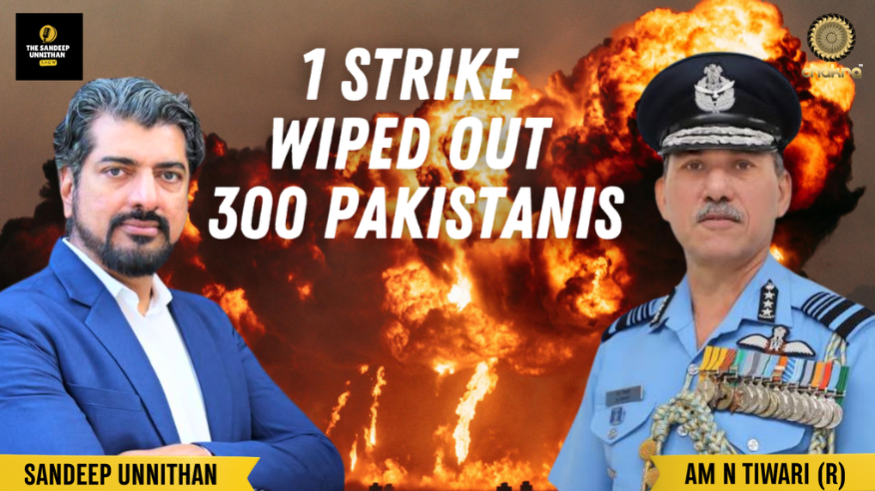
Air Marshal Tiwari: And practically, you could see some pockmarks on the ground, but nothing visible, which really destroyed the target. Whereas just one mission of four aircraft followed by a confirmatory launch of the lightning pod to film it, you know, the whole camp was destroyed. And they probably lost between 100 to 300 people there.
It was the major loss for them in this Kargil conflict.
Sandeep Unnithan: Was it the single largest loss of Pakistani lives in the whole Kargil conflict?
Air Marshal Tiwari: Yes. And it really broke their back in the battalic sector. And things became much easier for the army subsequently.
So this pod made a huge difference. Of course, people remember Tiger Hill as a mission. Right.
But that was a week later. But I think in my view, the attack on Munthodalo was actually the most important mission of that Kargil conflict.
Sandeep Unnithan: Right. What were your feelings like when the Munthodalo dump exploded? And you were, of course, there to capture it, you know, with your lightning pod.
Air Marshal Tiwari: We were very, very exuberant and we were really thrilled. More than us, the army was very thrilled because immediately there was a lot of chatter on the radio. And they came to know that because remember, this was on the other side of the cliff.
So the army could not visually see it because they were on our side. There was a huge cliff and then there's, you know, a small valley kind of a thing overhang. So visually, the army was not.
But when the camp actually got destroyed, there was a lot of chatter on RT and, you know, the number of people lost and panic messages going back from the Pakistani sides to their, you know, their bases. And they were all intercepted. So the army was absolutely exuberant that we had done this. And I think really increased the josh. And that was our aim also.
Sandeep Unnithan: Right. And finally, Air Marshal Tiwari, you know, was there. You've been getting a lot of messages, especially after Operation Safed Sagar, the OTT series asking why the Mirage lightning combo came in so late.
And what is it that people have misunderstood about this timeline that you have so explained in such granular detail to me?
Air Marshal Tiwari: OK, I think I also saw the Netflix series without taking away anything.
Sandeep Unnithan: Yes.
Air Marshal Tiwari: I like this series, frankly.
Sandeep Unnithan: It's a very well-made series, of course. So you mentioned getting messages about asking you why the Mirage and lightning combo came in so late. So you've just gone over the entire timeline with me in very great detail.
Why do you think there are these questions being asked? Is it about what Operation Safed Sagar depicted? It's a very well-made series, I must add.
Air Marshal Tiwari: Yeah, so of course, I went through the whole series and I agree with you. It's well-made. It captures the Air Force life.
And I think, to large part, what 17 Squadron did very accurately. Right. But I'm sorry that they really missed out the facts on the Mirage 2000 and lightning integration. They got it completely wrong. So I don't know. Probably a better due diligence should have been done. But the point is, I've told this timeline to you. First of all, the squadron was not involved at all in this integration. This was all happening in Bangalore. And even in Gwalior, it was the AST team which was doing it.
Sandeep Unnithan: Right.
Air Marshal Tiwari: And that must be acknowledged.
Sandeep Unnithan: Yes.
Air Marshal Tiwari: Both the lightning pod as well as the bomb initially. All the trials were done in Gwalior. Part of the reason why probably a lot of people are not aware, like I said, we were doing it in a lot of secrecy when the squadron was already deployed.
So very few people knew exactly the facts on ground. So that could be one of the reasons why probably they got it wrong. The second aspect also is that while the timeline is what it is, if you see what I've told you, between 29th of May and 5th of June, finally, when I moved to Udhampur, we had finished the entire integration and integrated the new weapon, practically a new paved guided bomb, laser guided bomb, as well as all got the pod online and we are working 24-7 practically.
So it was just a matter of one week and we deployed to Udhampur. So the pod was already being used from 7th onwards. In fact, if I see my logbook, I started initially briefing them and doing the training for the people in 7th squadron and within we formed a small core group.
So while the operations were happening, the training was also happening parallelly. And first time we really effectively used, initially we were using for reconnaissance and it proved a great asset during the Muntho Dhalo attack. So maybe these facts were not known to other people who were deployed at other places.
So if you look at this timeline, it was not such a long timeline when the pods finally came in. But maybe a little bit of a cinematic license, I would say, the dialogues were written in such a way that the bomb and the pod came in very late. But practically within about 10 days, it was being used during the operations.
Sandeep Unnithan: And possibly this is something that the filmmakers could correct in another season of Operation Safed Sagar. We hear that there's a possibility there could be another season of the battle access being deployed. But that is a cinema for you.
That is OTT for you, Air Marshal Tiwari. But tell us about the spirit of the Indian Air Force.
Air Marshal Tiwari: Sorry, just to interrupt. I thought there should be a clarification because I think the acknowledgement, which is due in the right place, it should be put out even in this series. And I'm sure if they want to make something with the Mirages, I think it will be as interesting if not more.
But they should get the facts right. I think that's important.
Sandeep Unnithan: Absolutely. And Air Marshal Tiwari, finally, is this the fastest that the Indian Air Force has deployed a platform, a system in combat? You know, you're talking of what timeline of literally days, 10, 12 days is when you went from literally the word go to the bombings at Muntodhalo.
So tell us about that, the josh that was there in the squadron in the AST amongst your officers and men when you are executing this mission.
Air Marshal Tiwari: See, that's the good thing about uniform and our training is we know that you're training for that one day when you're really required. And people don't worry about, you know, working hours and things like that. And it is not only me and my small team, but everybody else was, you know, so joshed up with adrenaline that you are practically working 24 hours.
You never worried about did you get enough sleep or whether you are. I flew three, three sorties a day, despite flying, you know, despite being, you know, sleeping two or three hours at times. Even on, I remember the Tiger Hill attack.
When we have a Chief Marshal Tipney's had come the previous evening, and I flew a sortie with him in the night because he wanted to see the, you know, how the littling capable lightning capability was at night. We, we finished, we came back, we had dinner because he was on the base and Adam poor. And we wound up at 11 o'clock at night.
And we were up at four in the morning because I had a briefing for the Tiger Hill. Okay, so there's two aircraft mission and he flew with us on the third aircraft. So I was flying in one aircraft with squander all with the flight commander, wing commander Nambiar and monitor Monisha that was in the other aircraft.
We were the two aircraft main formation. And the Chief Marshal Tipney's with the CEO that time, Wing Commander Chhabra. He insisted so he flew on the third aircraft trailing us to see visually how what was happening with the attack.
So we got up at four in the morning. So practically, we slept three to four hours. So that is to be the josh that we no task was difficult, too difficult for us.
And that is true for everybody else also.
Sandeep Unnithan: But no task is difficult for us. And indeed, that's a fact when it comes to the Air Force. And you know, I have a little story myself, Air Marshal Tiwari.
I was a young reporter in Mumbai in those days with a newspaper. And I remember Air Chief Marshal Tipney's had visited us just a few days after Op Vijay. And I asked him what it felt like, you know, to be the Air Chief at a time when the Indian Air Force had been deployed offensively.
Of course, like you mentioned, there were restrictions. And he said, you know, I was a young pilot sitting in the cockpit of an aircraft in 1962 along the Indo-Gangetic Plain, one of your air bases there, waiting for the order to be given to take off to strike at the Chinese. And that order, he said, never came.
So, you know, it was a vindication of sorts for him to be the Air Chief, when finally you saw the use of offensive air power. And of course, my last question to you is, Air Marshal Tiwari, you've given us such a fantastic overview of how the Air Force went to, you know, testing and deploying platforms like this. Game changers, the lightning pods, the laser designators, the air to ground munitions that you use.
Would you say that from Safed Sagar to Operation Sindhur, when you were the Vice Chief, you saw the beginning of the political leadership understanding the use of offensive air power?
Air Marshal Tiwari: I would think so because, you know, before Op Sindhur, you had Balakot.
Sandeep Unnithan: Yes.
Air Marshal Tiwari: So, the fact that air power can be utilized even in limited conflict, I think that is now fairly well established and the political leadership is aware of it. And the efficacy of long-range strikes, even the Air Force has been planning this for many, many years. So, it is not the capabilities that we used in Op Sindhur didn't come overnight.
It had, it was 14 or 15 years in the making. So, we are very clear the trajectory on which the technology is going. And Air Force tries to be as, you know, up ahead in terms of technology as possible.
But like I said earlier also, you know, you had Op Sindhur and I was fortunate enough that I was the Vice Chief. So, with the background of Kargil conflict, I think a lot of the lessons we learned there, we have incorporated, especially in our targeting and intelligence. And that's why you saw the kind of strikes that we did. They were so accurate. It is very easy to say, you know, you can take a long-range weapon and put it on an aircraft and go. But the kind of work that goes on behind, that is what really determines whether the strike will be successful or not.
And that happens largely on ground. And for, you know, you have to make target folders and things like that, accuracy of coordinates. So, there are a lot of aspects involved, even directions of attack, you have to take into account jamming and things like that. So, all these aspects, some of it, of course, I carried with me from my own operational experience in Kargil and it does come in handy. And it is true for, you know, all the senior leadership. I think you get basically what you have been through in your career.
I think some of the lessons you take forward and hopefully try to improve so that as an organization, the Air Force is better off the next time.
Sandeep Unnithan: Right. Absolutely. And the foundation of that was laid during Operation Safed Sagar in 1999.
Thank you so much, Air Marshal Tiwari. What a scintillating account that you have given us about your time, your experience of developing those special weapons and capabilities for the Indian Air Force, which has stood us in such good stead during Operation Sindoor as well. Thank you very much for your time and for your thoughts.
Air Marshal Tiwari: Thank you. Thank you very much, Sandeep.
Watch the full podcast: https://youtu.be/Lp60A-WoC-g?si=Xa_Cbxk5DWhH5TGJ
Savio Rodrigues
Savio Rodrigues is a Research Analyst at Escape Velocity MediaWorks Pvt Ltd, where he writes extensively for Chakra Newz on defence, national security, geopolitics and emerging technologies. He holds a Master's degree in International Relations and Strategic Studies from the University of Mumbai and has experience in geopolitical risk analysis, strategic research and international affairs.


Comments