












5 key takeaways from a conversation with Lt Gen A K Bhatt

"Our aspiration is that by 2040, an Indian on an Indian spacecraft is there on the Moon." – Lt. Gen. A.K. Bhatt (Retd.), Director General, Indian Space Association
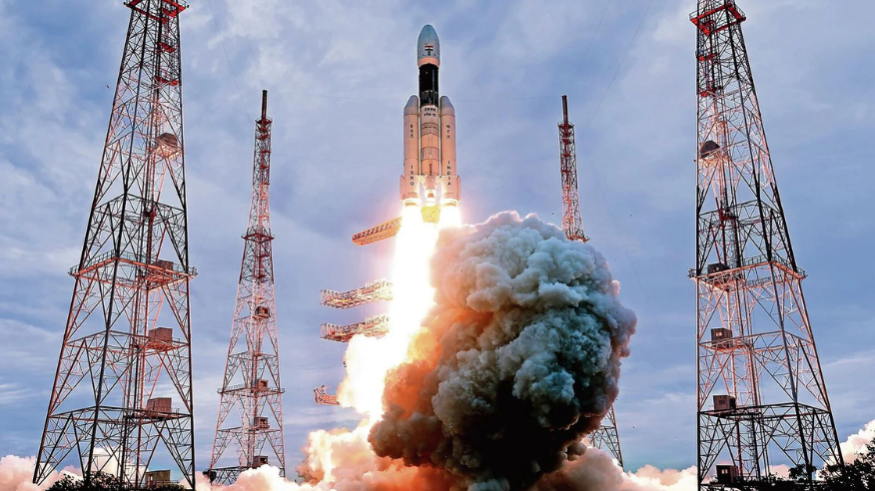
In an engaging and revealing edition of Cutting Edge, Lt. Gen. A.K. Bhatt (Retd.) traced India’s remarkable progress in space—from launching borrowed rockets to setting its sights on sending an Indian astronaut to the Moon aboard an Indian spacecraft by 2040. Drawing on his leadership in the Indian military and now at the helm of the Indian Space Association, Gen. Bhatt outlined how India’s space efforts are evolving from scientific achievement to strategic capability.
Here are five key takeaways from the episode:
1. From Chandrayaan to Shubhanshu Shukla: India’s Human Spaceflight Era Begins
India’s first astronaut, Rakesh Sharma, flew aboard a Soviet Soyuz in 1984. Four decades later, Group Captain Shubhanshu Shukla is aboard a SpaceX mission, gaining vital experience for India’s indigenous Gaganyaan programme. This is a landmark transition from dependence on foreign powers to self-reliance in human spaceflight.
2. Private Space Sector Is Taking Off
India’s space startup count has grown from just one in 2014 to over 200 today. Companies like Skyroot, Agnikul, Pixxel, and Digantara are innovating in launch vehicles, satellites, and space situational awareness. Enabled by ISRO and new regulatory bodies like InSpace and NSIL, this private push is driving faster, cheaper innovation.
3. Military Satellites and ISR Are Needed-Now
While India has made gains with Cartosat and Risat satellites, Gen. Bhatt warned that 8–9 ISR satellites aren’t enough for today’s real-time intelligence needs. A new project, SBS-3, will field 52 satellites by 2029—but until then, India will remain partly reliant on foreign ISR providers like Maxar.
4. Space Debris Is a Growing Threat—and an Indian firm has the answer
There are over 11,000 tonnes of space junk and 36,000+ pieces larger than 10 cm—travelling faster than bullets. Indian firm Digantara is already launching space situational awareness (SSA) satellites to monitor threats and protect Indian assets in orbit, especially in the increasingly congested Low Earth Orbit (LEO).
5. NSIL Replaces Antrix as India’s Space Business Arm
With Antrix being phased out post-legal troubles, NewSpace India Ltd (NSIL) now leads all commercial efforts—handling PSLV contracts, tech transfers, and PPP models for building rockets like GSLV. It’s a crucial bridge between ISRO and India’s emerging space economy.
Deepak Bhadana
Over the past decade, Deepak Bhadana has built expertise in multimedia storytelling, with a focus on military conflicts, insurgencies, international relations, the defence industry, and occasionally, wildlife and environmental issues.




Comments