
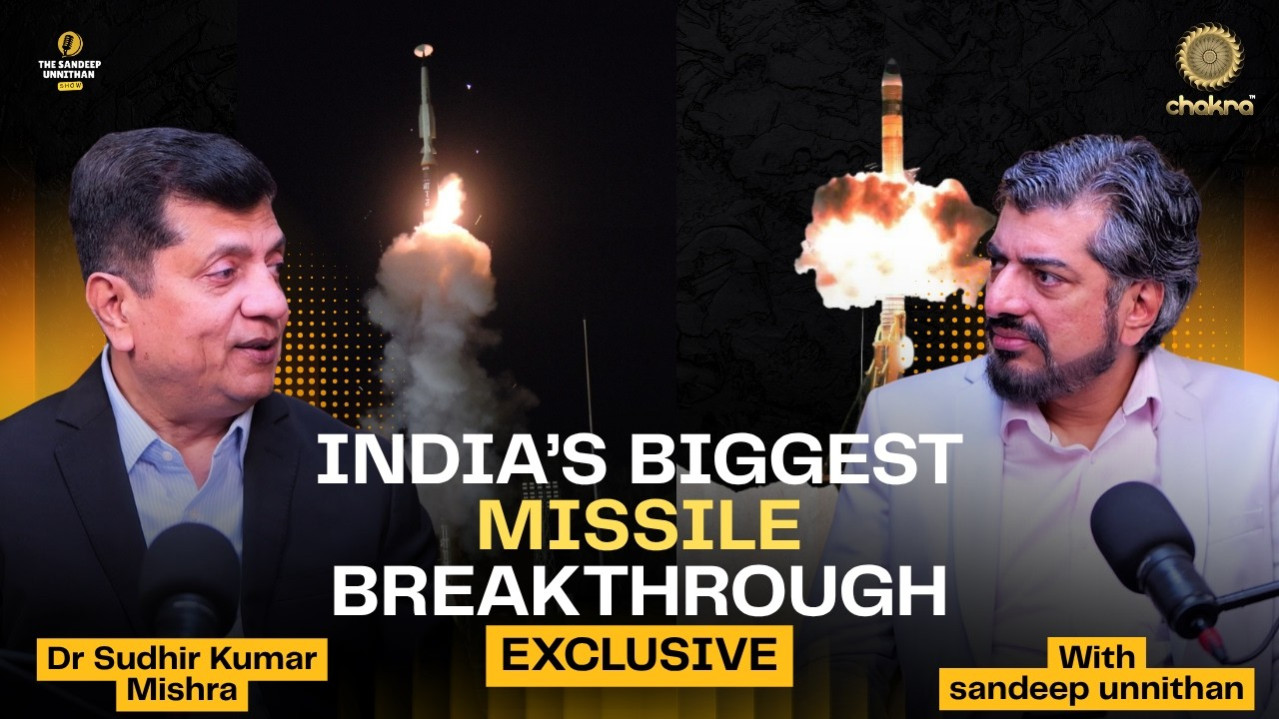




Hypersonic Missiles, Scramjets & MIRVs: India's Next Gen Weapons

The Sandeep Unnithan Show
With Dr Sudhir Mishra, Former MD & CEO, BrahMos
Sandeep Unnithan: Hello and welcome to the Sandeep Unnithan Show, your weekly dose of defence, geopolitics and much more. Today I am privileged to have on my show with me, Dr Sudhir Kumar Mishra, a veteran scientist, distinguished scientist, former head of the BrahMos, missile cooperation with DG BrahMos for eight years, a key person behind this very successful Indo-Russian supersonic missile. I'm going to be talking to him today about India's recent breakthrough missile tests. Dr Mishra, welcome to my show.
Dr Sudhir Mishra: Thank you. Thank you, Sandeep, and good day to your viewers.
Sandeep Unnithan: Dr Mishra, your organisation has been in the news. Your organization DRDO, has been in the news recently. Several missile tests, breakthrough capabilities, hypersonic missiles, MIRV missiles, and, of course, scramjet engines have been tested on the ground as well. Break down for us the importance of these three very important missile tests.
Dr Sudhir Mishra: Thank you, Sandeep. I'm very happy and proud that the idea has achieved a real breakthrough in missile technology in the last month. And if you look at these tests with the background of the US-Israel versus Iran conflict, then it gives huge confidence to our armed forces that we are really far ahead in the race to develop the next generation of missiles. You have been watching since the 1980s, when the IGMDP integrated guided missile program was first introduced. We have been developing missiles that have been successfully tested, refined, and inducted into our armed forces. But these tests, which have been conducted in the last month, will give enormous capability. And they are very different from each other.
Sandeep Unnithan: So, let's start with the first test, Dr Mishra. Interestingly, you would say that this is a new generation of missiles that have been tested. Let's talk about the long-range anti-ship missile, the hypersonic boost glide that we just tested. What's the capability of this missile? Why is it such a breakthrough? Explain to us in person. I understand your missile.
Dr Sudhir Mishra: Today, I want to speak in the language of common people, students, and sometimes housewives, so that they can understand the technology and complexity behind these breakthroughs. You see, when it comes to the long-range hypersonic anti-ship missile you see today, the capability is that we have missiles like the Klub, BrahMos, and they have the, you know, range limitation 300 km to 600 km like that. So If you see, we are surrounded on three sides by the Bay of Bengal, the Arabian Sea and the Indian Ocean. Oh, and we have thousands of kilometres of open sea facing us. So, we needed the capability so that we can, you know, deter our enemy from the standoff distance of 1500 or 2000 km. So, this missile has that kind of capability. When we say hypersonic sea, first we have to understand the various stages of this missile. So this missile is launched vertically, and then it has the boost phase in the sense that the first stage takes the missile to a certain altitude. Then there is a second stage, again it takes it to a much higher altitude. And then the boost phases over. And the missile reaches the, you know, apogee. And then it takes a turn to see or land towards our Earth. And then you have the glide phase. This glide phase is a properly guided glide in the sense. So, it is regarded aerodynamically. So, you have the aero structure, which takes it to the glide phase. And the glide is not a simple glide like an aircraft. The glide can also be, it can have a certain typical shape. I want to give you an example. When you throw a stone in a lake, Stillwater Lake, then the stone will touch the surface, then it will go up the second one, then the third one. It'll keep on skipping. So, this glide phase is like that. Now this glide creates a lot of confusion for the enemy, because the enemy is watching your missile through its radar, so it's difficult to predict where it will come from, at what height, or direction. The missile is going to come. So, in the terminal stage, we have the seeker. So, this seeker may be an X-band seeker or RFC, any kind of seeker; this seeker locks onto the target and the terminal stage. In the endgame, the missile is locked on, and it goes and hits it. So, the advantage is the first very long range because you are taking it to the boost glide phase. So the range may be 1500 km or 2000 km. And the second is unpredictability against air defence. The third is the seeker lock-on capability of the missile. So this is going to create a huge deterrence to the enemy. A deterrence of 2000 km is quite formidable. It's a formidable weapon. And yeah, the challenges we have conducted this test have to be repeated, and then we have to create it in numbers and implement it in either the coastal security system or on the ships. So the number, the induction and the number are very important. We have watched the Iran conflict, the US-Iran conflict, that if we are thinking in terms of ten, 20, 50, 100, the number has to be in multiples of hundreds. Yes, yes.
Sandeep Unnithan: But this is again a capability we've not seen during the war. I don't think even the US has this kind of knowledge.
Dr Sudhir Mishra: They have the Dark Eagle, and there was a dancing missile, but that was because of, you know, the typical design of the boost phase. But this is talking about the glide phase. And you see, you must have read about it, I'm sure. And your viewer also must know there are, you know, the hypersonic glide vehicle. Well, this is basically a hypersonic glide vehicle against a ship, right against a ship. And this would be kind of large. And yeah. And you see it is against the ship. It is usually the hypersonic glide vehicle. They carry nuclear weapons. Well, this is not going to carry a nuclear weapon. This is a conventional weapon. Conventional weapon. So that's why we are saying it is against the ship.
Sandeep Unnithan: What kind of targets are you talking about, aircraft carriers?
Dr Sudhir Mishra: Sometimes I feel that aircraft carriers are anyway getting obsolete. Maybe ten, 20 years. Whatever has been created will solve, but later on, it will be very difficult for them to protect against incoming missiles. So it is against warships and aircraft carriers. It can be used against land targets also in future. As of now, it's anti-ship.
Sandeep Unnithan: anti-ship. How difficult is it to intercept a hypersonic missile?
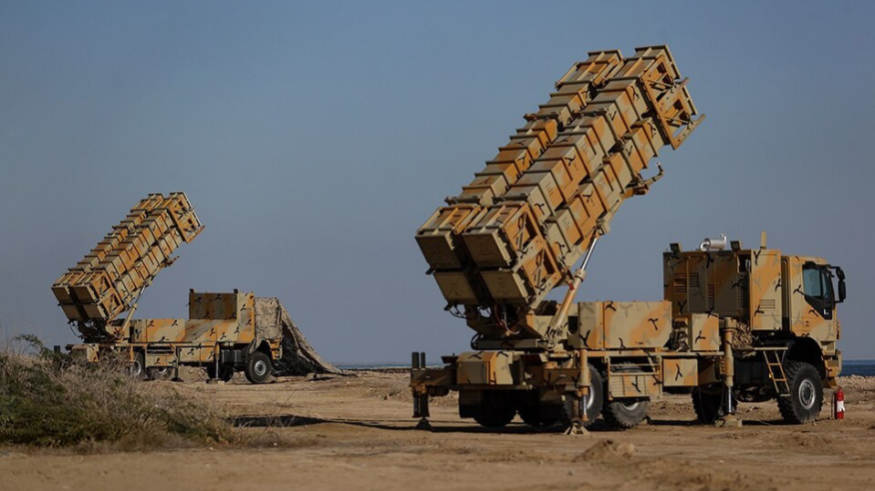
Dr Sudhir Mishra: Impossible. Impossible with the present capabilities? No, it's very difficult to even engage the supersonic missile. You have seen recently that Pakistan, you see, the Chinese have supplied their HQ-9 air defence system to Pakistan, but it could not, you know, neutralise the BrahMos missile. So if the air defences are helpless against supersonic, then hypersonic is far away.
Sandeep Unnithan: So this actually anticipates missile defences of the feature hypersonic weapons like this and will overwhelm at that
Dr Sudhir Mishra: And yes, but if it is not overwhelmed, it will not be able to engage it. Overwhelming means you are firing a number of missiles, and the system gets saturated. But in this, even if there is a single missile coming, it will be very difficult for any air defence to stop it.
Sandeep Unnithan: So, Dr Mishra, how long now? We've already had two tests of this missile from 2024 to 2026. How many years would it reasonably take to test and induct the missile on this kit?
Dr Sudhir Mishra: Before every test, there are certain objectives. So I'm not aware of the objectives of the test, but only from the looking from the media and the, you know, talking to people like you, who know how to analyse a flight test, I can tell you that maybe they may go for another test, usually, 2 to 3 tests are good enough to give you a mature system. So once maturity is achieved, I'm sure the armed forces might have already given the signal to the DRDO to, you know, to transfer it to the industries for the mass production, mass production.
Sandeep Unnithan: And you think it's reasonable to expect this missile to be in service in the next five years?
Dr Sudhir Mishra: You see, I would like to tell you that such missiles are not available in the market. Nobody will tell you. So, services would be in a hurry to, you know, grab this missile, induct it into their system and project the capability to animate. So, it's a it provides a penetration capability to our armed forces. As your predecessor, Dr Sivathanu Pillai, would say, free delivery items, free items for our adversaries. Dr Pillai is one of the very important pillars of missile technology in our country. So, in fact, I learned a lot of things from Dr Pillai, and he's a great technology leader of our country.
Sandeep Unnithan: Of course. Yeah. But you know, talking about Dr Pillai and the fact that you've been in Brahmos for eight years. You headed the organisation for eight years. Is it reasonable to assume that we are with the long-range anti-ship missile, hydro sonic missile, where we were with the BrahMos in 2001? Is this our next-generation BrahMos missile?
Dr Sudhir Mishra: You see here, I would like to give you a clarification that we have created BrahMos for the Army, Navy and Air Force. And the name BrahMos is singular, but different versions have different ranges, designs, and capabilities. So, when you say that BrahMos was created in 2001, I say yes. The first one was tested in 2001, but after that, the version which we had tested and given to the users had hundreds of differences. Hundreds of additions to the capability have taken place. So, the 2001 BrahMos and the 2026 BrahMos are both different.
Sandeep Unnithan: That’s a kind of spiral development that you have brought in.
Dr Sudhir Mishra: So yes, yes, a lot of development takes place. Apart from this, when you talk about the future, you see BrahMos is an air-breathing missile, whereas a hypersonic glider is not. So both are different technologies. There is no commonality. But yes, one commonality is that we conducted the scramjet engine test.
Sandeep Unnithan: I was going to ask you about that next. Yeah. You know, Dr Mishra explained to our viewers why scramjet technology is such a breakthrough technology? What is it that a scramjet does that a hypersonic missile or a supersonic missile doesn't?
Dr Sudhir Mishra: Actually, I would like to tell you that the scramjet engine test is the biggest success of India's missile program. Yes. This capability has really surprised us. China, Australia. Why? I'm saying China, Australia, and America are because they have been. These are the three countries that didn't have the hypersonic capability. And they have, you know, they have invested a huge amount of resources to develop this technology, but they have not reached the level where we have reached a 20-minute test on the ground, 20 minutes test on the ground is something which our country can really take pride in. And our scientists have done a fantastic job. I tell you, this is one of the most difficult technologies that India has mastered. You see, I want to tell your viewers that any aero system, any system which flies in the air. It is designed based on the power system available. So, we have a scramjet engine as a power source. Now, around this engine, we have to develop an aero structure. We also have to develop a very ruggedised electronics guidance system, navigation system, warheads and communication links, then launchers. So, everything will be developed around this scramjet engine and the scramjet. You see what I want to tell you, you viewers, that scramjet means a supersonic combustion ramjet engine. So, in the BrahMos little technical things. I would like to tell you that when you take a drummer, it's having a supersonic, the supersonic exit. So what happens when it flies in the air? The air is taken in at supersonic velocity. Then it is, you know, because the nozzle is there. So, it is reduced to the subsonic in the nozzle and ignition. The fuel is injected when you know, in the chamber, when the air is at a subsonic speed and then exits as supersonic. But in the hypersonic scramjet engine, the fuel is injected when the air is at supersonic speed in the chamber, and the exit is at hypersonic speed. Hypersonic means seven times ten times 15 times more than the speed of sound. So when you are injecting fuel in the chamber at a supersonic speed, then the fuel has to be properly atomized means it should be properly, you know, sprayed so that the burn can take place in an efficient manner. The second challenge is a flame retainer. What happens? The air is flowing at such a high speed that any ignition will not be able to take place. You, you know, you remember when you take a matchstick, and you want to blow it out. So you, you know, you throw the air from your mouth, and it's blown out. Just imagine when the ignition takes place at the hypersonic and the supersonic speeds. Then you, you know the flame will not be able to withstand there. So the flame retainer design has to take place. All those things are very complicated. A very important thing is the material, your material metallurgy, your material has to withstand 1000 200,400°C. So there are very few materials available. So, the DRDO has developed those materials. DRDO has shaped those materials to fit into the engine. So, I'm talking about the manufacturing process and then the testing of the ancient. So, this design, I will say, is one of the biggest achievements of DRDO till today.
Sandeep Unnithan: In the last 70-odd years
Dr Sudhir Mishra: Yes. And I, I would like to state that with this achievement, now the idea has reached a level where it can design any kind of variety, any type, any range of missiles for the country. People are surprised. And you see, we have done it with a very limited budget. Indians are famous for frugal engineering. So, we have done it with a very limited budget. Maybe 100 or 1000 of the US or Australian budget.
Sandeep Unnithan: What have they spent on the scramjet technology? Yes, yes. You know, it's claimed was now from the ground test, the 20-minute ground test, to take it to the vehicle level like a flying platform. How much time will it take in terms of years?
Dr Sudhir Mishra: It depends. I feel it should take around five 5 to 7 years.
Sandeep Unnithan: So, in the 2030s, we would see
Dr Sudhir Mishra: We would have our own hypersonic. And remember one thing, this engine is a cruise engine. A cruise engine means we can design a cruise missile around this engine. You see, we were talking about the hypersonic glide vehicle. So, a hypersonic velocity was there, but it was not properly, you know, it was a gliding. But in this scramjet engine, any missile with a scramjet engine would be powered till the last second of its flight.
Sandeep Unnithan: There's no glide, no glide
Dr Sudhir Mishra: There's no glide, no glide. So the engine will be, you know, a source of power throughout the flight. Number one. Number two, you can change the you can manoeuvre the, the missile's trajectory through various waypoints. Okay. Am I able to explain to you? So the waypoints are like this. Like you can change the way points so that the enemy is always taken by surprise. Another thing is that this missile. Like a BrahMos, it's a you can say BrahMos. BrahMos-K, Kalam standing for Dr Kalam. So we can always fit into this, and it's going to be a very, very credible capability for our armed forces. This engine can be used not only for the Navy, but it can also be used for the Air Force and any kind of platform.
Sandeep Unnithan: What you're saying is that it's basically a new generation of cruise missiles.
Dr Sudhir Mishra: To say that it's a new generation. It's an ultra-new generation of missiles in the country.
Sandeep Unnithan: And this is going to be entirely IDDM. Indian Designed, Developed and Manufactured.
Dr Sudhir Mishra: It is going to, you know, create a huge problem for the adversaries. Yeah. And you see what happens. One is the weapon capability. The second is an engineering capability. So, the country has achieved engineering capability in the hypersonic region. Hypersonic region. Someday in the future, you can travel. Right now, you are travelling with a supersonic jet engine. You can also fly in a hypersonic jet engine. So yeah, this is the beginning of a new era in missile and aviation technology.
Sandeep Unnithan: You mean even for manned aircraft, you have scramjet technology?
Dr Sudhir Mishra: Yes. If we have mastered this technology, we would be able to modify it. You see, now we know the behaviour of material. Fuel, aerodynamics, and thermodynamics. So we can always, you know, adapt it to meet other, other engineering requirements.
Sandeep Unnithan: So, this is like the standard technology is the holy grail of the Holy Grail,
Dr Sudhir Mishra: Of the Holy Grail of missiles. Yes. You have used the right word. It's a holy grail of missile technology. Right.
Sandeep Unnithan: So, as a missile scientist, you know, tell us what your understanding of the scramjet was. I mean, how often did you think about standard technology when you're discussing this, Dr Kalam?
Dr Sudhir Mishra: Yeah, actually, you see, when we made BrahMos, then in one of the functions, Dr Kalam was the chief guest. And he said that DRDO should aim to make a missile which will fly with the hypersonic capability, will be made up of composite materials, and will be able to return to the base, you know, written, written back. So after, it should be able to deliver a nuclear payload, a strategic payload, which can be anything.
Sandeep Unnithan: It can be reusable.
Dr Sudhir Mishra: It can be conventional. He was talking about a reusable hypersonic missile. So we have now reached the hypersonic missile reusable. I think we would come maybe after a few years once we start working. So he was talking about that.
Sandeep Unnithan: And this was in the 1990s,
Dr Sudhir Mishra: 1990s.
Sandeep Unnithan: I remember being at one of them. Yes, yes, I was telling you this science fiction.
Dr Sudhir Mishra: It was like a, you know, dream. And I was, you know, I was thinking in a very sarcastic manner that he is talking, you know, theory, he is talking about something impossible to meet. So, after watching the successful test of the scramjet and watching the reusable motors of Musk, Elon Musk, and SpaceX. So now the reusable rocket motor, it means maybe someday it will become possible. It may take 5 or 10 years, but a reusable strategic missile able to deliver a strategic payload is going to become a reality quite soon in the future. This is not science fiction but a possible reality.
Sandeep Unnithan: Science fact indeed. And as you've said, to explain to our viewers, our strategic missile functions are that the missile is like a one-way attack system. It’s a kamikaze weapon system. It delivers the warhead and crashes onto the target, destroying the target and, of course, extinguishing the missile as well. In this case, you're talking of something like a hypersonic drone, which, like a fighter aircraft,
Dr Sudhir Mishra: like an unmanned fighter,
Sandeep Unnithan: Unmanned fighter aircraft moving with the speed of hypersonic right over Mach 5.
Dr Sudhir Mishra: over Mach 10 15.
Sandeep Unnithan: Like so. But you know, let's go to the third. Besides, in the series of tests that he argues were carried out, the MIRV-equipped Agni-5 test Project Divyastra is a very fascinating technology project which the DRDO has been testing of late. This is another capability that India has acquired very recently. Tell us why MIRV technology is so important for me, actually.
Dr Sudhir Mishra: Actually, God's are very kind to India, because we have been coming up with newer and newer capabilities in almost all the fields of defence technology. Remember Zorawar tank that we successfully developed, and so many other things coming back to this missile MIRV, you see, Amiri is basically, you can think of the first, let me tell you, the full form. It's a multiple independently injected re-entry vital. Right now, everything has a meaning. Multiple means many more than one independent means; they are not dependent on each other. Injectable means you desire to inject it into the atmosphere based on your requirement. And re-entry means you are re-entering the atmosphere. So, what happens? As you know, India has the Agni class of missiles, which are strategic missiles. And so, with MIRV, what do we do? The present Agni has a single warhead, so we can put one warhead, conventional or strategic and then launch it. But in mid, we would be able to pack the warhead with multiple warheads. So, multiple means it can be five, ten, twelve, depending upon the size, shape, and space available. So, in this, what did we do? The missile is launched in a very conventional manner. In this test. What did we do? We have changed the metallic motor. Metallic. It's made up of a maraging steel motor casing with a composite motor casing. The reason our, you know, every kilogram saved allows you to pack a few more cages of propellant explosive warhead, missile lighter, so it can go to a longer range. So this was one change. The second is in MIRV. You see, when the vehicle re-enters the atmosphere, then you have the liberty to inject a warhead at a certain interval. Now you can inject the first warhead, maybe after a few seconds second warhead, then the third warhead, fourth warhead. These warheads have their own powered motors. So one is a motor to give them speed. The second motor is called a retro motor. A retro motor to reduce the speed to reach the destination. Now, just imagine a single warhead was able to go and hit a pinpoint in Italy at a certain place on Earth. In MIRV, you can if you inject 5 or 7. So if you inject seven means the seven warheads would be spread over maybe 400 by 400, not by it should be elliptical. So, the major access would be maybe 400 km, and the minor access would be 300 km. So over so much of the area the missile would be able to hit. Now it creates a lot of unpredictability for the adversary. The adversary would watch the missile. They would see the missile from space or from ground-based radars, but they would not be able to predict where the warhead would land. So one is unpredictability. The second is when the warhead is coming towards the target. Then they will be using the address system. So air defence systems, if there are 5 or 7. There can be a dummy warhead.
Sandeep Unnithan: Decoys.
Dr Sudhir Mishra: There would be a decoy, a dummy warhead. So instead of seven, there may be 20. So if decoy warheads are there, they are going to target the decoys. So again, they are wasting their resources. Number one, it means they are compromising on their defensive capability. So these 10 to 15 warheads will go and saturate their system. It will give them a lot of unpredictability. And the most important thing is fear. The fear of MIRV is going to create a huge uncertainty and a kind of deterrence that lets not annoy India, so MIRV is a very different capability. And you can precisely guide these warheads to reach the particular place. So they are, precisely guided warheads to multiple destinations,
Sandeep Unnithan: They are like many missiles you can.
Dr Sudhir Mishra: Missiles that you are putting in one packing up in one.
Sandeep Unnithan: Yeah. It's that kind of capability that's good. India has developed this now.
Dr Sudhir Mishra: And you can put it up in any kind of missile. You can put it up any kind, any kind of Agni, I mean, which are any it can be fitted. Because once you have tested it for 1 meter or 2-meter diameter. So any missile which is two meter diameter, it can take it.
Sandeep Unnithan: So it can be retrofitted and go across the board.
Dr Sudhir Mishra: It can be across the board. All, all the missiles which are having that much diameter. Yes, that is important.
Sandeep Unnithan: So it would be fair to assess that even for undersea launch missiles. You can have MIRVs when I say all kinds of missiles.
Dr Sudhir Mishra: So the platform is immaterial right. It can go all in all kinds of missiles. It's an injuring capability. Which country has achieved and demonstrated to the world? So you see again, I want to tell Dr Kalam used to say that missiles are a weapon of peace. We want to say that, you know, we have such a capability. So don't consider us a weak country. We are. We are strong now, don't you know? Unnecessary trouble. If you want to fight a war, then we have a wide inventory of weapons to defeat you.
Sandeep Unnithan: So, you know, you've in the course of our conversation, Dr Mishra, you've spoken of Dr Kalam so many times, you know. And that brings me to your role in the IGMP with the Integrated Guided Missile Program, which you are part of. Tell us what Dr Kalam brought to this design program that you know. What is the kind of imaginative team building we've heard so much about? Give us your perspective on working with him so closely. What was he like?
Dr Sudhir Mishra: Actually, I'm very fortunate that I have worked with Dr Kalam, and I will not say that immediately, but we were in the second orbit. We were watching, we were learning, and in the first orbit, we had people like General Sundaram, who designed Prithvi, and Dr VK Saraswat, father of AD program, and again, then Dr Agarwal, Agni series, then Dr Prahlada, Akash series and Dr Pillai, the originator of BrahMos program. And then we had Nag project director Dr S.S. Mishra, and before him, Dr Rao. So these were the people. Uncle SS Mishra. He's no more passed away. But he is my uncle, Dr S.S. Mishra. So they were the people who were in the first orbit. We were in the second, and you can say subsequent orbit. So we were watching, learning, trying to emulate his way of thinking, working, and behaving. One thing I keep telling people is that Dr Abdul Kalam had a very human quality, very difficult to find in, you know, in the people in the leaders like him. So we learned to, to be sincere, hard work. You know, humans treat their team as they treat their children or their brother. Then he taught one more thing, that of patriotism. Dr Kalam used to say, everything that you see, you are not working for me. You are not working for DRDO. You are working for India to become a strong, successful and very, very powerful nation. So although these are very abstract things too, you know, to tell you, but when you watch through examples, because, you know, many people say that you do the hard work, okay, he is preaching and going to enjoy life. But we have seen Dr Kalam working for I have seen him working for 36 hours continuously. Right? Yeah. And yeah, without a break or one and a half day standard was 9 to 9, 12 hours. So we learned such a thing from him. So he is an apt example to tell that, you know, you remember the US president. He said that I am not able to recall the name that I didn't ask, don't ask me what country can do to you, but you ask what you can do to the country.
Sandeep Unnithan: John F Kennedy.
Dr Sudhir Mishra: So, John F Kennedy, this statement has been implemented, emulated and given the right example by Dr Abdul Kalam. We learned it from him.
Sandeep Unnithan: You know, the interesting thing that you mentioned is the fact that you are in the second orbit and you went on to hit the most missile program after being director, missiles in DRDO. Was he also putting that leadership into place? First generation leadership, second generation, third generation. Is that how we always planned it?
Dr Sudhir Mishra: Yes, I have worked with many leaders, but I have seen Dr Kalam creating a leadership to take over his role. You see it many times.
Sandeep Unnithan: succession planning
Dr Sudhir Mishra: I will not say succession planning. It was not a success. It was leadership, you know, being taught to so many people at a time, so that they compete among each other to take over his position. I think from that point of view. So he, you know, these five people, integrated guided missile program we used to call Panch Pandav. So these Pandavas were competing among each other to succeed, to take over his position. And he was not insecure about his position. I have seen very few people who are not, you know, secure, who are secure about their position. So Dr Kalam was very secure about his position, his role. That is why he could become the chief of DRDO, then the President of India. He was never afraid of his juniors, and he had one very good quality that whatever he was eating and living, the same standard was being provided to the last man in the queue. Also a worker. The worker is also eating the same food. He is also eating the same food.
Sandeep Unnithan: Is that the quality that he mentioned? Quality? Humane quality?
Dr Sudhir Mishra: Yes. Very.
Sandeep Unnithan: And he was deeply empathetic.
Dr Sudhir Mishra: Yes. Very. He had deep empathy.
Sandeep Unnithan: How would Dr Kalam have reacted to this series of tests? Those three very impressive series of missile tests?
Dr Sudhir Mishra: I tell you, Dr Kalam would have given another goal. He would have moved the goalpost to, you know, another. You can say a milestone, saying that, okay, you have reached here. Now you reach another level of, you know, the technology. So of course he would have congratulated people, you people have done a good job, but you have not reached the 30 minutes. So you reached the 30 minutes, and we would again celebrate. So he would have given another target, another mission, he used to call a mission, another mission to the team of scientists.
Sandeep Unnithan: He wouldn’t rest on his own
Dr Sudhir Mishra: No. Dr Kalam is a person who has worked and served the nation till the last breath of his life. Very few people get such a portion. He has got so he is an example. I also want to work till the last breath of my life. Don't want to stop. This is the learning from him.
Sandeep Unnithan: I mean, this is so inspiring, what you just said. And I mean, as someone who's been deeply privileged to have Dr Kalam as well, and this is also the lesson that I take away from that. But, I mean, you, of course, work with him. I've only seen him as a journalist, and everything that he said was, you know, it was at that time it appeared to me, as I said, science fiction, but now we are actually working. We are actually implementing those dreams, realising that. Now, of course, there's a very, you know, inspirational figure as well. Tell us now, Dr Mishra, where we are. After maybe four decades of the meeting, which you began in 1983, it's been more than four decades now. Where is India today as a missile power? When you compare it with the other countries in the world.
Dr Sudhir Mishra: India can design, develop and produce missiles which are required to meet our security needs. Secondly, now in the present government, we have started the export of missiles to friendly nations. So we yes. So we can export BrahMos Akash, and Pinaka is a rocket system. So we have exported, and a few days back, our defence minister went to Vietnam. I'm sure he must have convinced them to buy the system. And this missile. I'm talking about BrahMos. If the BrahMos has beaten HQ-9 air defence systems in Pakistan, it means it can. It can defeat any other additional defence missile of China. So all the people who are concerned about China, you know, overwhelming aggression, they would like to take BrahMos and defend their interests. So we have achieved our own requirements. We have achieved the goal of exporting the missile to friendly nations. So I feel that we have reached quite a mature level, and you see the situation, the global scenario, it keeps evolving, keeps changing. So the missile roll also would keep evolving and changing. Whatever we have developed today would serve the requirement for ten years, 15 years. Then a newer challenge will come. Then we have to design a newer missile to meet that challenge. So the life of a missile scientist will keep on going. Yeah. ṅ
Sandeep Unnithan: Scientists will, of course, continue to live in interesting things to live in this. But, you know, again, the Prime Minister mentioned on the 15th of August from the right, for he spoke of the Sudarshan Chakra system. Explaining to our viewers what the system is and how it changes things from what it already exists. Now, our missile offensive missiles and our defensive missiles. How will we integrate all?
Dr Sudhir Mishra: First thing, I'm very proud of my Prime Minister, who has declared the Sudarshana Chakra. At the same time, Trump has declared the Golden Dome. So Trump is thinking of protecting us from incoming missiles. At the same time, my Prime Minister is also thinking of protecting the country from incoming missiles. So now, when it comes to the thought process, India is at par with us. I'm talking about thinking now, what is the Sudarshan Chakra? Sudarshan Chakra is basically to provide security to our defence installations, civil infrastructure, and critical assets. Now what are those? You see what happens. We have a lot of important buildings, like a storage facility and a command control centre. The Army, Navy, and Air Force assets are located, so we have to defend them now. Civilian infrastructure means dams or roads, bridges, and railway stations. They have to be protected, protected. Then you have large ones, like the petroleum sector, energy sector, and power generation plant. They have to be protected. So there may be thousands of places in our country that need protection from incoming missiles. So there will be long-range radar, which can look into 3000 to 4000 km, a variety of radars, radars starting from 300km to 4000km. Number one. Number two, there will be space-based sensors which will observe and react to incoming missiles. Third would be, you know, there would be telescopes, which would be, you know, maybe 40,000, 45,000 km up in the sky. I'm talking beyond satellites. Oh, they also would be able to observe the enemy territory and give us a signal that, yes, somebody is going to attack or somebody has taken launch where it is going. We would come to know through satellite and ground-based radars. Now this is the these are the sensors. Now we need a kind of weapon to neutralise the threats. So there would be missiles like, right from the man-portable to short range missile. Short range means up to 10 km. Then you have missiles like. Like Akash, 25 km. Then you have Akash plus 40 km. Then we have MRSAM LRSAM, same. They say Indo-Israel joint venture. So those missiles will have a range of 60, 70, 80 km. Then you have the missiles like 150 km, like, you know, XR-SAM extended range, surface-to-air missile. Then, then comes the Kusha will provide you with 150 km, 250 km and 350 km. And then you have the S-400 system also. And these all would be, you know, supported by high-power microwave and high-power laser systems. So these are the weapons. You have the sensors. And both will be connected through a command and control system. So the command and control system will keep on getting the information from radars. It will give a signal to the respective missile to act. And the whole thing would be connected to the Army, which has the Akash command and control system, AKASHTEER, so it will be connected to Akash. It will also be connected to the Indian Air Force IACCS. I ask so it's going to be a very big system, but it will provide security to the nation, critical assets and. As I told you in the beginning, very happy, very proud that our strategic thinking is at par with the US thinking.
Sandeep Unnithan: Absolutely. Indeed, our strategic thinking is on par with the US. But, you know, I have to ask you this question in conclusion that we are clearly a missile power from what you've just told us, that we are developing missiles, which very few countries in the world have the capability of doing so. When it comes to aircraft engines and fighter jet programs, we seem to be lagging in choosing missiles over aircraft. What was the reason for us to have an example which has given us so many missiles, but we won't see a similar thrust when it comes to developing, say, the fighter jet engine, transport, aircraft engines, and fighter jets? Why? Why this, you know, different approach to two very critical systems?
Dr Sudhir Mishra: Yes. You see, I would like to, you know, give it a play in a very short sentence. When you are successful, there is only one reason, okay? One means maybe 2 or 3 reasons. But when you have failure, then there are hundreds of reasons for failure. So there are many reasons, like changing the technical goalpost of the engine. Number one, secondly, you know, any engine development takes 30 to 40 years. We have given ourselves quite a short time. The third thing is the scientist, the location of the lab, Bangalore. So most of the best minds went to the software industry. That is also another reason, then, you know, we have not developed the capability for testing of the engine. Then manufacturing. Manufacturing is a lacuna even now. So those days, we also did not have the manufacturing capability then. A very important thing is that you know a single crystal blade. So, single-crystal blade manufacturing capability. You know, all those people claim that now we have it in India, but it has not yet gone into the engine to be tested. So, the taste of eating is in the pudding is in eating. So this single-crystal engine blade has to be used, then only will we come to know. So, a variety of reasons, although the government sanctioned the program, the consistent support would have really driven the engine of our air force.
Sandeep Unnithan: So why did we have a very successful missile program? Again, I'm going to ask you this in a different way, but not a not-so-successful engine, which didn't get enough attention. There was not enough political.
Dr Sudhir Mishra: I think Dr Abdul Kalam was missing in the arrow. Possibly.
Sandeep Unnithan: That's an interesting thought.
Dr Sudhir Mishra: We didn't have a Dr Kalam, you see. We didn't have. In the latter part, we tried to revive the marine application for this engine, as it's not being discarded. It's a misnomer that if people say that not being successful is successful, and it is being used in marine applications and possibly in UAVs.
Sandeep Unnithan: But can India become a great power without having its own fighter jet engine?
Dr Sudhir Mishra: No, India has to develop its own aero ecosystem to be a powerful nation. Things are evolving, you see the UAV, if we mean in the world human beings. If we develop a very intelligent and powerful UAV, then fighter jet engines, fighter jets, they have a limited life.
Sandeep Unnithan: You mean manned fighter jets.
Dr Sudhir Mishra: They have a limited life.
Sandeep Unnithan: Spoken like a true missile scientist, Dr Mishra, you have faith in unmanned systems.
Dr Sudhir Mishra: Unmanned system is a future every time. So when we are investing in fighter aircraft, we should think only for to meet a requirement for 30 to 40 years. Beyond that, it will not survive. There are many technologies which have become obsolete, so this also would become obsolete after
Sandeep Unnithan: You give a man a fighter aircraft for 30 to 40 years.
Dr Sudhir Mishra: Not more than that, not more than that. And beyond that, it's going to be its even now it's unmanned. You see, between India and Pakistan, when we had operations indoors, how many aircrafts have crossed the border? None. And everything was fired from a standoff distance of 300 to 400 km when we had an air superiority fighter aircraft. Rafale is much more advanced than the Chinese ones, but we didn't cross the border. So this whole change has taken place in the last 20 years, 20, 25 years. So imagine if 25 years can bring so much difference. When you remember we sent MiG-21 and Rafale inside Pakistan, and they have. But when the real war means they are ready, we are ready. The aircraft didn't take off. They were, you know, far from each other.
Sandeep Unnithan: They didn’t cross the borders?
Dr Sudhir Mishra: Yes. So in the coming 20 years, again, they will the situation is going to become much more critical in the sense that they will still be far away from each other. And UAVs and missiles, high-power microwave lasers. They will become a very powerful weapon of the future, right?
Sandeep Unnithan: Absolutely. That seems to be a future that India is prepared to realise.
Dr Sudhir Mishra: This time, I'm happy. India is fully prepared. And after five years, India will be fully prepared in the UAV. Critical technologies. Also, critical technologies mean using precision navigation guidance, using. You know, you can say. What should I say that power systems, power system means I'm not talking about battery power. I'm talking about the fuel propulsion system, fuel cells. And we are already developing these technologies in the country. In the subsystem technology, India would become really very mature. And the coming five years are going to be completely game-changing, transformative for the warfighting machine.
Sandeep Unnithan: And we keep coming back to Dr Mishra to understand our progress and our achievements in this very critical sector of national security. Thank you for your time and for your thoughts.
Dr Sudhir Mishra: Thank you, Sandeep. Thank you. Good day to your viewers. Thank you.
Watch the full podcast: https://www.youtube.com/watch?v=-SQtB5-dk-Q
Chakra Desk
Chakra News is a specialised digital media platform committed to in-depth coverage of India’s defence, national security, geopolitics, and critical technologies.



Comments