








How Pakistan helped North Korea build its Nuclear Capability
North Korea’s supreme leader Kim Jong Un has called for expanding the country's nuclear weapons production and deploying more tactical nuclear weapons. On November 25, he visited nuclear material production facilities and inspected what appeared to be uranium enrichment centrifuges and small nuclear warheads. He described North Korea's nuclear status as “irreversible” and said its nuclear material production capacity would continue to expand.
Kim also directed the military to prepare for the use of tactical nuclear weapons across different domains and missions. Citing threats from the United States and South Korea, he warned that any attempt to challenge North Korea's nuclear status would be treated as a “declaration of war”.
Behind North Korea's expanding uranium enrichment programme lies a decades-old connection with Pakistan. Pakistani nuclear scientist Abdul Qadeer Khan and his associates supplied Pyongyang with centrifuge technology, equipment and technical assistance in the late 1990s. The transfer helped North Korea develop an additional route to produce weapons-grade nuclear material, which Kim Jong Un is now seeking to expand.
Since 2006, North Korea has conducted six nuclear tests — the latest in September 2017. Its nuclear programme has relied on two main routes to produce weapons-grade fissile material — plutonium production and uranium enrichment. The country operates nuclear facilities at Yongbyon, where it has a reactor and spent-fuel reprocessing infrastructure. Its uranium enrichment programme provides an additional route to produce highly enriched uranium for nuclear weapons.
Estimates of North Korea's nuclear arsenal vary. South Korea's Defence Minister said in August that Pyongyang could possess between 80 and 120 nuclear warheads. He clarified that the estimate was based on private research and could not be officially confirmed. North Korea has also displayed its Hwasan-31 tactical nuclear warhead, which its state media claimed could be fitted to several delivery systems, including short-range missiles.
The centrifuges displayed during Kim's latest inspection trace links to Pakistan's nuclear technology. An investigation by the Washington-based Institute for Science and International Security (ISIS) in April 2025, identified similarities between North Korean centrifuges and Pakistan's P-2 design.
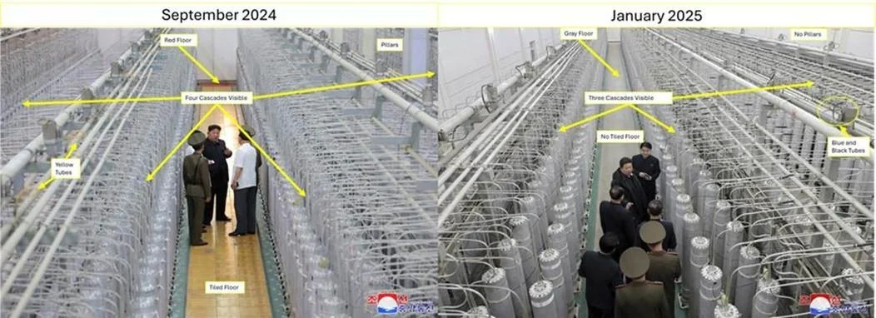
North Korea’s nuclear enrichment facilities: The Pakistani P-2 cascade at Kahuta alongside the North Korean cascade at Yongbyon (Image Courtesy: Institute for Science and International Security)
The ISIS researchers examined photographs released by North Korean state media in September 2024 and January 2025. They found that the height and diameter of the centrifuges were consistent with Pakistan's P-2 machines. The cascade arrangements also appeared consistent with a 344-centrifuge design used by Pakistan to produce low-enriched uranium. This configuration typically consists of four rows of 86 centrifuges each.
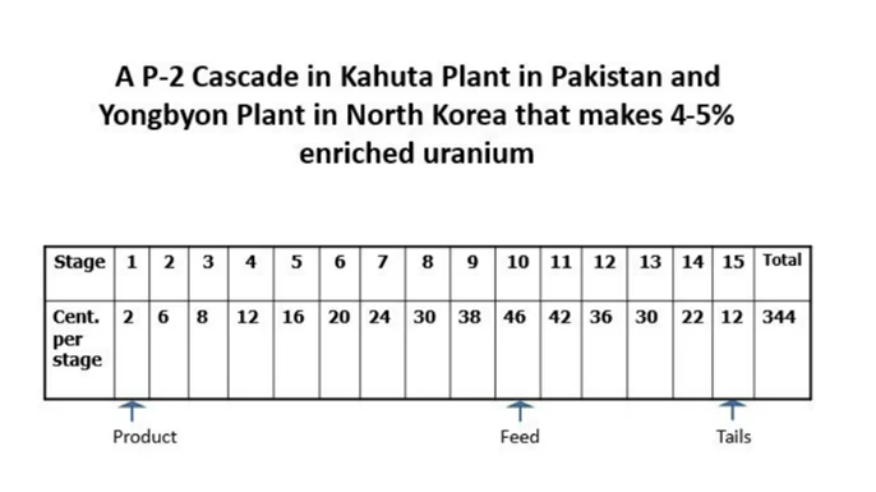
(Courtesy: Institute for Science and International Security, USA)
The report said the P-2 centrifuge was based on the German G-2 design — which AQ Khan had acquired through the European uranium enrichment industry in the 1970s. Khan later developed the technology at Pakistan's Khan Research Laboratories (KRL). The ISIS report also confirms — Khan and his associates provided North Korea with P-2 centrifuge technology, equipment and technical training in the late 1990s. They also helped North Korean technicians manufacture difficult components, including rotor tubes and bellows.
The transfer was part of a wider nuclear proliferation network operated by Pakistani scientist AQ Khan. Khan led Pakistan's uranium enrichment programme and later became central to an international network that supplied nuclear technology to other countries.
Former Pakistani President Pervez Musharraf acknowledged the North Korean transfers in his 2006 memoir, ‘In the Line of Fire’. He wrote that Khan had transferred nearly two dozen P-1 and P-2 centrifuges to North Korea. The equipment reportedly included a flow meter and special oils used in centrifuges. Khan also provided technical coaching and arranged visits to Pakistan's secret centrifuge facilities.
The United States had also mentioned about the transfers. In February 2004, US President George W. Bush publicly identified North Korea, Iran and Libya as recipients of nuclear technology supplied by Khan and his associates. A 2006 Congressional Research Service report said that US official statements left little doubt that nuclear cooperation between Pakistan and North Korea had taken place. However, important details about the scale of the transfers and the Pakistani government's role remained unclear.
Pakistan in exchange, received North Korean ‘Nodong’ ballistic missile technology — becoming the basis for its Ghauri missile programme. US Congressional Research Service documented the missile and nuclear technology links. The exact terms of the exchange remain disputed.
The Khan network also supplied centrifuge technology to Iran. It received P-1 centrifuge technology through the same network and used it to develop its uranium enrichment programme. The transfers to Iran and North Korea exposed how nuclear technology developed within Pakistan's programme had spread beyond the country.
Musharraf acknowledged that Khan had supplied North Korea but maintained that the scientist's proliferation activities were not authorised by the government. US assessments and subsequent investigations have raised questions about the extent of institutional knowledge and assistance. However, they have not conclusively established the level of authorisation by Pakistan's political and military leadership.
North Korea's present uranium enrichment infrastructure shows the long-term result of the technology transfers. The centrifuge programme gave Pyongyang an edge to produce weapons-grade fissile material alongside its plutonium programme. Nearly three decades later, Pyongyang continues to expand its nuclear material production capacity.
Savio Rodrigues
Savio Rodrigues is a Research Analyst at Escape Velocity MediaWorks Pvt Ltd and writes for Chakra News on Defence, Geopolitics, National Security. He holds a Master’s degree in International Relations from the University of Mumbai.


Comments