








Rafale M Trial Revives India’s CATOBAR Question
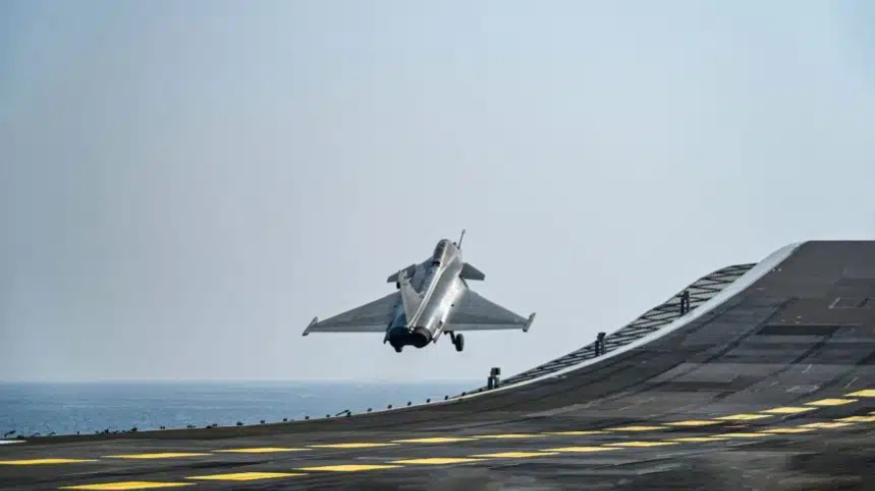
On October 29, the first Rafale M successfully landed on Indian aircraft carrier INS Vikrant. This marked a major step in the Indian Navy's plan to operate the French carrier fighter from its indigenous aircraft carrier. The Navy described the ongoing trials as the first steps towards operationalising the aircraft. The aircraft also subsequently took off from Vikrant's ski jump during the trials.
France operates the aircraft from its carrier Charles de Gaulle, which uses a catapult-assisted take-off and arrested recovery system or CATOBAR. India operates INS Vikrant and INS Vikramaditya with a different system called STOBAR, or short take-off but the same system of arrested recovery for landing.
Under STOBAR, aircraft use their own engine power and a ski jump to take off whereas a catapult is the mechanism that accelerates an aircraft for take-off. CATOBAR forms the entire system of the launch and recovery arrangement using a catapult for take-off. Arrestor wires are used for recovery under both systems, while only their take-off systems differ. India's current carriers do not use catapults.
India signed a ₹63,000 crore agreement with France in April 2025 for purchasing 26 Rafale M aircraft, comprising 22 single seat and four twin seat aircraft. The aircraft are intended for Indian aircraft carriers INS Vikrant and INS Vikramaditya. The Rafale M is the marine version of the Rafale fighter, specially modified for aircraft carrier operations.
The Rafale M trial on INS Vikrant shows the Rafale M can operate from Indian carriers because it can perform a ski jump take-off. The recent trial also demonstrates that this can be done from the actual deck of Vikrant, rather than only from a shore-based test facility.
The difference between the two systems becomes significant when the aircraft's weight increases. A catapult provides additional acceleration to the aircraft before it leaves the deck. This allows a fighter to launch with greater combinations of fuel and weapons. A STOBAR aircraft has to generate most of its take-off speed using its own engine. The ski jump changes the aircraft's flight path and provides additional lift, but it does not provide the same acceleration as a catapult.
CATOBAR can support heavier aircraft and expands the types of aircraft that can operate from a carrier. This is particularly important for fixed wing airborne early warning aircraft, which can provide surveillance and battle management from much greater distances than helicopters. STOBAR also imposes greater restrictions on aircraft launch weight and the number of aircraft that can be operated efficiently from the deck.
India's carrier history also shows that the country has used different approaches. The original INS Vikrant, commissioned in 1961, was designed as a CATOBAR carrier. It operated the Sea Hawk and Alizé aircraft. The carrier was later converted to operate Sea Harriers using the short take-off and vertical landing concept and an angle deck.
INS Viraat continued with the Sea Harrier era. India then moved to STOBAR with INS Vikramaditya, which was acquired from Russia and entered service with the MiG 29K as its initial fixed wing fighter. India's first indigenous carrier — INS Vikrant retained the STOBAR configuration. The carrier was commissioned in September 2022 and has a full displacement of close to 45,000 tonnes.
The choice of STOBAR was linked to the cost and complexity of CATOBAR. A 2022 report by the DRDO noted that India's proposed second indigenous aircraft carrier — IAC 2 was planned with a CATOBAR system. The proposal faced budget constraints, while a repeat order of the Vikrant design emerged as a lower cost alternative. The same report noted that STOBAR was cheaper than CATOBAR but reduced the number and operational flexibility of aircraft that could be accommodated. IAC 1A is the proposed improved follow-on to INS Vikrant, retaining the basic STOBAR architecture. The follow-on carrier has not yet received final approval or entered construction.
CATOBAR also requires complex launch machinery and a carrier designed around it. Earlier Indian plans for a larger IAC 2 envisaged a catapult-based system. India has examined electromagnetic catapults as part of these discussions. The move from conventional steam catapults to electromagnetic systems such as EMALS has also raised the technological and power requirements of modern CATOBAR carriers.
In an interview on India's future carrier fighter requirements, former Indian Navy chief Admiral Arun Prakash specifically highlighted the importance of fixed wing AEW aircraft and CATOBAR, saying, “Air-borne Early Warning (AEW) remains a vital requirement for a carrier at sea. Comprehensive warning and control can be delivered only by fixed-wing AEW aircraft Such machines can be operated only from CATOBAR carriers.”
Other navies have followed different paths. The United States operates CATOBAR carriers, while France operates the Charles de Gaulle with a catapult system. China has moved from its earlier STOBAR carriers, Liaoning and Shandong, to the CATOBAR equipped Fujian. Fujian uses electromagnetic catapults, giving China a carrier architecture capable of launching heavier aircraft and expanding its fixed wing aviation options.
The Rafale M will present a significant upgrade over the Navy's existing MiG 29K fleet operating from the current carriers. The main improvement is in sensors, electronic warfare and weapons. Rafale M uses the RBE2 AESA radar and SPECTRA electronic warfare suite, along with weapons such as Meteor, MICA and Exocet. India already operates 36 Rafales with the IAF, giving the Navy some commonality in training, maintenance and weapons.
The Rafale M will serve as a bridge between the MiG 29K and India's planned Twin Engine Deck Based Fighter or TEDBF. Developed by the Aeronautical Development Agency with HAL and the Navy, TEDBF is intended to become India's indigenous next generation carrier fighter. The Rafale M gives the Navy a modern fighter while TEDBF is developed, and its operation from Vikrant will also provide valuable experience in integrating a new generation fighter with India's STOBAR carrier system. The TEDBF programme remains under development, with its design largely matured and aerodynamic validation underway, but formal CCS approval for full scale development is still pending.
The Rafale M trial thus underlines that a fighter developed for a CATOBAR carrier can be adapted to India's STOBAR environment. The question for India's future carrier programme is whether STOBAR will remain the preferred architecture or whether a future carrier will finally move to CATOBAR. That decision will shape the aircraft India can operate, the payload they can carry, the airborne surveillance available to the fleet and the overall effectiveness of its carrier aviation.
Savio Rodrigues
Savio Rodrigues is a Research Analyst at Escape Velocity MediaWorks Pvt Ltd and writes for Chakra News on Defence, Geopolitics, National Security. He holds a Master’s degree in International Relations from the University of Mumbai.


Comments