







THE G 3 MEET: HIGH ON OPTICS BUT LOW ON SUBSTANCE
Introduction
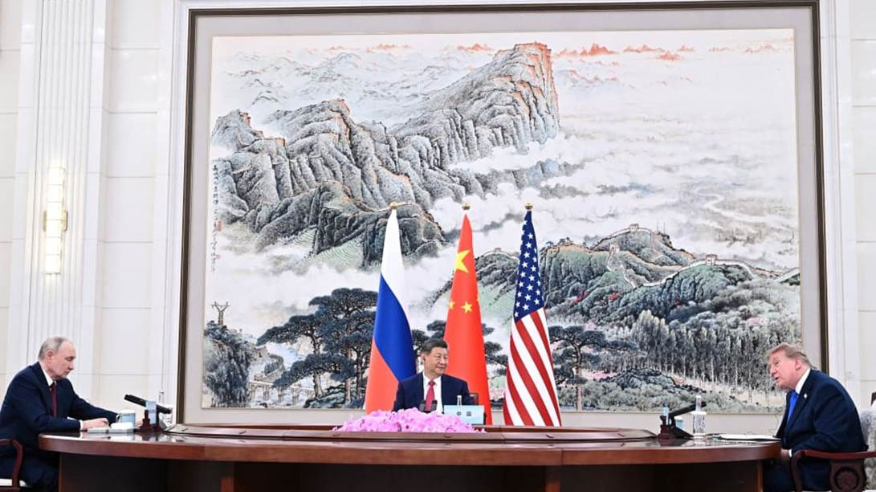
On 19 November the first ever formal trilateral talks were held between Chinese President Xi Jinping, US President Donald Trump and Russian President Vladimir Putin on the sidelines of the Asia-Pacific Economic Cooperation (APEC) summit at Shenzhen. The talks yielded a joint “peace declaration” and effusive assessments from the three leaders. The trilateral comes at a time when the world is in the midst of ongoing conflicts and is an important moment in great power diplomacy.
While some believe the success of the meeting could have a stabilising effect on an international order in turmoil, the broad consensus among analysts is that this first-of-its-kind meeting worked more as a confidence-building exercise between the rival nations rather than a focus on resolving the global problems.
According to a joint statement released after the meeting, stated that they had “in-depth exchange of views on the current international situation” and committed themselves to maintaining strategic stability and international security.
The Four Points
They agreed on four points, including a commitment to reform UN so it can respond more effectively to global challenges and conform to its fundamental mission of international peace and security. They pledged to “increase the production and supply of refined petroleum products for the benefit of all nations and reaffirmed the importance of stable energy flows.” Incidentally, the three US, China and Russia have the greatest refining capacity in the world. However, Russian refineries are under attack from Ukraine hence is this a message to Zelensky to stop targeting them.
The leaders also said they would hold a dialogue on reducing nuclear risks and preventing the proliferation of nuclear weapons, and agreed that the International Criminal Court (ICC) and similar institutions “must not abuse their jurisdiction”.
In his opening remarks at the meeting, Xi noted the responsibilities that lie on the shoulders of major powers. Their positive interaction is not optional, but a must,” he said, adding later that the three countries should maintain regular high-level engagement, keep channels of dialogue open at all levels and establish crisis communication and prevention mechanisms.
Trump, in turn, called for a reduction in nuclear weapon stockpiles and expressed his feelings regarding “rogue globalist organisations”, pointing the finger at the ICC, which his administration has been working to dismantle.
Trump also set aside the criticism for the three-way talks with China and Russia by stating that “No peace was ever forged by declining opportunities for engagement. Together, we are choosing a different course,” he said.
Like the other two leaders, Putin noted a shared responsibility for maintaining global peace and security and spoke of shared interests in tackling issues like transnational crime. But top of his agenda was the war in Ukraine, which Putin said he had discussed when he met Xi and Trump separately. However, the joint statement said nothing about the Russia-Ukraine war, which was the issue Putin had originally proposed for discussion.
The “Declaration towards Peace” is an acknowledgement to fight the global challenges
The most promising outcome from the final statement was the pledge to engage in dialogue on reducing nuclear risks and preventing the proliferation of nuclear weapons.
The famous line that nuclear wars “cannot be won and must never be fought” has now been reiterated by the US and the Soviet Union in 1985, by the Permanent Five members of the UN Security Council in 2022 and now again in during this trilateral summit. It’s a positive sign, of course, that these leaders intend to avoid nuclear war. On the other hand, it’s easier to agree on reusing a statement used for more than forty years than to say something more substantial.
That apart the Declaration was modest. However, the gathering of the three leaders tried to convey some sort of congruence of interests at a time when there is actually a divergence in their geopolitical goals and ambitions.
The Outcomes
All three leaders appeared to have gotten something out of the trilateral meeting. For China, being the host country meant it could shape the agenda and spotlight the country’s centrality within the global order.
The success of the meeting has had a positive effect on China’s international status and influence, and it also reflects Beijing’s diplomatic power in being able to bring the three parties together. Shenzhen, has personal significance for Xi. His father, Xi Zhongxun, played a major role in building up Shenzhen from a small village into a major technology hub. In gathering world leaders there, Xi demonstrated how he is continuing to transform the country and building on his father’s work. He has staked his legacy on making China strong on the world stage.
For President Putin, the meeting is a sign to the world that Russia remains a peer power. It’s is also a signal that Russia is not isolated globally. The photograph of the meeting validated Russia as a great power and him as a global leader. Along with the photo with twenty other leaders, it underscored that European efforts to isolate Russia diplomatically had failed
While for President Trump this meeting serves to reassert US global leadership after his midterm losses have left him a lame duck President at home. The thing about Trump is that he seems to crave attention-seeking events. He likes the optics of doing unconventional things that no other American leader has done and a three-way meeting is good for his image.
"We had one of the most momentous international summits in many years," Trump stated on his return adding that there was "great electricity" between the leaders of the world's main powers. "I have fantastic relationships with Putin. That's a very good thing. I have fantastic relationships with President Xi. That's a good thing, and our country is safe because of that."
The wars in Ukraine and Iran did not get the required attention from the trio. China has no incentive to get involved in Iran, a war of Trump’s making from which he is trying to extricate the US. And as far as Ukraine is concerned China is watching from the sidelines as both US and Europe remain preoccupied with the conflict which suits China fine.
In concluding remarks, Xi described the talks as “positive, constructive and fruitful” and Putin is quoted telling Xi: “I don’t think anyone even expected everything to go so well.” And he later told a press conference that the meeting was “open” and “very useful”.
Symbolism over Substance
However, the trilateral meet seems more about symbolism given the lack of concrete progress on thorny issues, including the wars in Ukraine and Iran.
With the fallout from the Nvidia affair and the midterms causing a recalibration in US strategy vis-à-vis China, is the trade truce between Washington and Beijing is at risk? Xi could ramp up rare-earth or other supply-chain restrictions in response to stricter enforcement of US chip controls.
The joint statement from the three leaders was a minor achievement, but a low-hanging fruit. But perceptions and optics matter to some extent in international politics.
A potential benefit of the trilateral meeting is that it can help the three countries boost mutual trust, which in turn can help to stabilise the current international situation.
Hence, having the meeting itself is significant as it sends out important signals that the three major powers have the capacity to manage their differences and competition through dialogue.
If symbolism is a pointer, the US President Roosevelt, UK Prime Minister Winston Churchill and Soviet Premier Joseph Stalin met in Yalta in 1945 setting out the post-war peace and carving up the world between them. At that time the US President was placed in the centre of the photograph. This time the image is of Xi Jinping at the centre of a large room, flanked to the sides by the Presidents of the US and Russia which suggests that the world increasingly revolves around Beijing’s power and preferences.
Conclusion
There is no doubt that allusions to Yalta 2.0 were overblown. Ukraine and Taiwan, were also not on the menu. Further, optics took precedence over substance. Some analysts believe there could be more trilateral interactions in the future. But one summit meeting was not expected to resolve all problems. The question whether it will evolve into a more substantive mechanism.
Each of the countries pushed an agenda. For China, it was reform of the UN. For both China and Russia, more fossil fuel production with a message of ensuring free flow of crude and not targeting refineries. The call for heads of state to enjoy immunity from the International Criminal Court is probably aimed at both Putin and Netanyahu. While conducting a dialogue on reducing nuclear risks and preventing the proliferation of nuclear weapons was probably put forth by the US.
The limitation of nuclear arms amongst the trilateral nations seems distant. China continues to expand its nuclear arsenal quickly and is unwilling to negotiate limitations while its nuclear stockpile is still a fraction of Washington’s and Moscow’s.
However, the concern about limiting “nuclear risk” is significant in a world of artificial intelligence, automated weapons and the proliferation of delivery systems that can deliver either conventional or nuclear ordnance. It important to to ensure human control of nuclear weapons and reduce the dangers of crisis escalation inherent in dual-use delivery systems.
But whether the meeting bears real fruit remains to be seen. As the statements ended up by tiptoeing around the actual problems afflicting the globe. The reality is that they did not commit to ending any war.
All eyes are now on what happens at the G20 in Miami in mid-December. Xi is expected to attend. Putin has been invited, but it is unclear whether he will attend. This is the next opportunity for the leaders to build on anything they established during the Shenzhen talks.
Maj Gen Jagatbir Singh, VSM (Retired)
Major General Jagatbir Singh is an Armoured Corps Officer who commanded the First Armoured Division. He served in varied terrains and tenanted important command, staff and instructional appointments including a UN Peace Keeping Mission in Iraq and Kuwait. He co-authored ‘Armour 1971’ and edited ‘Valour and Honour’.


Comments