






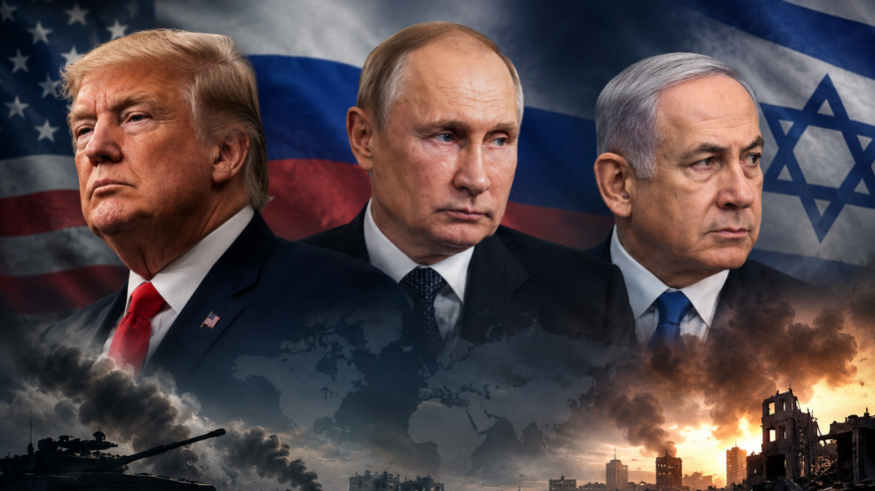
Why Trump, Putin and Netanyahu are caught in an endless conflict
Introduction
General VN Sharma the former Army Chief while writing the foreword of Armour 71; had written that; “it is easy to start a war, but once started, it is difficult to terminate hostilities on terms advantageous to oneself. A good General must plan for the termination of conflict before starting one. A good General must also attempt to achieve the national aim with minimum loss of men and material, both of oneself and of the enemy. To motivate troops in battle, ‘hating the enemy’ must be avoided as the aim is never to destroy masses of the human population or to cause total distress to the civil population by levelling cities and destroying families.”
India’s operations in 1971 were marked by careful planning and remarkable operational execution. This resulted in a decisive victory in a matter of sixteen days leading to the creation of Bangladesh. The benchmark had been set but no conflict across the globe thereafter has achieved this scale of victory. It was the finest example of a spectacular short swift war.
Victory
The word ‘victory’ derived from Latin (victoria, from vinco victus, ‘to conquer’), is mostly associated with fighting, battle, and competition. Amongst the most common synonyms for victory is winning, meaning to prevail, to triumph whilst another common synonym is conquest.
‘Military victory’ is alluring yet those who invoke the term rarely define it. “Victory” means achieving the political aims for which one went to war. But “military victory” implies more. It implies that political aims are secured through combat rather than negotiations which require compromise. Battlefield victory, by contrast, promises a defeated enemy with no meaningful choice but to accept the victor’s terms. This is what makes the idea attractive and so ubiquitous.
At first glance, victory in war appears straightforward. One side accomplishes its objectives, while the other loses both the capability and the will to continue fighting. Much military history is built on this simple logic. But victory ultimately rests on two questions: What have own forces achieved, and what has happened to the enemy?
The allure of military victory lies in its promise of absolute resolution, political dominance, and the structural reshaping of power. Throughout history, nations and leaders have been drawn to battle by the belief that decisive military triumphs can permanently secure borders, deter adversaries, and forge lasting peace.
However, modern warfare frequently defies the concept of a clean, decisive victory. Instead of permanent resolutions, current global conflicts often result in prolonged attrition, regional instability, deep humanitarian crises and festering wounds.
Unfortunately, the lure of military victory has repeatedly led governments to start or prolong wars on false premises about how those wars would end.
Historical Context
History is replete with numerous examples of battlefield victors eventually losing the war, or the defeated coming out as winners. More recent armed conflicts such as the wars in Iraq and Afghanistan have illustrated that strategic success cannot be achieved by military force alone and that victory requires not only the defeat of the opponent’s military capabilities but also the successful resolution of the deeper problems at the root of the conflict.
One of the greatest ancient Generals was Hannibal who commanded the forces of Carthage in their conquest of Spain and Italy in the second Punic War and known for crossing the Alps with elephants. He occupied most of Southern Italy for fifteen years. The Romans, led by Fabius Maximus, avoided directly engaging him, instead waging a war of attrition. Thereafter, Scipio invaded Africa compelling Hannibal to leave Italy to defend his homeland.
Hannibal demonstrated that winning individual battles does not guarantee ultimate victory. War is a complex interplay of factors which include the ability to sustain the war effort over time and the political will to continue fighting.
Additionally, the character of war since the end of the Cold War has changed, because of changing technologies and the re-emergence of a wide variety of non-state actors.
But modern wars have all ended in negotiated settlements. To end a war, both sides must choose to stop fighting and start discussing. Destruction matters, of course. It is what distinguishes war from peacetime politics. But its role is to shape the bargain.
Ongoing Conflicts and the Notion of Victory
The world is at war. Recent years have seen a series of high-intensity and far-reaching conflicts dominate global affairs, on a scale not seen in decades. As per the Uppsala Conflict Data Program (UCDP) Report for 2025 released in June this year were 65 conflicts raging worldwide. The number of interstate conflicts doubled for the second year in a row, from two in 2023 to eight in 2025. This is the highest figure since UCDP began its data collection in 1946.
For a long time, wars between states have been relatively uncommon, but developments in recent years indicate increased international tensions and changes in the global security order.
President Trump launched the war on Iran without clearly delineated objectives, without consulting Congress or US allies (other than Israel) , without exhausting diplomacy or economic coercion and without an exit strategy. Believing force could compel Iran’s unconditional surrender; instead, the US finds itself in a stalemate.
The US is far superior to Iran militarily. Yet, it has not succeeded in bringing Iran to its knees militarily. While Iran has managed to establish a degree of symmetry: through its ability to attack US military bases and allies in the Gulf region and through economic pressure via the Strait of Hormuz.
The expectation of military victory in Iran has left the Trump administration without a theory of how to end the fighting, even as the costs mount and global economic disruption increases.
The Russian army has now been fighting in Ukraine for longer than Stalin’s Red Army fought Hitler’s Wehrmacht in the Second World War. President Putin and his military strategists were completely wrong about how long the conflict would last, having originally intended to bring it to an end in a blitzkrieg. In quantitative terms, Russia is superior to Ukraine. Nevertheless, Ukraine has managed to respond to Russia’s escalatory moves though at a high cost. Putin’s expectation of battlefield victory in Ukraine has resulted in a war of attrition with no apparent endgame.
The formal objectives of the war in Gaza were a decisive defeat meant dismantling Hamas’s military power and eliminating its governance. Militarily, Hamas is no longer the entity it was before 07 October 2023. Its leaders have been killed and organizational structure shattered. But its fighters continue operating as small, uncoordinated guerrilla cells focused primarily on survival.
However, Hamas’s military defeat does not automatically translate into the end of its rule. Eliminating its governing capacity requires a competing authority capable of assuming control.
The Netanyahu government’s conviction that it can annihilate Hamas has lengthened the Gaza war and led to a genocide in pursuit of an unattainable goal. While the underlying political grievances and ideological drivers remain.
Unfortunately, the architects of these wars vastly exaggerated what military power can achieve, underestimated the capacity of adversaries to adapt, took for granted that allies would fall in line, and disregarded the lives of ordinary people.
Victory occurs at each of the four levels of national security; tactics, operations, military strategy and national strategy. Hence defeating an opponent militarily is not identical to achieving the object of war, the reason for which the war was fought.
Conclusion
Fred Iklé wrote in his book ‘Every War Must End’ (1971); that to ‘“bring the fighting to an end, one nation or the other almost always has to revise its war aims.” He also wrote that ‘those with power to start a war frequently come to discover that they lack the power to stop it.’
Misunderstanding how wars end can result in ill-designed military operations. Thoughts on how wars conclude also breed prewar errors in doctrines, intelligence, modernization, and force structures. Today most militaries are structured itself around assumptions of short, decisive wars and munition stockpiles are limited. These policies trade long-term staying power for short-term lethality and presuppose that conflicts end quickly by destroying the opposing military. Prudence dictates reconsidering the choices.
However, the elusiveness of military victory does not make battlefield effectiveness irrelevant. The purpose of fighting is to shape the bargaining leverage, not to annihilate the enemy. Success in combat must enable productive talks. To quote Liddell Hart, a 20th-century British military theorist ‘the object of war is to achieve a better state of peace—even if it is only from your point of view.’
The history of warfare also demonstrates that victory is achieved not only through military strength and success but by a combination of political direction, military professionalism, diplomacy, economic strength, technology and national will all working towards the strategic objective.
Unfortunately, few wars end well as pursuit of military solutions have instead deepened conflicts, consumed resources and left wars with no clear path to an end.
War however remains the ultimate arbiter in disputes and decisive military victory is the surest way to achieve one’s political aims.’ No wonder Clausewitz famous saying is that ‘war is a continuation of politics by other means.’ However, each war seems to leave behind consequences that fuel future tensions.
Maj Gen Jagatbir Singh, VSM (Retired)
Major General Jagatbir Singh is an Armoured Corps Officer who commanded the First Armoured Division. He served in varied terrains and tenanted important command, staff and instructional appointments including a UN Peace Keeping Mission in Iraq and Kuwait. He co-authored ‘Armour 1971’ and edited ‘Valour and Honour’.




Comments