











Indian firm offers rifles to UK military

For over two centuries, Indian soldiers carried British-made rifles— the Brown Bess muskets in the early 19th century and the Short Magazine Lee Enfield in the 19th century until the mid-20th century.
An Indian arms firm is determined to rewrite history. Bengaluru-based small arms maker SSS Defence has announced it will participate in a global contest to supply the UK Army with over 150,000 new rifles. A post on X by the SSS Defence said “We have taken a firm decision to pursue participation in the UK MoD’s Project Grayburn. For some time, this opportunity occupied our mindspace. No longer. Why make it official? Because we have successfully delivered to our Indian customers, and actions speak louder than words. Because we stand fully confident in the progressive design, manufacturing quality, and battlefield reliability of our weapon systems. Because commitment transforms ‘we might’ into ‘we will.’ From India to the world.”
SSS Defence CEO Vivek Krishnan, in a post on X, said that’ Project Grayburn is a go’.
While the other social media accounts amplified the post on X and wished the company all the best for the Project Grayburn
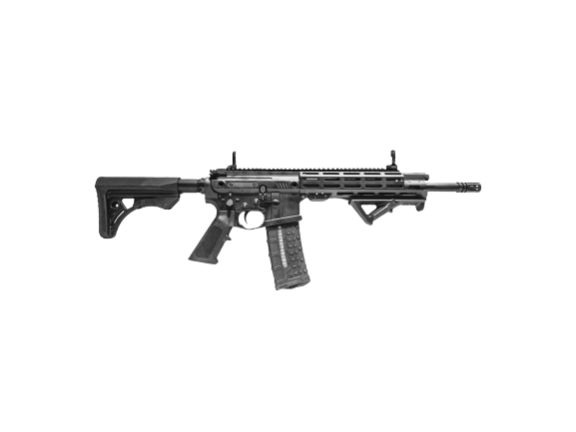
While the calibre is not known, high chances are it is going to be 5.56 NATO, and if it is 5.56 NATO, then Manohar-72 or M-72 chambered for the 5.56x45mm calibre ammunition will be offered for the United Kingdom’s Project Grayburn tender.
The project aims to replace the SA80, which has been in service with the UK since 1987. The SA80 will be phased out by 2030. They will be replaced by 150,000 to 180,000 rifles of a yet-to-be-decided calibre.
This bid, if it goes through, will make SSS Defence the first Indian private-sector firearm company to participate in a significant foreign small arms order.
The M72 is designed for reliability, accuracy, and adaptability in the harshest conditions. The short-stroke piston system of the M72 ensures cleaner operation, reduced recoil, and superior control - allowing operators to stay in the fight longer and with greater accuracy.
The M72 can be configured for different barrel lengths - 10.5”, 12.5”, 14.5” and 16’’ based on mission criteria and the barrel can be offered with a chrome plating or nitride finish to the bore. The barrel production process provides high wear resistance at the time of firing, as well as excellent accuracy and concentration of fire.
The rifle’s ambidextrous controls include a multi-mode fire selector (Safe, Semi, Auto), charging handle and magazine catch for greater versatility. Keeping in mind the operator’s form factor, the design incorporates multiple ergonomic features. The M72 has also been equipped with a drop-in trigger, an adjustable buttstock and Picatinny rails at 3, 6, 9 and 12 o'clock positions to add on accessories as the mission demands.
The external Cerakote finish ensures that the weapon can withstand extreme environments and has higher corrosion resistance.
If the UK decides on another calibre, then we might see a weapon by SSS Defence in that particular calibre, such as M-72 chambered in 6.8mm (.277 Fury), 6.5mm Creedmoor or the T-72 chambered in these two calibres. One more reason could be the US switching to 6.8mm
If the UK decides on 5.56 NATO, SSS Defence’s competitors will include American Sig Sauer, which may offer MCX, Knights Armament with KS-1, Italian Beretta UK subsidiary with NARP (New Assault Rifle Platform) and with SAKO M23 or ARG (Arctic Rifle Generation), Belgian FN Herstal with SCAR-L MK-2 and SCAR MK-3, Austrian Glock with GR-115 rifle and the German Heckler and Koch with their HK-416 and HK-433, Lewis Machine Tools with their MARS-16, Czech Republic CZ with Bren-3 and with Colt can offer M5 rifle, Colt Canada with their C8 assault rifle and the Israeli IWI ARAD assault rifle. Indian SSS Defence will offer its Manohar-72 (M-72) assault rifle. Other calibres, such as 6.8 mm and 6.5 mm Creedmoor, are being looked at.
Chances are the UK might choose 5.56 NATO as their special forces have 5.56 NATO and AR-15 platforms like KS-1 and MCX. The UK has become another country which has started discarding the bullpup platform in favour of the AR-15 platform.
The SA-80 assault rifles, also known as the L85, in service since 1987. The Royal Arms Factory manufactures it. The L85 family includes the L85 Individual Weapon, which is the rifle, L86 Light Support Weapon (LSW), in other words, L86 Light Machine Gun (LMG), and L22 Carbine and L98 Cadet weapon. The SA-80 is chambered in 5.56x45mm NATO and has an overall length of 785 mm (30.9 inches) with a barrel length of 20.4 inches.
The rifle has a muzzle velocity of approximately 940 m/s and an effective range of 400 to 600 meters, depending on the sighting system used. SA-80 is a Gas-operated, short-stroke piston with a rotating bolt, capable of both semi-automatic and fully automatic fire. The SA-80A1 rifle was plagued by reliability issues, which included fragile parts, and the rifle jammed frequently in the desert environment.
These issues were sorted out by German firearms manufacturer Heckler and Koch with versions such as SA-80A2 or the L85A2, and SA-80A3 or the L85A3. The SA-80A2 had improved reliability issues from the previous version and came into service in the 2000s. The SA-80A3 is the latest version entering service in 2018 with the British Army. This variant features a new handguard with a continuous Picatinny rail for modularity and improved internal components. The SA-80A3 will remain in service until 2030 and will be replaced by a new rifle under Project Grayburn.
The UK Commando have ordered the American Knight’s Armament KS-1, which is an AR-15 platform, designated as the L403A1 assault rifle chambered in 5.56 x45 mm NATO under Project Hunter in 2023. Another rifle selected by the UK Commando Force under Project Hay is the American Sig Sauer MCX. The MCX replaces the L119A1 rifles produced by Colt Canada and is designed to complement the Commandos' new general-use weapon, the L403A1, better known as the KS-1.
Project Grayburn will also replace pistols and light machine guns. A UK Defence Journal report says concept work is examining multiple variants built around a common architecture, likely including a standard dismounted close combat rifle, a shorter variant, a personal defence weapon to replace the L22 carbine, a generalist rifle and a cadet weapon to replace the L98. The MOD has now confirmed that decisions on barrel length and variant distinctions will also be taken during the concept phase.
Arjun Dev Singh
Arjun Dev Singh has a deep interest in defence, security, and strategic affairs. With a strong analytical lens and a passion for military and geopolitical developments, Arjun strives to bring clarity and context to complex national and international issues.





Comments