












The K-5 Emerges

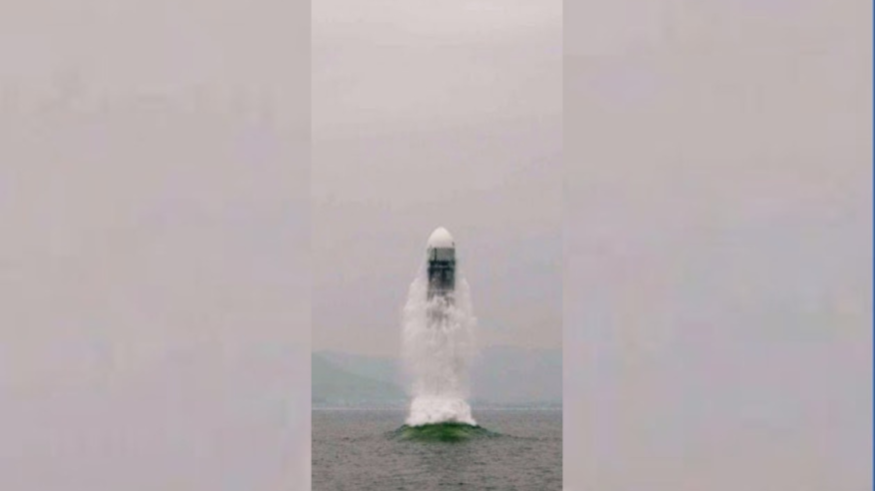
India recently conducted a pop-up test of its new submarine-launched ballistic missile, the K5. The test was conducted in the Bay of Bengal near Visakhapatnam in the last week of March. The K-5 missile has a range of over 5000 kilometres. It is the naval equivalent of India’s Agni-5 ICBM (Inter Continental Ballistic Missile). The missile has a length of 12 metres and a diameter of 2.4 meters. It weighs over 20 tons. The K-5 has a 2-ton warhead. It is believed to carry multiple warheads or MIRVs (Multiple Independently Targetable Re-Entry Vehicles). At least three from what we know.
The new SSBNs of the S5 series will be equipped with the K-5 missile. An SLBM is a ballistic missile that is fired from under the water from a submarine. The missile is ejected from a submarine underwater using a gas ejection system. Once, the missile clears the surface of the sea and ignites its rocket booster, which takes it out of the atmosphere. The missile warhead then re-enters the earth and strikes at its target.
A pop-up test is one where the missile doesn't fire its rocket booster. It tests only the first stage of the missile. It is a test of the gas ejection system that actually pushes the missile out of the vertical launch tube. The missile falls a few hundred metres away from the launcher.
According to a post on X by Damien Symon on March 24, India issued a notification for a 'Firing Exercise' (likely naval missile test) in the Bay of Bengal region, from 30-31 March 2026. Interestingly, India’s third SSBN, the INS Aridhaman, was commissioned on 3 April, a few days after this test. The pop-up test of the K5 is significant. It is the third type of submarine-launched ballistic missile (SLBM) in India’s inventory. All of these missiles are developed by the DRDO’s Advanced Systems Laboratory based in Hyderabad.
The last such pop-up test of a missile was that of the K-4 in 2010, which is more than 16 years ago. I broke the story of the “K missile family” in the India Today magazine in 2010. The K4 missile, which has a range of 3500 kilometres, is now in service on the Arihant class submarines. The K missiles are named for India’s former president and missile man, Dr APJ Abdul Kalam. The K-5 will arm the S5 ballistic missile submarine, which is currently under construction in Vizag. The S5 displaces over 13,000 tonnes. It is the largest non-aircraft carrier defence platform built by India.
The first S5 class submarine will enter service with the Indian Navy sometime in the early 2030s. India plans to build four of these giant submarines over the next decade. Each submarine will cost over Rs 20,000 crore. The S5 will augment the Arihant class into the 2030s. These SSBNs will form the most secure and survivable leg of the nuclear triad comprising air, land and sea-based vectors. It will allow India to target all its adversaries from the Bay of Bengal. But it will take some years for the K5 to enter service.
What's next for the K5 missile?
The successful pop-up tests of the K-5 will ensure that the DRDO can move on to the next phase of tests. The actual full range test, where the missile will not just pop up, but also fire its two-stage rockets. This is likely to be in the Bay of Bengal. In November 2025, the Advanced Centre for Energetic Materials completed successful static tests of the K-5S 10-ton-class, stage-2 rocket motor at the Armament & Combat Engineering Systems facility in Hyderabad. The test confirmed various parameters for the solid rocket motor. Its effectiveness and reliability for the actual test— ballistic performance, safety margins, subsystem integration, burn time, thrust, and structural integrity.
Sandeep Unnithan
Veteran journalist with 30+ years in media, Sandeep Unnithan is a national security expert and author of two acclaimed books, including Black Tornado, adapted into the web series State of Siege.




Comments