







India-China thaw not driven by Trump pressure: Amb Ashok Kantha.
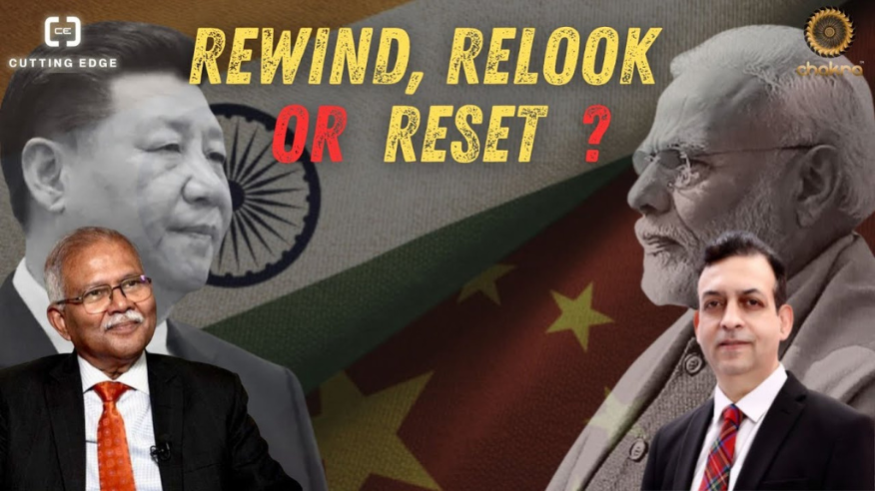
Prime Minister Modi is visiting China for the first time in seven years. What to expect from the visit? Colonel Anurag Awasthi (retired) spoke with Ashok Kantha, Former ambassador to China.
Col. Awasthi: To begin with, if we look at the timelines post Galwan post 2020, we have seen the prime minister meeting Xi Jinping in 2022 then, he met him in 2023 in Johannesburg in 2024 of course, there was a little perceived thaw as we could make out in Kazan and now he meets again this time in Tianjin in the SEO summit. So, are there some tangible things that are likely to come out in spite of all these pain points that we have with China?
Amb. Kantha: Well, you know what you're witnessing, especially since the Prime Minister's meeting with President Xi Jinping in Kazan on October 23rd last year. There is a process of gradual improvement in relations. India's channel relations, as you're aware, have gone through a very rough patch. Especially after Chinese transgressions in eastern Ladakh during the summer of 2020.
It took us a very long time to get over that hump. We maintained the position that unless border areas return to normal, it's very difficult for us to have normal relations. This engagement was more or less completed by October last year. The Prime Minister's meeting with Xi led to the beginning of the process of re-engagement and rebuilding of relations, and that has progressed since then.
Focus has been much more on what we call people-centric contacts. There have been high-level exchanges. Most recently, we had Foreign Minister Wang Yi of China visiting India, and he had a very substantive visit to India. Earlier in the context of SCO, we had visits of our defence minister, our minister of external affairs, and the national security adviser to China, and also, the foreign secretary earlier to Beijing.
Col. Awasthi: You've been in China for three tenures. I mean, you've had three major tenures in China, including the Indian ambassador in Beijing, and your predecessor was the current foreign minister, you know, that is Mr. Jaishankar. So you've had some great insights into how China actually functions, sir. So do you think, sir, there's going to be a very major upheaval of things in times to come, and how is it going to affect the Indian foreign policy?
Amb Kantha: Well, there's no doubt about the fact that we are living through a reordering moment. Yes, in the global landscape. There were some important changes that were taking place even earlier. But in the second Trump administration, those changes have been accelerated. He has proved to be a disruptive personality.
So, we are faced with a bolt that is turbulent. We are faced with a strategic partnership with the USA, which has been progressing quite steadily for nearly a quarter of a century. And now, there are serious question marks about the future trajectory of the relationship. Yes. So, because you know what, we see several negative signals emanating from Washington, DC, on a whole lot of issues. It's not just a question of tariffs, where you know what President Trump has done is unreasonable. Both the tariff of 25% and the proposed penultimate tariff of another 25% because we buy oil from Russia.
It's not only that we received no signals on Pakistan during the 4-day conflict with that country in the context of India and also China, because we don't wish to look at our relations with the USA through the prism of China or with China through the prism of the USA. The fact remains that these critical relationships are influenced by a changing global landscape and geopolitical environment.
Col. Awasthi: How do you advance your interests, keeping in mind a somewhat longer-term time horizon? Okay, rather than quick-fix solutions, possibly how much would be this time horizon?
Amb Kantha: It's very very very difficult to say that because you can't control behavior of other site for instance let's talk about USA, it's an essential partnership for us very deep yes and it's an essential partnership not only for navigating a very complex geopolitical environment but also as a factor in our advancement towards the objective part by 2047 it's the largest you know market in the world it's the most important source of technology in the world so we need to bring that relationship back to more normal track How long that will take I don't know. But that objective should be borne in mind. We can likewise discuss China later if you like. But then you know, I think it's it's I I think it should transcend personalities as I look at it, sir. And then there are those midterm elections which are there next November.
Col. Awasthi: So there's a lot of play that is happening insofar as the United States is concerned. But, my question to you sir at this juncture as we speak like we you've spoken about strategic patience and all all our viewers must read Ambassador Kantha’s columns in Vivekananda international foundation on strategic strategic patients I think they're outstanding you must read them give you a great perspective as to how things are panning out but either way sir, when you look at it do you think like you've been in Beijing for so long do you think this you know New Delhi Moscow Beijing access can be a reality one day. Is it possible or not possible?
Amb. Kantha: I don't think we are heading towards any kind of access involving these three countries. Yes. I mean, there is the RIC forum, which has met earlier, even at the summit level. Somewhere down the road, there may be no resumption of contacts at that level. I have been part of the RIC process both at the track one level and the track two level. I have seen that it's a triangle where one arm is short and weak.
And that is the India-China relationship. India has good relations with Russia., Russia has good relations with India and China, but when it comes to our relations with China, there's still a serious deficit. Okay. This makes it difficult for us to find a robust agenda based on the convergence of interests. And so I say that a dialogue forum may be useful. But as a platform for you know developing common positions, I doubt it. And there is another significant problem that Russia and China have moved much closer in recent years, because their strategic engagement always has an anti-Western sort of complexion to it. There's a tension now for us that's not part of our agenda. We are not anti-Western. No, we have excellent relations with Western countries, notwithstanding the current difficulties we are facing with the USA. So we don't want to be part of such a you know sort of approach which can be predicated on sending out anti-western signals. So it has its limitations.
Col. Awasthi: You think when you're looking at BRICS and BRICS as a counterbalance to whatever is happening today, and you have the currencies and you have the talent and you have the geographies and you have the you know economic heft of these five countries together vis the rest. If that ever happens and China takes that pole position into that, do you think this, in case it works out, calls for an Asian unity and the global south unity against the others? Is it possible? Not possible. Sir,
Amb Kantha: You know, Anrag um India has not quite looked at bricks as a strategic platform. You know, China is taking the pole position there. No, dominating BRICS. BRICS has been useful in terms of certain practical initiatives it has taken, for instance New Development Bank, the BRICS bank, which was an Indian initiative. In fact, we took the initiative, and finally, you know it gained traction and know it was established in Shanghai when I was there, in fact, and the first president was Mr. Kamat from India.
Col Awasthi: But can it be a counterbalance to the Bretonwoods twins at some stage in time?
Amb Kantha: You need various sources of funding, and while the bank or ADB they're not enough. So there was room for a new development bank, which came up. You have contingent reserve arrangements. That's also a useful mechanism, but there are aspects of bricks we were not very comfortable with, like the way expansion of the organisation was carried out. India would have preferred a criteria-based expansion, which would have been more deliberate, but China forced the pace, and so they are all friendly countries that have come. So we didn't want to oppose them, but to some extent, the cohesiveness and effectiveness of bricks as a platform have been diluted.
So, that's one you know. Secondly, you know we will always be mindful that it's not hijacked by country X or country Y. So it has its limitations. Thirdly, we are not comfortable with initiatives like the BRICS currency. It's not pragmatic. It's not a realistic proposition. We are not pursuing an agenda of de-dollarisation. We have clarified that. We are there in Brexit as a major stakeholder, but we wish to maintain a degree of stability in the outfit and see that no, you know it it doesn't go off.
Col. Awasthi: So, but sir, you know you've been there, and you know when you left, you had these grave issues of Doklam first in 2017, and then Galwan happened in 2020. Now, interestingly, sir, in spite of these border issues and in spite of these great clashes, which got flashed out by the international media spiraled the relationships spiralled beyond repair in some manner or the other, there was no major implication on trades. It is surprising. But the only implication is that you know the reciprocal investments of India and China, and China and India have not grown as much in spite of the trade, which has not taken a very big hit. What are the reasons behind this?
Amb. Kantha: Well, first, you know trade. Why is it that you know trade has continued to expand even when our political relations were going through a very rough patch? You know, imports from China are essentially sticky imports. These are goods that we need. China can provide them at a competitive rate. So, Indian business, we are a free economy. Indian business now finds it useful to source from China and there were no restrictions on sourcing from China that has continued except in certain areas where you know there are security interests like telecom equipment one can't say the same thing about our exports to China because goods and services where we were globally competitive we have been unable to make any dent whatsoever in Chinese market for instance you know I'm referring to pharmaceutical products we are known as pharmacy of the world but not for China we can't very difficult to sell anything there likewise you know you're aware of our strength in the area.
You know you know we have had the presence of our IT majors in China for a long time now. All major companies are present. You have TCS, Infosys, Vipro, you name it. But they have not been able to get any meaningful entry into the domestic market because of all kinds of restrictions that have continued. They have presented they've shown perseverance, often they service other markets from China, correct Japanese market for instance so I'm just giving these two examples, you know so this is this is a problem this is what we keep telling the Chinese side that this kind of imbalance is unsustainable we can't and there's another aspect to it which is very worrisome.
You know, we have developed a very heavy dependency on imports from China in critical areas like active pharmaceutical ingredients, electronics, you know, equipment for green energy transition. They mostly sourced from China when we set up domestic manufacturing capacity, like solar panel components that are still coming from China. Now, China has an unfortunate track record of weaponising such dependencies. That is that they you know sort of stop clamping down absolutely. We had the same problem with certain kinds of speciality fertilisers.
They stopped selling tunnel boring machines to India, but I think they've now been cleared. After you know the point is that in some cases they might have resumed, but you know in the case of serial earth magnets, they have introduced a requirement of end end-user certificate. Yes, and extensive documentation, which is very user-friendly whenever we wish. So we'd like to sort of reduce, but it's not going to be easy. Now one you know an argument that is given that let's you know take Chinese help to set up the manufacturing capabilities of India. We have, in fact, tried hard to attract investment from China.
I recall when I was in Beijing, the prime minister visited in May 2015, and he made a very strong pitch. He had organised a meeting for him with all the top business leaders in Shanghai. He welcomed them to come to India, and we did work very hard to get
investment there. Unfortunately, what came from China was limited, okay, not much investment two it was in areas that were a little problematic for us, like datari areas, where we had security concerns. In some areas with very small investment, they could capture a very large segment of the market, like you know, cellular handset, and there was a real risk of opportunistic takeover. You'll recall that press note 3 was introduced on 17th April 2020 in the aftermath of the outbreak of the COVID-19 pandemic, before we had difficulties along the borders. It was not linked to the border much before the government. Before that much. So those concerns haven't gone away. Haven't seen any sign of Chinese companies being serious about creating, you know, meaningful manufacturing capabilities. India Chinese extremely careful about exporting technology like electric vehicles. They will not export technology to us now. We would like to have investment from China but investment coming in areas of interest to us and also involving some degree of transfer of technology.
Col Awasthi: Now, sir, you know what you've said is, I think, it's hit the nail on the head, but then when you look at bricks today, we just spoke about bricks, and now we are talking about SCO. Pakistan is a part of SEO, whereas it is not a part of bricks. Do you find any conflict of interest in this, or don't you? Given the China collusion, which we all know, I mean, there's nothing to gloss over that.
Amb. Awasthi: You know, when we were discussing India's entry into the SCO, and Pakistan was also joining at the same time, so this issue had come up. I happened to be the ambassador in Beijing at that time, and we had told them that, look, we are not interested in bringing bilateral issues to this forum. We deal with bilateral problems bilaterally with Pakistan. But there are larger crosscutting concerns that are not really bilateral. For instance, cross-border terrorism. Now that's one issue that is at the heart of the agenda of SCO. In fact, in some way, that was the basis for the establishment of what was initially known as Shanghai 5 and became the SCO later.
Yes, but I'm not sure we'll be able to make any meaningful headway because China Pakistan they work very closely together what you refer to collusions of course you would have seen recent comments by Chinese ambassador to India when this question was posed to him yes at a public seminar he said no Pakistan is also a victim of terrorism but I experience is somewhat different.
So it does create a problem. But, there's a larger issue with rag. I mean, this is not just limited to SCO, that while we are trying to rebuild our relations with China and it's very important for us, you know as prime minister told foreign minister Wang Yi we need you know stable predictable and constructive relations between India and China but, while pursuing that critical agenda we cannot be unmindful of certain unpalatable truths.
And one of them is the kind of collusion we witnessed between China and Pakistan during the 4-day conflict. Which was unprecedented, you know, operational collaboration, battlefield collusion that took place. So these are issues we need to discuss with China. Then you have borders, and there are issues of water. Now there are issues with Taiwan.
You know the mismatch between what we think and what they think in Taiwan. I mean, the pain points are far too many. I still know it's it's it's it has been a fraught relationship. It has been a complex relationship that hasn't prevented us from trying to improve, and that process should continue, but we shouldn't have any illusions that we can have a breakthrough in the relationship. We can have a reset in relations because you know the prime minister is meeting with the president. So, that kind of expectation will be unrealistic and counterproductive.
Col. Awasthi: So you know we are looking at the quad summit, which is supposed to be held this year. So, here in India and somehow I feel that India's as you're aware, we are between empires now, sir. So you have China, you have Russia and the United States. So do you think the new chord is going to be India, China, Russia and the United States? Do you think it's going to happen like that? So how do you balance all this?
Amb. Kantha: It's going to be one trapeze act that India needs to be doing now. Yes. I mean, it will require very careful navigation of extremely choppy waters, but you know it's not that we are facing the worst situation that we've encountered. We have dealt with worse situations. In fact, if you recall, after Pokharan too, the kind of pressures we were subjected to by the USA. The USA is working in cooperation with China. There's a pincer movement when Russia was not being very supportive then. But we did come out of that, and we came out much stronger from that situation.
So let's not know we should we should have as I said strategic clarity about assessment of situation we should have strategic patience and we should never you know jettison critical you know compass of strategic autonomy if we do that we'll do all right so we shouldn't we shouldn't we shouldn't be anxious okay and you know especially you know it's very important that as some people are suggesting that okay we are facing problems with USA let's make common cause with China let's develop some kind of India China Russia axis.
I think those approaches are not based on realism or a carefully considered strategy, and I'm very happy that just a couple of days ago, speaking at the Economic Times leaders forum, Dr. Jaishankar made it clear that look, you know, we are not seeking good relations with China because of our problems with the USA.
No, in fact, the process of improving relations started in October last year. So that has its own bilateral dynamics. We have our own set of concerns and considerations when it comes to engaging with China and surely I don't think our leadership is so naive as to think that by moving you know closer to China somehow we'll be able to you know address whatever strategic deficit we may have with USA so that's not going to happen and actually if you look at China's relations with the USA today.
They are working very seriously on what Mr. Trump calls a beautiful deal with President Xi. China has been given no extended truce, trade truce in some ways. In fact, Mr. Trump has been relatively soft on China. So, they are doing their own business. We should monitor that closely. We shouldn't think that you know the difficulties we have with the USA answer lies in working with other countries. So there's no offset either way.
Col. Awasthi: So I'll ask you if you know the last question, possibly today, sir and a very direct one: can the elephant dance with a dragon, sir, by changing its music by wearing different shoes, by wearing different costumes, by changing the beat whichever way?
Amb. Kantha: First, let me confess that I don't particularly like this analogy of the elephant and the dragon and and you know, dancing together for two reasons. One, it will very unseemly dance. Can you visualise, no, it's not going to be beautiful at all. More importantly, you know it sort of invokes certain memories that are not very comfortable for us. You know the memories of Hindi Chini Bhai Bhai, what happened. So let's be realistic. Let's work together without falling for you know tropes like the elephant and the dragon dancing together. India and China should have better relations.
I do not doubt it. It's an objective we can achieve only if China is more responsive to our concerns, our interests, our aspirations, is willing to accept India as a peer nation and not expect us to be some kind of junior partner in an Asia dominated by it, because it will not be acceptable to us.
We should keep pushing for not developing a paradigm where the simultaneous reemergence of India and China as major powers takes place in a relatively supportive manner. It should certainly not be an adversarial engagement. Yet the fact remains that if you go by facts on the ground, China is for us the biggest strategic challenge. We cannot ignore it, but that doesn't mean we shouldn't seek better relations with China.
Arjun Dev Singh
Arjun Dev Singh has a deep interest in defence, security, and strategic affairs. With a strong analytical lens and a passion for military and geopolitical developments, Arjun strives to bring clarity and context to complex national and international issues.



Comments