



Why Trump is desperate for an off-ramp from the Iran War

President Donald Trump launched the US into a war with Iran on February 28 with five objectives— regime change in Iran, capping Iran’s nuclear enrichment programme, removing its supply of highly enriched uranium, rolling back its ballistic missile program and finally, ending its support for non-state actors.
After 40 days of the most intense air campaign since the 2003 Iraq war, the US is not close to achieving any of these aims. The US is believed to have toyed with multiple options to achieve its war objectives— from capturing Kharg island to launching special forces to dig the HEU out of the octopus-like fortified tunnels near the Isfahan Nuclear Technology Center. Iran seemingly outmanoeuvred Trump by blockading the Strait of Hormuz, through which nearly 20 per cent of the world’s energy flows.
On April 12, a day after the collapse of the 21-hour peace talks in Islamabad, Trump finally settled for one of the oldest maritime stratgems— the naval blockade.
Naval blockades are prolonged affairs. In the case of Iran, they are a double-edged sword. Iran exports over 80 per cent of its oil to China. If Trump interdicts Iran’s oil exports to China, he risks getting into a confrontation with Beijing.
If China feels the US is threatening its energy supplies, it could retaliate against US interests elsewhere. But if Trump doesn’t halt Iran’s oil exports, the blockade is meaningless.
Iran has warned it will open ‘new fronts’ and increase economic pressure on US allies and regional countries in response to the blockade on Iranian ports. This could mean activating Iranian proxies the Houthis who have not carried out any attacks on international shipping during the current conflict.
As Iran looks for ways to bypass the naval blockade, it is also looking for an off-ramp. Forty days of fighting have killed over 2000 Iranians and brought the regime to the point of collapse.
For Trump, time is running out. The blockade is among the last arrows in his quiver— all other options, including seizing Kharg, could see US body bags.
On the 14th of April, Trump said that the US and Iran may hold another round of talks in Pakistan.
Trump needs a win with Iran, or even a deal. A big one at that. Something far greater than any delivered on Iran by the six American Presidents since 1979.
He has three reasons for wanting this big win.
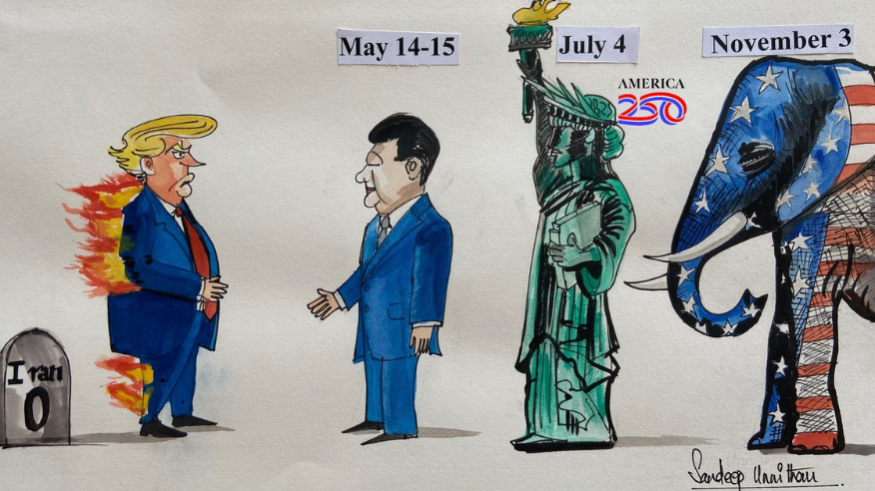
Between 14 and 15 this May he will meet President Xi Jinping in Beijing for his first state visit to China in his second term. On the 4th of July he will oversee the 250th anniversary celebrations of US Independence. And finally, towards the end of his year, he will see the mid term elections which decides whether the Republicans continue to control the House, or give way to the Democrats.
Trump, the US President fascinated by strongmen, has to appear strong ahead of all three events. He has to look President Xi in the eye ahead of what will be a significant summit. Two months later, at the US Semiquincentennial, Trump would hate to go down in history as the American President stalemated by an inferior side.
His political legacy will be decided by the third and final act this year— the US mid-term elections in October. If Trump doesn’t win the House of Representatives when the results are declared on November 3, he spends the remaining two years of his term as a lame duck.
Trump knows this. And this explains his frustration. It could also explain invective laden Truth Social posts, attacks on former allies ranging from Italian PM Georgia Meloni to talk show hosts like Tucker Carlson and Joe Rogan, and even Pope Leo XIV. The man who authored the bestseller The Art of the Deal, desperately needs a big Iranian deal.
Sandeep Unnithan
Veteran journalist with 30+ years in media, Sandeep Unnithan is a national security expert and author of two acclaimed books, including Black Tornado, adapted into the web series State of Siege.



Comments