








THE UN IS UNABLE TO ADDRESS THE NEW REALITIES FACING THE WORLD
Introduction
On 22 September the UN General Assembly began its annual meeting at a time when the Security Council is divided among its five permanent members with two waging wars of aggression.
With interstate conflict raging the UN Secretary General Antonio Guterres had a few days earlier while addressing the Security Council expressed concerns regarding the UN being able to carryout its founding mandate. 'We do not lack tools. What we lack, all too often, is the political space to use them' and stated that “We cannot keep peace when there is no peace to keep”.
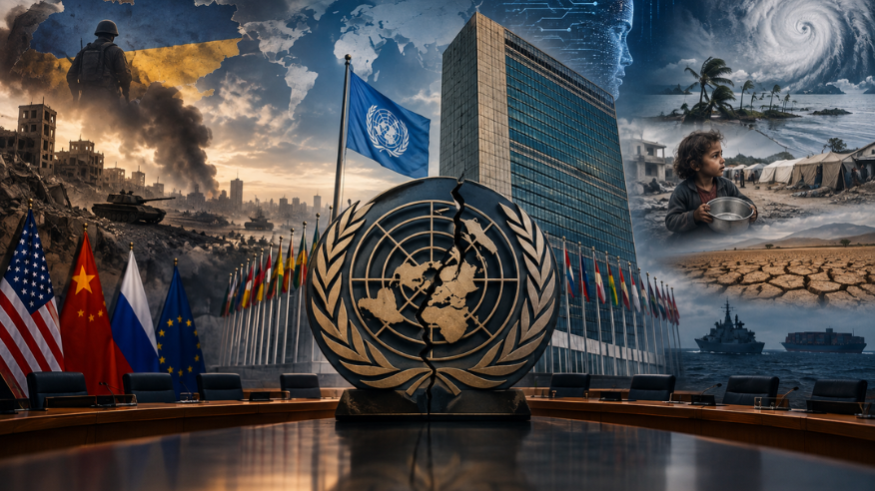
Thereafter, while addressing a Press Conference on the eve of the meeting he said “It would be hard to imagine a scenario as threatening as the one we’re facing right now”. This grim pronouncement stretched from the consequences of the US-Israeli aggression against Iran and the repercussions of the conflict over Ukraine, the issues in Gaza and Sudan to the increasingly evidence of the impact of climate change and the emerging threat of artificial intelligence (AI)” two issues that pose existential risks”.
These are precisely the kind of catastrophes the UN was created to prevent eight decades ago. While it spouts appropriate warnings, but increasingly acknowledges that it is effectively helpless in dealing with wars and genocides and cannot do very much about famines or climate change.
The Security Council bears primary responsibility for maintaining peace and security but it can only assert its authority as far as its permanent members allow.
The UN Needs Reform
Whether the UN serves any useful purpose in the 21st century is a question that has often been raised, but is yet to be convincingly answered. The fact is that institutions such as the UN reflect power equations of decades long past.
The world has changed and will continue to change. There has been the emergence of new powers. This is visible if one looks at the global economy, where the percentage of developed countries in global GDP is diminishing while the percentage of emerging economies in the global GDP is increasing. This has led to a change in the relative weight of countries in the world today in relation to what it was when these institutions were created. As a result, the power relations no longer correspond to the realities of the world.
As the world is becoming more and more multipolar, the imperative need is a redistribution of power. It is absolutely essential to reform the multilateral institutions in order for them to be effective in relation to the promotion of peace, development and human rights. The two multilateral institutions where this reform is essential as per the UN Secretary General are ‘the Security Council of the UN and the Bretton Woods system.’
A Window for Peace
There were analysts who looked at the gathering of leaders at the UN General Assembly as a window for facilitating peace with regard to the ongoing conflicts. But this year the Trump administration withheld a visa to prevent Mahmoud Abbas of the Palestinian Authority from addressing the assembly. His presence in New York would have made only a symbolic difference at best, but the fact is that UN can do little to override the US who also withheld the visa of the Sudanese Army Chief General Abdel Fattah al-Burhan in an apparent bid to pressure him into accepting a ceasefire proposal.
The Iranian President Masoud Pezeshkian said he hoped the UNGA meeting can “work towards ending war and bloodshed”. In his speech he stated that Tehran would never bend the knee to the US. But he balanced defiance with a willingness to talk, saying: “It must be understood by President Trump and those who seek to bully us that we are ready for dialogue and diplomacy and negotiations but without the language of force.”
His speech came after President Trump had told the General Assembly that he had a big decision to make; “whether to annihilate Iran, driving the Iranians ‘into hell’ or to make a deal that would end the war and allow the country to rebuild”.
It was felt that diplomatic efforts on the sidelines could produce a fresh attempt to halt the violence in the Gulf, as well as Lebanon and Yemen. In fact, there was a meeting between Iran’s Foreign Minister, Abbas Araghchi, and the US special envoy Steve Witkoff which was regarded as constructive by both sides.
However, the Israeli war on Gaza and Lebanon continues while Yemen and the Red Sea are now the latest battleground. This has widened the regional conflict and added another layer to the escalating confrontation between the US and Iran.
Beyond the economic fallout across the world, the political implications of spreading conflicts are also serious. With new actors having entered the fray there are new challenges in forging agreements, making the diplomatic process more complex and difficult to find a negotiated end to the conflicts.
Unfortunately, while ongoing conflicts including the Ukraian conflict which is now in its fifth year, were major topics, but the focus was more on pointing fingers than solving problems. A real global consensus on these unprecedented threats including those to maritime security and freedom of navigation in vital chokepoints, with implications from energy security to food security remains elusive.
To quote the External Affairs Minister S Jaishankar “the inability to maintain peace, is not just undermining security, but threatening progress, and retarding development. In a globalized world, the effects of war are felt worldwide. Countries far from conflicts, are being penalized for no fault of theirs. Those most impacted, often have the least say. This Assembly must face up to the true state of affairs.” ‘We are really living on the edge of an abyss. All it takes is one more step to push us over.’
Conclusion
The UN emerged in the aftermath of World War II. It was intended in large part to avert the next one. It could be argued that it served its purpose to some extent in the early decades of its existence. There has been no world war since 1945. But nor has there been peace.
The UN today seems helpless to deal with the ongoing conflicts as it is bound by its rules regarding veto powers. While the institution has not sunk, but it is getting harder to keep it afloat. It is no coincidence that President Xi timed his visit the US and held a bilateral Summit with President Trump and skipped addressing the UNGA overshadowing the biggest diplomatic event.
No wonder Jaishankar stated that " the post-1945 order is giving way to new realities. This process of adjustment, accommodation and acceptance will not be easy. Much of the turbulence that we witness today emanates from those very difficulties".
The UN seems to contain a contradiction: an institution built on the idea that humanity can act together it is now being challenged every day by evidence of how difficult that task is. Unfortunately, it is struggling with the very idea it expressed.
Maj Gen Jagatbir Singh, VSM (Retired)
Major General Jagatbir Singh is an Armoured Corps Officer who commanded the First Armoured Division. He served in varied terrains and tenanted important command, staff and instructional appointments including a UN Peace Keeping Mission in Iraq and Kuwait. He co-authored ‘Armour 1971’ and edited ‘Valour and Honour’.


Comments