
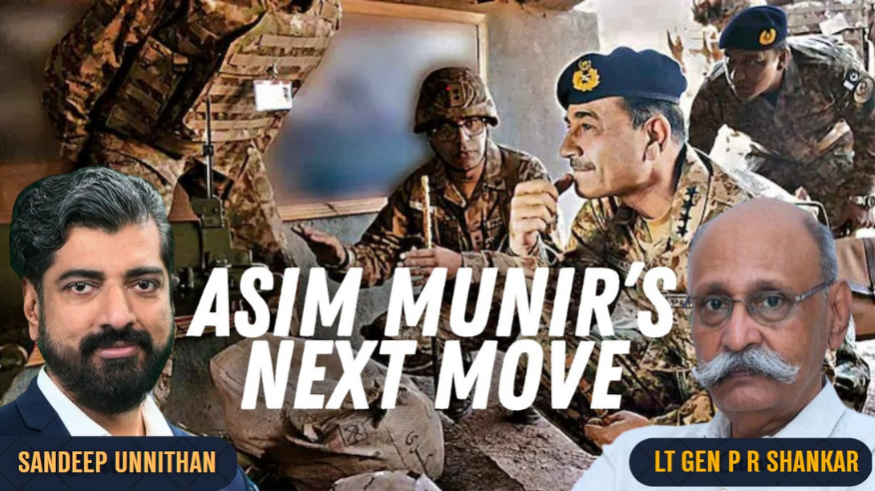








Sandeep Unnithan at ‘The Algorithmic Battlefield’: AI Will Define the Next Era of Deterrence

Sandeep Unnithan, Editor in chief, Chakra News, delivered his opening address at the maiden ‘CHAKRAVIEW’ event held at the United Services Institution, New Delhi. His address emphasized that the future of warfare emerging would not entirely depend on the size and capacity of conventional military capabilities, the very base on what it was all designed. Rather, it will increasingly integrate the role of softwares and algorithms in the conduct of warfare. Today, we stand at the threshold where the most profound technological changes would not just affect militaries, but all spheres of society.
Sandeep Unnithan said that when Chakra News was launched a year ago, our focus was on AI- not Artificial Intelligence, but Atmanirbhar Indians. Our focus is to spotlight the entrepreneurs, innovators, our armed forces, policy makers- all of them, with the understanding that behind every machine that works- there’s a human which is involved and that is the ultimate machine which matters.
However, today Artificial Intelligence plays an over-arching role in all human operations, all domains. Historically, all revolutions have influenced certain domains, which made our lives easier. The steam engine eased transportation. Smartphones transformed communication. AI is not confined to a single domain. It is comprehensive to a level which experts call, a ‘general purpose technology’, equating it with the invention of fire, electricity and the internet. It would change everything.
Also, he mentioned that the advancement of AI is happening at an unprecedented rapid speed. According to Tesla Founder Elon Musk, cognitive machines are just 5 years away. Whether or not, the prediction is proven right, it has certainly begun showing implications. The numbers, in itself, represent the magnitude of this shift. This year itself, four of the top US technology companies are spending over 600 billion dollars to build AI related infrastructure. That’s the equivalent of 10 Indian defence budgets.
In his recent book, The Technological Republic, Palantir co-founder Alex Karp mentions that the world's defence establishments were designed for a kind of warfare that may never return. He pointed out that military procurements have been always designed for militaries with mass number of soldiers, which may never return, ought to the advent of AI in the conduct of modern warfare.
For India, the question is not whether AI will transform warfare. It already is. The real question is whether we are preparing fast enough for a future where autonomous systems, intelligent sensors and algorithm driven decision making become central to military power. The idea of robotic soldiers operating along the Himalayas may sound like science fiction today, but technological history repeatedly reminds us that yesterday's fiction often becomes tomorrow's reality.
Beyond the realm of combat, AI also presents us a lot of opportunities. Consider India's maritime sector. Nearly one in every ten global seafarers is Indian. During the recent global conflict, we have seen Indian mariners frequently caught in conflict zones. India already possesses much of the digital infrastructure needed to monitor and protect them. The Indian Navy's Information Management and Analysis Centre (IMAC) tracks maritime activity, while the Directorate General of Shipping maintains comprehensive databases of Indian seafarers. The challenge is not the absence of technology, but the integration of existing capabilities into a unified national system.
This reflects a broader challenge that was described by Sandeep as the "Ashokan Lion Syndrome." Akin to the four lions of the national emblem looking in different directions- India's military, scientific community, bureaucracy, industry and academia often pursue their objectives independently. Yet the complex challenges posed by Artificial Intelligence, require collaboration rather than compartmentalisation. No single institution can prepare the country for the algorithmic battlefield alone. Integration and communication would be key in preparing the country for the upcoming type of battlefield.
Chakra Desk
Chakra News is a specialised digital media platform committed to in-depth coverage of India’s defence, national security, geopolitics, and critical technologies.



Comments