









Made in India Combat Free Fall Parachute System

Parachutes have been in use since World War I and World War II, and even today they remain crucial. Soldiers jump from aircraft at high altitudes for insertion into enemy territory.
Once a soldier lands, a key challenge emerges: changing gear. Typically, they carry two different loads: the combat load and the parachute load. Accordingly, there are two types of parachutes: a sports canopy and a military parachute canopy, each with very different requirements.
For a military parachute, the primary objective is precise targeting, high-altitude deployment, and remaining undetected by the enemy. Ideally, even the aircraft should avoid detection by enemy radar systems.
There is a very famous saying: “Who packed my parachute?” The idea is simple. If the parachute is packed properly, it will deploy properly. If it is not, it can lead to emergencies mid-air.
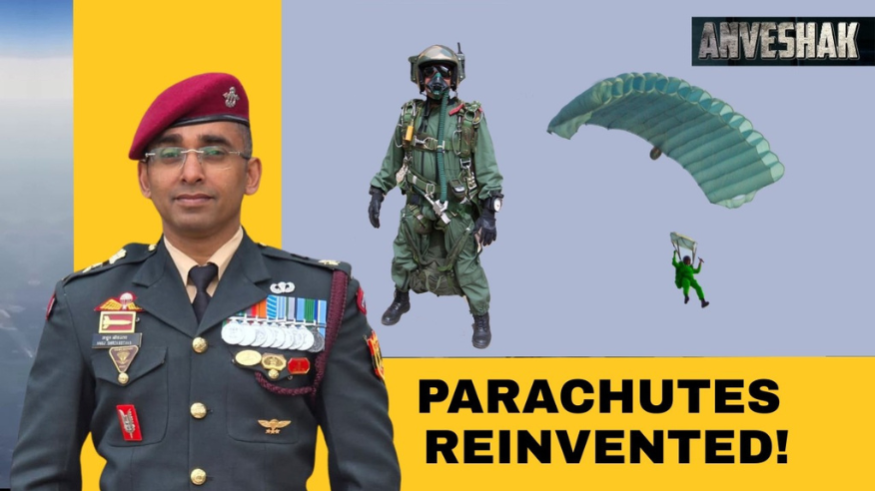
To address this, Lieutenant Colonel Anuj Chandra Srivastava developed a solution: the Military Combat Parachute System (MCPS), also known as Hans. This marks the first time Combat Free Fall (CFF) parachutes have been developed in India.
Alongside this, several supporting systems have been created. Kit Vartika is designed for load-carrying equipment for paratroopers. Kit Adi is a safety device for night jumps, especially for young paratroopers. Kit Shambhavi focuses on rescue operations and uses condemned parachute material.
Lieutenant Colonel Anuj Srivastava describes the system:
“The MCPS consists of a whole lot of subsystems. To start with, it has a helmet. That’s a bulletproof helmet named Kit Shashi, one of the world’s only bulletproof combat free-fall helmets that we have developed. Then come the goggles, splinter-proof goggles named Aditi.
Then comes the breathing system, PBOS. This equipment helps with pre-breathing before and during the jump, as oxygen levels are low at high altitudes. At that time, you need an external oxygen system.
Then comes the gear, consisting of two layers of protective clothing: an inner layer and an outer layer, depending on the temperature. There are gloves and a navigation system—a chest-mounted tablet connected to NAVIC satellites to ensure reliance on our own systems.
Then come the shoes, followed by the combat load carrier bag named Kit Vartika. And finally, the main parachute and the reserve parachute. Earlier, we depended heavily on OEMs, so even small modifications required going back to them.”
“The side that is technologically aligned and ahead is the winner.... Keeping that in mind, if technology is the driving force, a smart player will adopt it as soon as possible,” he notes.
Watch the full episode: https://www.youtube.com/watch?v=_zflohsAu9w&t=347s
Arjun Dev Singh
Arjun Dev Singh has a deep interest in defence, security, and strategic affairs. With a strong analytical lens and a passion for military and geopolitical developments, Arjun strives to bring clarity and context to complex national and international issues.



Comments