








WHEN THE BATTLEFIELD WATCHES BACK: Persistence, Signatures and The Changing Character of Manoeuvre

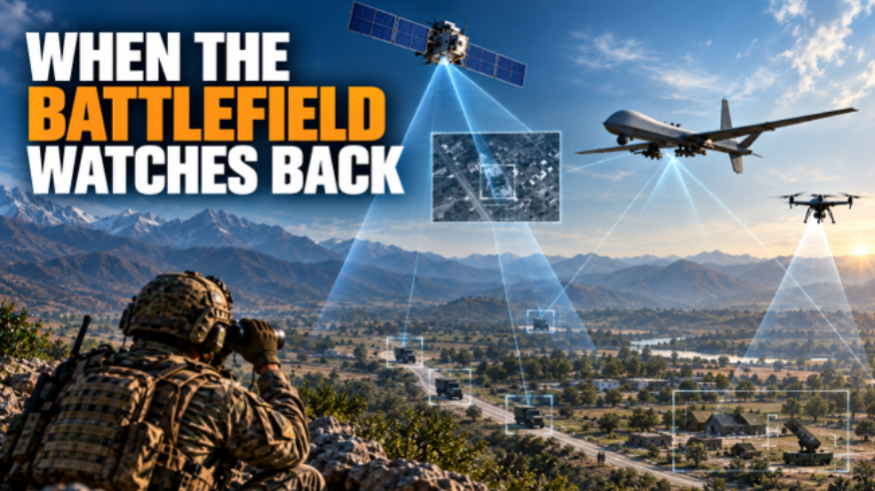
For much of military history, concealment bought time. On the battlefield emerging today, time itself is becoming difficult to conceal. Satellites, persistent drones, multi-spectral sensors, electronic sensors, geospatial intelligence and automated analysis are making it increasingly difficult for a force to remain unseen for long.
The change is larger than the spread of drones. Movement creates patterns. Concentration creates signatures. Repeated behaviour creates predictability. Time spent in one place carries associated risk. As observation becomes persistent and the interval between detection and engagement shrinks, the conditions for manoeuvre are changing.
Centuries ago, Kautilya understood the enduring value of knowing the adversary. His emphasis on intelligence, deception and understanding the enemy’s disposition reflected a simple truth: information creates opportunity. Technology has not changed that principle; it has increased its reach, persistence and speed. The modern commander must ask not only, “What can I see?” but also, “What is the enemy seeing about me?”
From Observation To Understanding
The modern battlefield is moving from intermittent reconnaissance towards persistent observation. A single reconnaissance effort may reveal a position. Repeated observation can reveal a pattern of life: where vehicles assemble, when they move, how communications change and where supplies arrive.
The signature of a force is therefore more than its physical appearance. Thermal, electromagnetic, acoustic and behavioural indicators can all contribute to detection. A headquarters may be well camouflaged and still become vulnerable if its vehicles follow a predictable routine. An artillery unit may scoot after firing and nevertheless expose itself through movement or logistics.
The sensing challenge is also moving beyond the visible and thermal spectrum. Hyperspectral imaging can identify subtle differences in the spectral characteristics of materials and terrain, potentially revealing distinctions that conventional imagery may miss. Camouflage can no longer mean simply making a tank, vehicle or soldier look like its surroundings. Survivability increasingly requires managing signatures across several sensing domains.
From Pattern To Target
The power of persistent observation is not entirely new. The hunt for Osama bin Laden demonstrated the value of combining intelligence from different sources and developing a pattern of life around a concealed individual. Years of collection and analysis eventually linked a key courier to a compound in Abbottabad.
The killing of Qasem Soleimani in Baghdad in January 2020 illustrated another stage: intelligence and tracking could be converted into a precision strike against a high-value individual. Today, similar processes are being extended across the battlefield, where headquarters, artillery gun positions, air-defence systems and logistics dumps can become objects of persistent observation. The target is no longer merely an object. It can even be a pattern.
Manoeuvre Under Observation
The Russia–Ukraine war has demonstrated the operational consequences. Dense networks of UAVs, electronic warfare systems and satellite-enabled intelligence have made concealment increasingly difficult. Concentrated forces can be found and engaged; repeated movement can reveal routes and routines; logistic activity can expose formations that are otherwise well protected.
India is steadily moving towards greater persistence in space-based observation as well. Privately led Earth-Observation Constellations are being developed to increase revisit frequency and reduce the interval between observations. As that interval contracts, the opportunities for forces to move, regroup or sustain themselves without renewed observation will also diminish.
Ukraine has also demonstrated how rapidly observation can be converted into action.
An ISR drone may detect and track a target while an FPV or other attack drone exploits that information almost immediately. The observer and weapon need not be the same platform, or even belong to the same unit. What matters is the speed and reliability with which information reaches an available weapon. The lesson is not that manoeuvre has become impossible. It is that manoeuvre must be conducted under observation.
Mobility now contributes directly to survivability. Dispersion can reduce vulnerability, but excessive dispersion can weaken combat power. Concentration can create decisive effects, but can also create lucrative targets.
The commander must balance the need to mass effects with the need to avoid presenting a predictable signature. Movement, deception, dispersion, concealment and rapid displacement become complementary measures.
The Rear Is No Longer Safe
Persistent observation is also eroding the traditional distinction between the front and rear. Ammunition, fuel, maintenance, communications, bridges and routes can all become part of the adversary’s targeting architecture.
Logistics must therefore become more dispersed, mobile and resilient. Redundancy and deception acquire greater importance. A fuel dump or ammunition carrying convoy cannot be treated simply as a support function; its survival can directly determine the ability of combat units to continue operations.
Casualty evacuation faces a similar problem. Routes, collection points and evacuation platforms may themselves become detectable.
The rear has not disappeared, but the assumption that it provides sanctuary is increasingly difficult to sustain.
Lessons From Recent Conflicts
The Israel–Hamas conflict has highlighted another dimension: persistent surveillance becomes far more consequential when information from multiple sources can be rapidly brought together for target development.
The lesson is not that technology removes uncertainty or human judgement. It is that the ability to maintain awareness, correlate information and act quickly can compress the time available to an adversary.
Operation Sindoor brought these questions into the Indian context. It demonstrated the importance of integrated ISR, unmanned systems, electronic warfare, air defence and precision effects. It also highlighted the wider information environment surrounding a conflict. Senior Indian Army leadership subsequently stated that Pakistan had received “live inputs” from China during the fighting. The precise mechanisms and extent of such support are not fully established publicly. Nevertheless, the episode underlined an important reality: a battlefield can be observed by actors beyond those physically engaged in it.
For India, this has implications for ISR partnerships as well as indigenous capability. Sovereign systems remain fundamental, but future advantage will also depend on the ability to use trusted external sources and complementary capabilities while retaining control of the operational picture.
The 2026 Iran conflict adds another dimension. It has shown the growing integration of sophisticated ISR and precision systems with large numbers of relatively inexpensive drones. The lesson is that different levels of technology can be combined to create sustained pressure, jeopardise defence and stretch the adversary’s decision cycle.
From Data To Decision
More sensors do not automatically produce better situational awareness. Data can remain divided between Services, platforms and headquarters, leaving commanders with many feeds but an incomplete picture. The real advantage lies in connecting the fragments. A satellite image, drone feed, electronic indication, radar track and report from a ground unit may each reveal only part of a situation. Fused together, they may reveal intent.
Artificial intelligence can accelerate correlation, pattern recognition and anomaly detection. But technology does not remove the need for judgement. Commanders must understand what the data means, how reliable it is and what decision it supports. The objective is therefore not simply information superiority. It is decision superiority: shortening the path from sensing to understanding to action while making that same path difficult for the adversary.
Counter-Reconnaissance As Manoeuvre
If reconnaissance is becoming continuous, counter-reconnaissance must become continuous too. Counter-UAS, electronic warfare, camouflage, decoys, deception and action against enemy reconnaissance assets increasingly create the conditions in which manoeuvre becomes possible. The aim need not always be to destroy every enemy sensor.
It may be enough to make the adversary’s picture incomplete, ambiguous or too slow to support effective targeting. A false signature can be as useful as concealment. A temporary break in observation can create a window for movement. The contest is therefore between two systems trying to complete their own sensing-to-decision cycle while disrupting the other’s.
The Commander Of The Future
The future commander will have to go beyond weapons and platforms. He will need to understand how sensors, networks, data, deception and fires interact. He must recognise when the force is becoming too predictable, when concentration has become exposure and when information is insufficiently reliable to justify action.
This is not merely a technology problem. It is a question of organisation, training, doctrine and command culture. The commander must be comfortable operating with large volumes of information without being hostage to them. The most capable force may not be the one with the most sensors. It may be the one that can connect the right sensors, interpret their outputs, act quickly and remain unpredictable while doing so.
The Battlefield Ahead
The wars in Ukraine, Gaza, Operation Sindoor and Iran are different in scale, geography and character. Yet they point towards the same broad development: the battlefield is becoming harder to hide within.
This does not make manoeuvre obsolete. It makes intelligent manoeuvre more important. Forces will need to move without becoming predictable, concentrate without remaining exposed, communicate without creating unnecessary signatures and sustain themselves without presenting a fixed pattern for the enemy to exploit.
Future combat power will depend not only on firepower, range or protection, but on the ability to manage visibility. The decisive advantage may increasingly belong to the side that can see clearly, understand quickly, act decisively—and remain difficult to see while doing so.
In the battlefield that watches back, survival will belong not simply to the force that can strike, but to the force that can remain elusive long enough to strike first.
Lt Gen Tarun Chawla
Former Director General Artillery, DG Financial Planning of Indian Army



Comments