







Why US troop pullout will not end Washington's engagement with Iraq
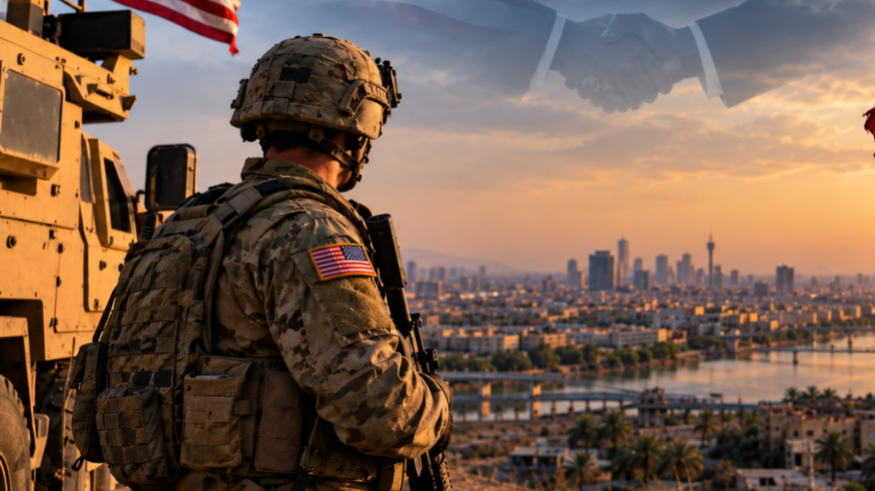
On 30 September the last US troops left Iraq, ending more than two decades of US military presence. Since the 2003 invasion, the US-Iraq relationship has been defined by their troop presence.
The security agreement to end ‘Operation Inherent Resolve’ to defeat the Islamic State of Iraq and al-Sham (ISIS) was negotiated in September 2024 during the Biden administration in two phases. The first phase included the withdrawal from Central and Southern Iraq, including Balad Air Base North of Baghdad and Ain al-Asad Air Base in Anbar province by September 2025. The second phase includes the withdrawal of approximately 2,500 American soldiers from the Kurdistan Region of Iraq and the closure of the Erbil Air Base.
The Trump administration is now implementing the phased drawdown of the operation and a transition to bilateral security cooperation.
Why Iraq Matters
Iraq has weighed heavily on the US psyche after years of US military engagement, billions of dollars spent and thousands of American and Iraqi lives lost. For many Americans, Iraq is the one of the “forever wars” and the US withdrawal from Iraq aligns with President Donald Trump’s vision of reducing the overall US military footprint in the Middle East.
The departure will be celebrated by many Iraqis and by the Iranians, who have long sought the exit of US troops from Iraq. Iran shares its longest land border with Iraq and had fought a ten-year conflict but the US invasion that toppled Saddam Hussein removed Tehran’s greatest regional threat apart from Israel and paved the way for Iran to increase its influence in Iraq economically, politically, and militarily. Iran backed militias in Iraq grew in strength and numbers in the years that followed, provided a potent tool for Iran’s asymmetric defence. Though Iraq’s current Prime Minister, Ali al-Zaidi, has promised to disarm these militias.
Even as Iraq seems to be fading from the American consciousness, the US remains paramount for Iraq’s rulers, who view the US as a pivotal counterweight to Iranian overreach and a critical economic lifeline.
Iraq’s leadership be it Shia, Sunni or Kurds has indicated that there is broad support for the relationship with the US across the political spectrum, even from those with political and economic ties to Iran. Iraq’s Shia leaders may have religious and political linkages to Iran, but they also have their own distinct interests. While Iraq’s political leaders have not always acceded to US demands, they have made decisions that advanced Iraqi interests, even when those decisions are at the expense of Iranian interests.
Why The US Needs to Remain Engaged in Iraq
The argument for the US to remain engaged in Iraq is about long-term US strategic interests. For more than a decade, each US President has attempted to pivot to Asia and reduce US focus on the Middle East. But every administration has found itself drawn back as a result of regional crises. Whether it was the return of US troops to defeat ISIS, the conflict in Gaza by Israel following Hamas’s 07 October 2023 attacks, the US-Israel war with Iran and the latest being the Houthi offensive in Yemen. The fact is that the US has enduring interests in the region that will continue to keep them engaged.
Iraq is directly involved in the equation of the conflict between Iran and both Israel and the US. There are the Popular Mobilization Forces (PMF) factions, most of which are aligned with Iran and follow the doctrine of the Guardianship of the Islamic Jurist in Qom. From them emerged the alliance of the Islamic Resistance in Iraq, which includes a number of factions most closely linked to Iran and which claimed responsibility for targeting American bases in Iraq and Syria in response to the Israeli war in Gaza.
Recently, Iran-backed Iraqi militias targeted a Saudi pipeline, and they have launched numerous attacks on US personnel and bases in the region throughout the war.
With consistent US engagement and a modest commitment of resources, many analysts felt that the US could use its substantial influence in ways that advance American interests and help reshape Iraq’s political orientation in the region away from Iran and more toward Iraq’s own interests. That means maintaining an active security partnership and investing economically.
Further, in case the US needs to launch a land offensive into Iran, Iraq is important as it shares a 1599 km border. But the PMF threat to target American assets across the region if Iraq is used as a staging ground can lead to an internal civil conflict. Hence, the other argument is that Iraq is already lost to Iran, hence continued US engagement will yield only limited gains.
Ending the US presence, with its military infrastructure represented by numerous bases, deprives Iraqi armed factions of the opportunity to continue targeting those bases, and also deprives Iran the opportunity of launching missile and drone strikes against the same bases.
It also eliminates the justifications from various factions in Iraq for retaining weapons outside the official state framework. These factions had linked surrendering their weapons to the Iraqi government with the continuation of the US military presence, making its end a condition for relinquishing their independent military and security structures, which in many cases ran parallel to the state's security role.
Whether it was the first Gulf War, the Iraq War, or the fight against ISIS and now the Iran War, Iraq’s stability has always had a broader regional impact. With its 48 million people, strategic location and enormous oil and gas resources, Iraq remains an important player in the region and its stability matters.
Concerns Remain
The US withdrawal can lead to a major security vacuum that could be exploited by ISIS cells in two areas. The first is the disputed territories between Baghdad and the Kurdistan Region, which lack a security presence from either Iraqi security forces or Kurdish Peshmerga forces, creating security gaps. The second is the Syrian-Iraqi border region.
While security vacuums during such transitions between security phases are expected, the fear of a security breakdown resulting from these vacuums is particularly acute in Iraq as the region is characterized by the willingness of countries to use military force as a mechanism for managing a crisis.
Iraq is at the heart of this geographically, due to its location and interactions of armed factions within it and their external role in supporting one side or the other.
Another significant repercussion is the US dismantling its Air Defence (AD) systems in Iraq, particularly the Patriot system. The US has insisted on not providing Iraq with American AD systems under concerns that such equipment would fall into the hands of ISIS or Iranian-backed factions, thus exposing sensitive technology to US adversaries in the region. Further, the US imposes strict conditions on countries importing American AD systems, most importantly that they not be used to threaten allies, which includes Israel and the Gulf states.
But Iraq cannot acquire any alternative AD system, such as the Russian S-300, in order to maintain Iraq's security dependence on the US.
Adding to the complications is the military doctrine upon which the Iraqi Army was formed after 2003. The US aimed to create an Iraqi Army whose sole mission was "combating terrorism" (first al-Qaeda and then ISIS), rather than one that functioned as a national defence force. This reflects in the nature of its armament.
The problem of withdrawing AD systems from Iraq lies in the fact that it will cripple Iraq's capabilities, particularly those of the Kurdistan Region, to detect and intercept missiles and drones.
The withdrawal of US forces from Iraq is supposed to facilitate the Iraqi government's efforts to restrict the weapons of the factions, given that the withdrawal would eliminate the factions' justifications for retaining their arms, however, the opposite may take place.
The factions may become even more determined to possess weapons, seeing them as the means by which they were able to threaten US forces not only in Iraq, but also in Syria.
Consequently, the Iraqi government faces two major challenges: first, the challenge of the security vacuum and the lack of an AD system and second, the possibility of the failure of the process of restricting the factions' weapons within the allotted timeframe, which ends in June 2027.
It can be stated that the US withdrawal on one hand and the project to monopolize weapons in the hands of the state on the other, are now compelling Prime Minister Ali al-Zaidi to take measures that keep pace with these two events.
While Al-Zaidi's vision is wavering between the idea of "dismantling" the armed factions on the one hand, and "organizing" these factions on the other but the most important is preventing the resurgence of ISIS.
The American withdrawal from Iraq, comes amidst many developments in the region and Iraq is directly at the heart of these developments and interactions. There are analysts who feel that the American withdrawal from Iraq may present Iran with an opportunity to further strengthen its political and security influence in Iraq through its allies among political forces and armed factions.
Maintaining an ongoing US security presence was critical to US strategic interests. That this withdrawal comes amid a protracted US conflict with Iran highlights the very reasons that the US should not disengage from Iraq.
Despite the enthusiasm with which the Iraqi government announced the end of the international coalition's military presence in Iraq, there remain significant concerns about the potential repercussions of this withdrawal.
The departure of US troops is a major landmark, but it is unlikely to lead to the end of American engagement with Iraq as it happened in Afghanistan. As the US remains locked in a war with Iran, the US military footprint in the region is unlikely to fully disappear.
Maj Gen Jagatbir Singh, VSM (Retired)
Major General Jagatbir Singh is an Armoured Corps Officer who commanded the First Armoured Division. He served in varied terrains and tenanted important command, staff and instructional appointments including a UN Peace Keeping Mission in Iraq and Kuwait. He co-authored ‘Armour 1971’ and edited ‘Valour and Honour’.



Comments