












The Week at Chakra

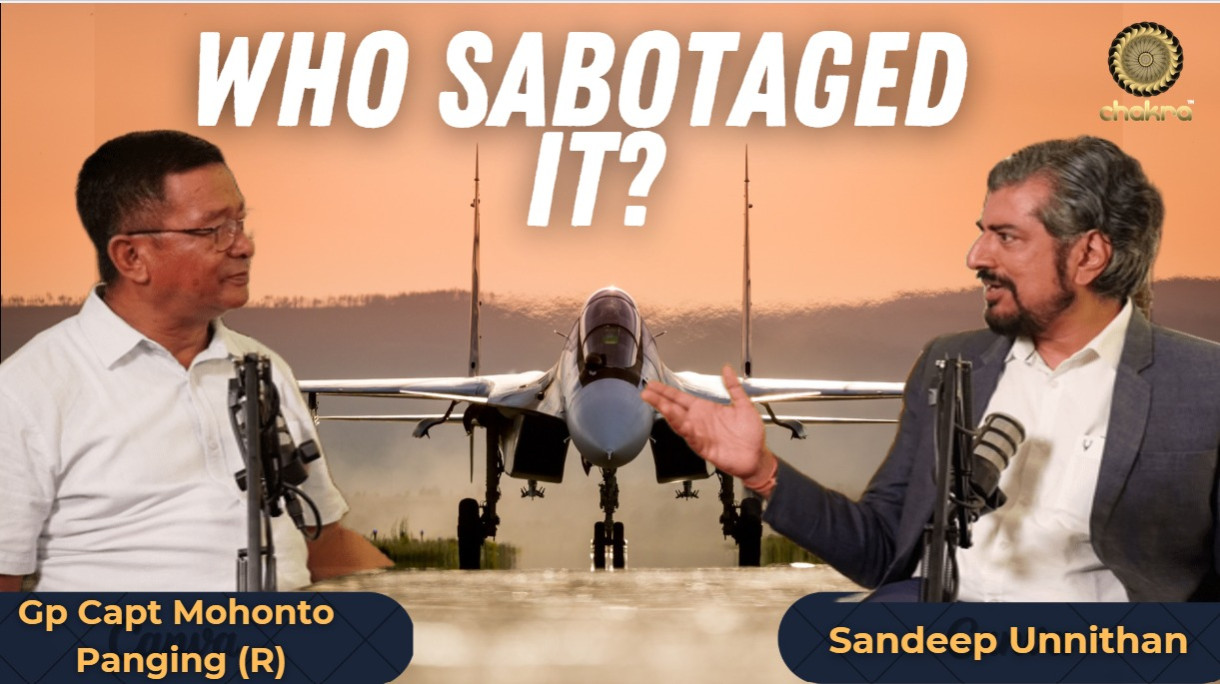
Taking inspiration from the Russia-Ukraine War, the US has started using autonomous surface vessels. India goes drone shopping for the Army and the Air Force, while China is producing fifth-generation fighter jets like the J-20 and J-35 in large numbers. These were some of the issues unpacked by Sandeep Unnithan this week at Chakra News.
On July 12, the US conducted its first sea drone strike against dozens of Iranian targets. The drone used in the attack was the Corsair, developed by Saronic. Asked about the US Navy's use of unmanned surface vessels (USVs), apparently drawing lessons from the Russia-Ukraine War, Sandeep Unnithan says:
"It's interesting that the United States Navy has the most powerful Navy the world has ever known. They have 11 aircraft carriers, super carriers, literally, because they're so large and powerful. They have the world's second-largest air force. The US Navy has the world's second-largest air force. They have 70 nuclear-powered attack submarines. They are a force of, like, sledgehammer force. And now they're looking at the poor man's war. They're trying to get those kinds of gadgets that they would have dismissed as, oh, these are all poor man's tools. We probably would never need them.
Now, don't forget that Ukraine has been using these for the last four years. Ever since the conflict with Russia began in 2022, you've been seeing the Ukrainians do some pretty crazy stuff with sea drones. I mean, they really damaged the Russian Black Sea Fleet. It's almost impossible for Russian naval warships to operate in the Black Sea."
India is also working on unmanned surface vessels, with companies such as Larsen & Toubro and Sagar Defence, along with DRDO, developing the technology. Asked whether India has an equivalent to the US Corsair USV and what its capabilities are, Sandeep Unnithan says:
"Larsen & Toubro is there. DRDO has entered the game as well. A lot of companies are investing in cutting-edge technologies. And, of course, I think the proof of concept came in 2024 with Matangi, an unmanned surface vessel made by Sagar Defence, which sailed all the way from Mumbai to Tuticorin in Tamil Nadu. That's 1,500 kilometres at sea, completely autonomous.
The heart of that boat, the Matangi, is the algorithm. That's proprietary IDDM technology, which they've deployed across a range of platforms. The Indian Navy has, of course, ordered several variants of these boats. It is a classified programme, so we don't know how many have been ordered. They're larger than the ones the US Navy has and can carry hundreds of kilograms of high explosives. They travel at more than 30 knots.
The Saronic Corsair, which the US Navy deployed, has a speed of about 35 knots and a range of about 1,000 miles. It is a modular, multi-purpose craft that can also be used for missions such as search and rescue."
The Indian Air Force is looking to procure airship-based High Altitude Platform Systems (HAPS), while the Army plans to buy jet-powered kamikaze drones worth ₹15,000 crore. In addition, a Request for Proposal (RFP) worth ₹30,000 crore for 87 Medium Altitude Long Endurance (MALE) drones is in the pipeline. Asked about these and other upcoming drone projects, Sandeep says:
"You have airship-based HAPS and fixed-wing HAPS. Then you have jet-powered kamikaze drones that the artillery is buyingabout 500 of them. Then you have a huge RFP coming up for MALE drones. You're also looking at Smart Unmanned Munition Systems (SUMS), with 800 more units being acquired by the Indian Air Force for ₹7,000 crore.
There are so many of these orders. All three services are looking at sea drones, which we just discussed. The Air Force is looking at long-range one-way attack drones and air-dropped loitering munitions that are launched like cruise missiles. The Army is also looking at similar drones.
The numbers are pretty staggering about ₹1.5 lakh crore, or well over $10 billion, over the next five years. And this doesn't even include unmanned combat aerial vehicles (UCAVs) like Ghatak. That's another ₹40,000–50,000 crore over the next five or six years. Overall, you're looking at acquisitions worth ₹1.5–2 lakh crore in drones, smart munitions, loitering munitions and related systems by the three armed forces."
China is producing the J-20 and J-35 in large numbers. Both are fifth-generation fighter aircraft. The J-20 serves with the People's Liberation Army Air Force (PLAAF), while the J-35 is the carrier-borne fifth-generation fighter of the People's Liberation Army Navy (PLAN). Asked about China's growing fleet, Sandeep Unnithan says:
"Analysts online have predicted that China already has in excess of 300. A hundred a year is what their production rates are. Very soon, at the current rate, China could have a thousand fifth-generation fighter aircraft of both types.
The bigger worry is that they could have enough fifth-generation jets to spare for the Pakistan Air Force. So, the Indian Air Force is going to be looking at a fifth-generation fighter threat on both its frontiers to the west and to the north.
It's a thorny situation. You have a northern adversary with hundreds of fifth-generation fighters, possibly crossing the thousand mark by the end of this decade. Meanwhile, the Indian Air Force is yet to get its first fifth-generation aircraft. We're looking at a stopgap purchase of two or three squadrons of the Su-57. I worry that this number could actually increase as Chinese fifth-generation fighter numbers continue to grow."
Asked about the solution, Sandeep says:
"I think we need to invest in a lot of counter-stealth technology: ground-based radars, airborne radars and satellites that can detect stealth aircraft. It's not a numbers game. Just because they have a thousand fifth-generation fighters doesn't mean we need a thousand. That's not the way to look at it.
We need technologies that make it far more difficult for China to deploy those aircraft. They already have challenges operating from the Tibetan Plateau. We need to find ways to deny them the use of that airspace. For instance, if there is a war, would India consider doing on the northern front what it did during Operation Sindoor on the western front, ensuring that airbases on the Tibetan Plateau cannot be used for aircraft operations? That means knocking them out very quickly, which is why we need a rocket force yesterday.
In an era where stand-off weapons are being used and air defence systems like the S-400 are so strong, it doesn't really make sense to send in conventional fighter jets. Hence the growing reliance on drones. The only kind of fighter that would be effective in such an environment is a stealth strike aircraft capable of penetrating those air defence shields."
Chakra Desk
Chakra News is a specialised digital media platform committed to in-depth coverage of India’s defence, national security, geopolitics, and critical technologies.




Comments