












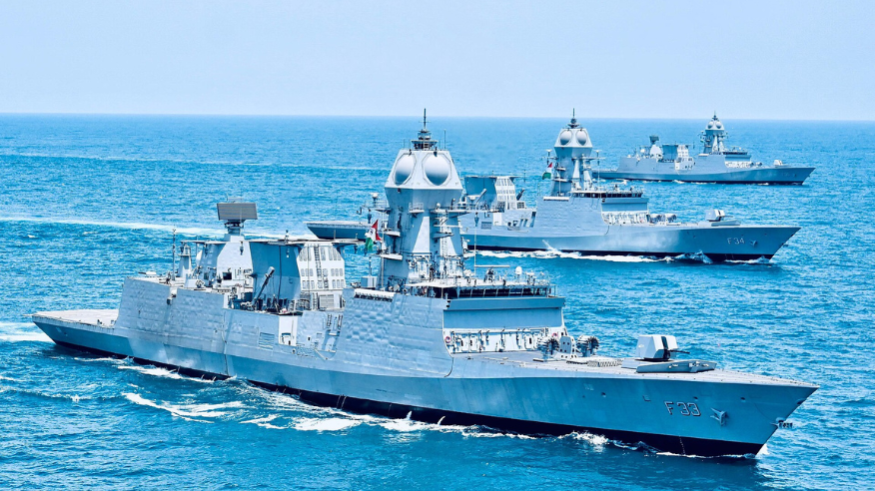
The Project-17 Alpha Frigate

Project 17 Alpha frigates, also called the Nilgiri-class frigates, are a series of seven multi-mission stealth guided-missile frigates currently serving in the Indian Navy. The seven ships under Project 17A are INS Nilgiri, INS Udaygiri, INS Himgiri, INS Taragiri, INS Mahendragiri, INS Dunagiri, and INS Vindhyagiri. The P-17A frigates are named after the former Nilgiri-class frigates, which served in the Indian Navy between 1972 and 2013.
The earlier Nilgiri-class frigates were updated versions of the Leander class, designed and built for the Indian Navy by Mazagon Dock Limited in Mumbai. Six ships were built between 1972 and 1981. Vessels of the class formed the 14th Frigate Squadron. The lead ship, INS Nilgiri, was the first major warship to be built in India and was constructed in collaboration with Yarrow Shipbuilders of the United Kingdom.
The first six ships of the Project 17 Alpha series were allotted names used by the older class—Nilgiri, Himgiri, Taragiri, Udaygiri, Dunagiri, and Vindhyagiri. The seventh and final vessel of the P-17A series, which did not have a namesake from the older class, was given the new name Mahendragiri. Most recently, INS Mahendragiri was commissioned in February 2026. INS Dunagiri was delivered to the Indian Navy on 31 March, and on 3 April, the Indian Navy commissioned INS Taragiri, the fourth Nilgiri-class frigate.
Each frigate is powered by two US General Electric LM2500 gas turbine engines, manufactured by General Electric (GE), and two German MAN 12V28/33D STC four-stroke engines, manufactured by MAN Diesel and Turbo. These are arranged in a Combined Diesel and Gas (CODAG) propulsion configuration.
The EL/M-2248 MF-STAR active electronically scanned array (AESA) radar serves as the primary radar. It is a multi-function phased-array system with 360-degree coverage, capable of tracking both aerial and surface targets at ranges of over 450 km. The class features eight VLS-launched BrahMos anti-ship cruise missiles, capable of speeds up to Mach 3. The BrahMos is widely regarded as one of the most formidable anti-ship missiles currently in service, given its versatility and manoeuvrability. The class also includes two RBU-6000 (RPK-8) anti-submarine rocket launchers, capable of firing ASW projectiles to depths of up to 1,000 metres.
The vessels are equipped with one upgraded OTO Melara, now Leonardo, 76 mm SRGM (Super Rapid Gun Mount) for anti-missile and anti-aircraft roles. The upgraded guns are manufactured by Bharat Heavy Electricals Limited (BHEL) and feature the Strales system with DART ammunition capability. The class also features 32 Barak-8 surface-to-air missiles, arranged in four 2×4 VLS configurations, with two positioned at the bow and two aft. The LR-SAM, an extended-range variant of the Barak-8, is designed to neutralise a wide range of aerial threats, including fighter aircraft, helicopters, anti-ship missiles, cruise missiles, ballistic missiles, and unmanned aerial vehicles (UAVs), with a range of about 100 km. The ships are also equipped with two AK-630 systems for close-in weapon system (CIWS) roles, along with multiple OFT-manufactured 12.7 mm M2 stabilised remote-controlled guns.
The entire Project 17 Alpha programme took 15 years from concept to completion. Project 17 Bravo, the successor to the Nilgiri-class frigates, is currently at the Request for Proposal (RFP) stage and is expected to be more advanced. The project was formally cleared by the Defence Acquisition Council (DAC) on 3 September 2024, with an estimated cost of approximately ₹70,000 crore. Following this, contracts will be awarded for ship construction. If approved and construction begins, the Indian Navy is expected to receive the first Project-17 Bravo vessel in the early 2030s.




Comments