












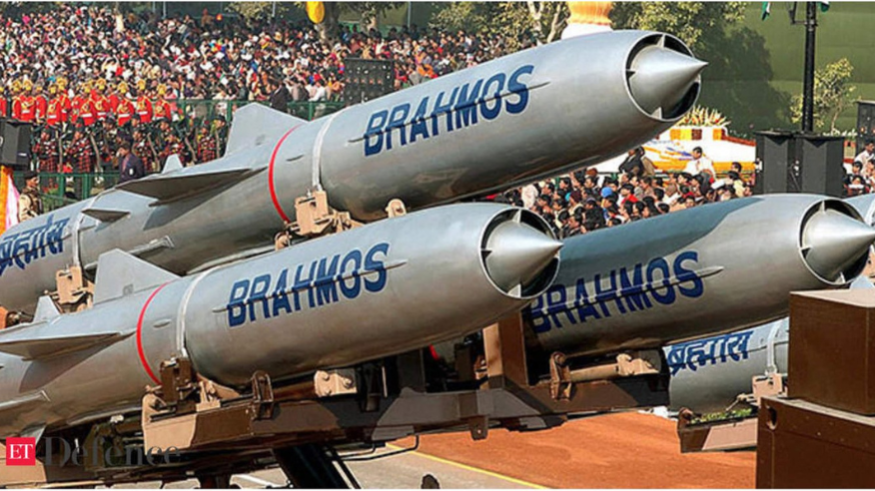
India's BrahMos Heads to Indonesia

Indonesia will soon become the third nation in the world to possess the Brahmos supersonic cruise missile. The landmark deal was announced during Prime Minister Narendra Modi’s ongoing visit to Indonesia. Worth over $200 mn, the deal will be inked between BrahMos Aerospace and the Indonesian Ministry of Defence.
A Landmark Deal
While the announcement may have come as a surprise to some, the deal has been long in the making. Talks between India and Indonesia first began in 2020 when the then Indonesian Defence Minister Prabowo Subianto visited to India. This came in the backdrop of increasing tensions in the South China Sea and Jakarta's consequent desire to build maritime deterrence.
Negotiations continued over the next few years with concerns like financing, Russian export clearance and technical integration being resolved by 2025. Then, in March 2026, Indonesia confirmed that procurement was underway, with an initial coastal defence package valued at US$200–350 million and plans for future expansion.
The announcement of the BrahMos deal was accompanied by several other significant agreements. Indonesia has also agreed to procure the ASTRA beyond-visual-range air-to-air missile (BVRAAM) and deepen cooperation with India in areas such as critical minerals and maritime affairs. While Indonesia has been tightlipped about the deal and neither India nor Indonesia has revealed the finer details of the agreement, reports suggest that the missile will be used for coastal defence and anti-ship operations. The deal will also probably include support in training, maintenance and integration and provisions for launchers, command-and-control vehicles, reload vehicles, and infrastructure for long-term deployment.
Why the BrahMos?
Incidentally the other two “customers” for the BrahMos programme are Vietnam and Philippines. Like Indonesia, both these nations face increasing Chinese aggression in the South China Sea. The BrahMos can be an efficient and lethal tool to shore up deterrence in such a scenario. Philippines has seen growing Chinese activity near the Natuna Islands and is concerned about the security of vital sea lanes.
The world witnessed the effectiveness of the BrahMos during Operation Sindoor, when just a few missiles put 13 Pakistan Air Force Bases out of action and virtually grounded the entire air force. A battery of BrahMos therefore, placed strategically on the shore, could be a lethal answer to any adversary and a much cheaper option than expanding the naval fleet.
At the moment the list of potential customers is growing as the UAE, Chile, Brazil, South Africa, Algeria, and Argentina have also expressed interest in acquiring the BrahMos missile.
For India, the BrahMos has emerged as a shining champion for its nascent military-industrial complex. India has for long been known as the world’s largest arms importer. But under Prime Minister Modi’s Make in India initiative, defence exports have surged dramatically.
In 2025-2026, Indian defence exports hit an unprecedented high of ₹38,424 crore (approximately $4.11 billion USD).
What’s in the Missile?
The BrahMos missile takes its name from two mighty rivers: the Brahmaputra in India and the Moskva River in Russia. Jointly developed by India and Ruusia, the BrahMos is available in land-attack, ship-launched and air-launched variants, while a submarine-launched version has also been developed. The next-generation BrahMos-NG (Next Generation), which is lighter and more compact than the current missile, is under development and is expected to be deployable from a wider range of fighter aircraft as well as submarines. India is also developing the hypersonic BrahMos-II. The BrahMos demonstrated its combat effectiveness during Operation Sindoor in May 2025.
The export version of the BrahMos has a range of 290 km, while the missile travels at a speed of Mach 2.8. It cruises at altitudes of up to 15 km before descending to as low as 5 metres during its terminal phase, making interception extremely difficult. The missile can carry a conventional warhead weighing up to 200 kg.
India is inducting the BrahMos-ER (Extended Range) variant, with a range of up to 800 km, across the Army, Navy and Air Force. Indonesia is expected to acquire the land-based coastal defence version of the missile. However, there is also the possibility of Jakarta procuring the air-launched variant in the future, as the Indonesian Air Force operates the Sukhoi Su-30MK2. The Indian Air Force already deploys the air-launched BrahMos on its Su-30MKI fighters.
Deepak Bhadana
Over the past decade, Deepak Bhadana has built expertise in multimedia storytelling, with a focus on military conflicts, insurgencies, international relations, the defence industry, and occasionally, wildlife and environmental issues.




Comments